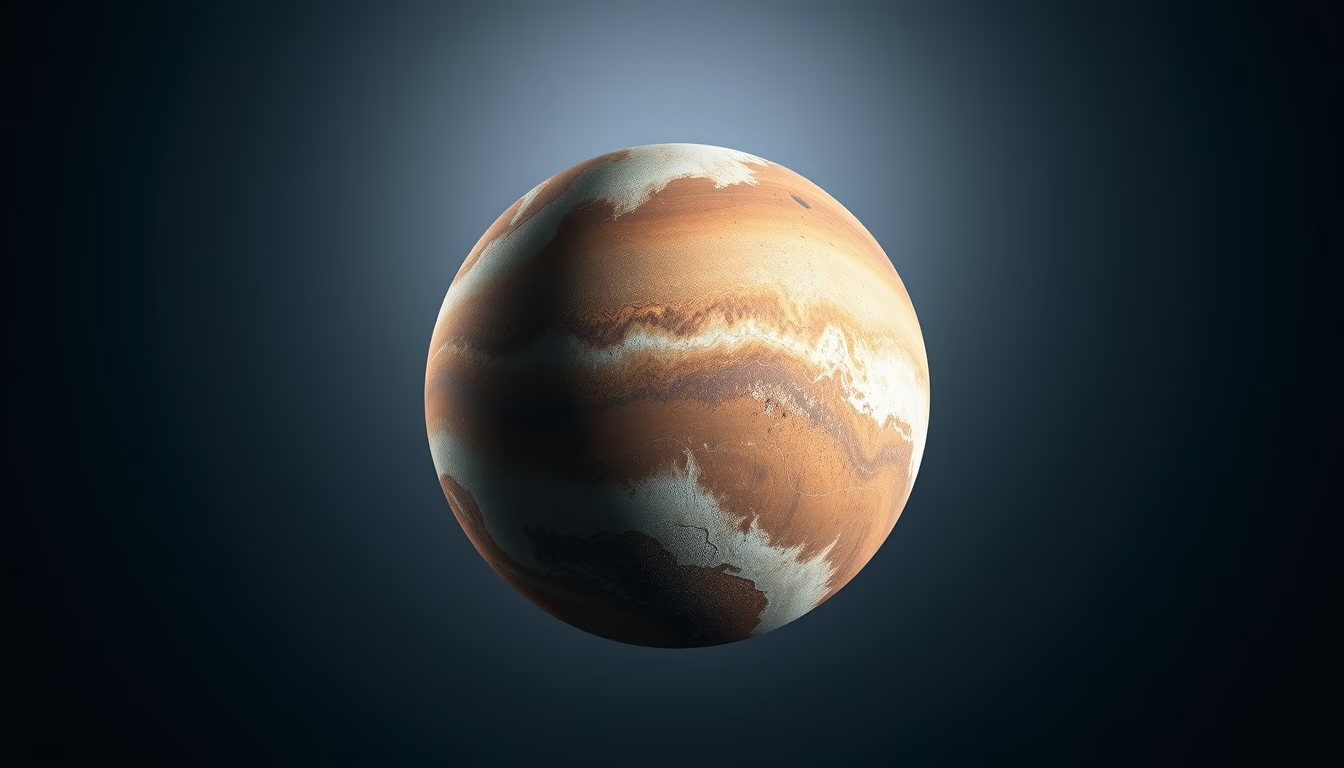
Trappist-1 system art
1344×768 · AVIF · CC BY 4.0

The TRAPPIST-1 system hosts seven Earth-sized rocky planets orbiting an ultracool dwarf star 40 light-years away, one of the most promising exoplanet assemblages in the search for extraterrestrial life.
About this subject
The TRAPPIST-1 system was discovered in 2016 by astronomers using the TRAPPIST (Transiting Planets and Planetesimals Small Telescope) at the La Silla Observatory in Chile. The central star, TRAPPIST-1, is an ultracool M8V dwarf with a mass about 9% of the Sun's and a surface temperature of roughly 2,500 K. Its luminosity is only 0.05% that of the Sun, placing the habitable zone very close to the star.
The seven planets, designated b through h, have sizes and masses similar to Earth, ranging from 0.7 to 1.1 Earth radii. Three of them (e, f, and g) lie within the habitable zone, where liquid water could exist on the surface. Transit and spectroscopy studies have revealed that some planets may be depleted in hydrogen and helium, suggesting rocky or watery compositions. The extreme orbital proximity means all are likely tidally locked, with one hemisphere permanently facing the star.
The system has become a prime target for the James Webb Space Telescope, which began atmospheric studies in 2022. Early observations indicate a lack of thick clouds and the possibility of CO2-rich atmospheres, similar to Mars and Venus. The orbital stability of the planets is remarkable: simulations show a dynamic and possibly resonant system, with orbital periods forming patterns like 3:2, 5:3, and 8:5 among the planets.
Interestingly, the system's age is estimated at 3 to 8 billion years, comparable to the Solar System. Despite the star's low activity, X-ray flares may affect atmospheric retention. The search for biomarkers such as oxygen and methane remains the main focus for upcoming space missions dedicated to habitable exoplanets.
Frequently Asked Questions
How many planets does the TRAPPIST-1 system have?
The TRAPPIST-1 system has seven confirmed planets, all rocky and Earth-sized.
What is the distance from Earth to the TRAPPIST-1 system?
The system is located about 40 light-years away in the constellation Aquarius.
Can any TRAPPIST-1 planet support life?
Planets e, f, and g lie in the habitable zone. However, intense stellar radiation and tidal locking pose challenges. The James Webb Space Telescope is studying their atmospheres for potential biomarkers.
Direct URL
https://pub-c7d6a6ea828543ac903a74a341ccb2e1.r2.dev/imagens/trappist-1-system-art-film-grain-authentic-fresh10.avifHow to credit
Include a visible link back to UtilizAí. Copy one of the snippets below:
<a href="https://xn--utiliza-eza.com/en/midia/imagens/trappist-1-system-art-film-grain-authentic-fresh10">Trappist-1 system art</a> by <a href="https://xn--utiliza-eza.com">UtilizAí</a>, licensed under <a href="https://creativecommons.org/licenses/by/4.0/">CC BY 4.0</a>.
[Trappist-1 system art](https://xn--utiliza-eza.com/en/midia/imagens/trappist-1-system-art-film-grain-authentic-fresh10) by [UtilizAí](https://xn--utiliza-eza.com), CC BY 4.0
License: CC-BY-4.0