Rogue planet darkness
1344×768 · AVIF · CC BY 4.0
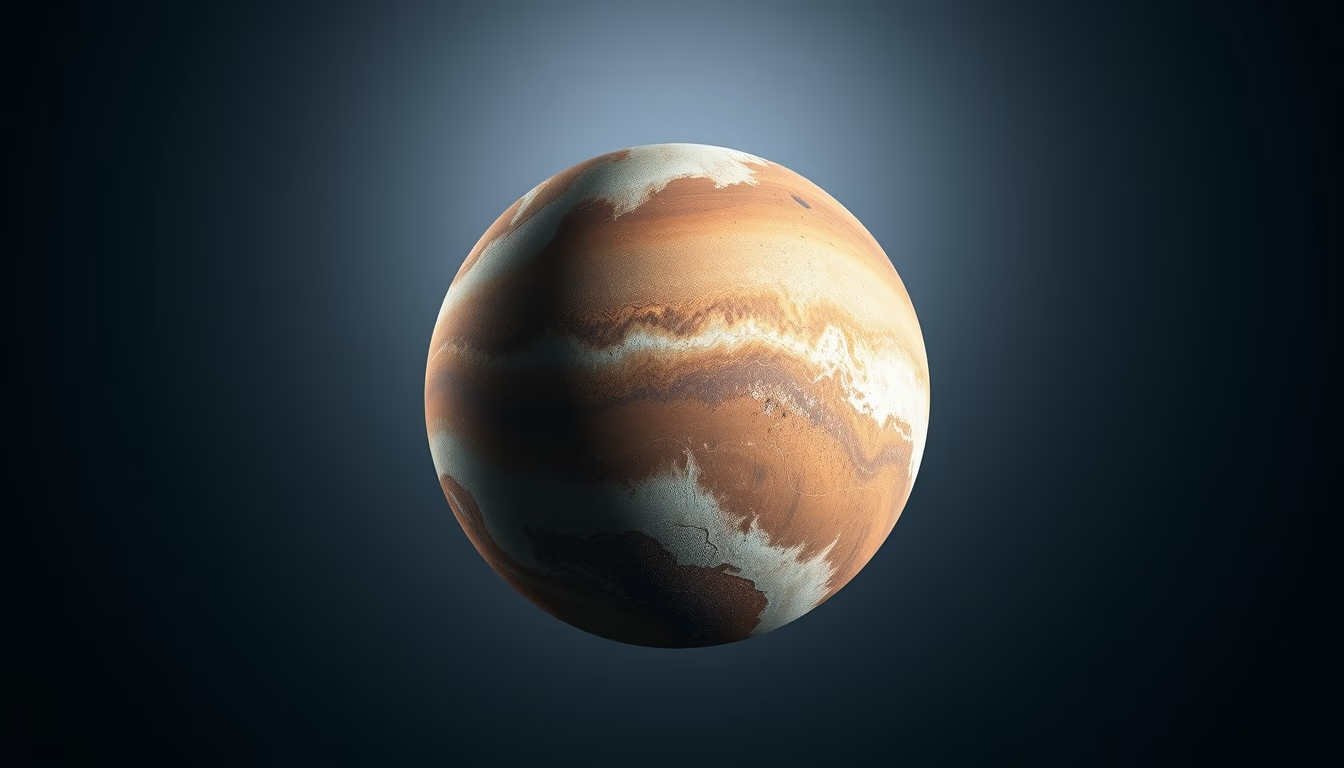
Rogue planets are starless worlds drifting through interstellar darkness, with billions estimated to roam the Milky Way alone.
About this subject
Rogue planets, also known as interstellar or free-floating planets, are celestial bodies that do not orbit any star. They drift freely through space, illuminated only by faint sources such as cosmic background radiation or the glow of distant galaxies. These solitary worlds are thought to form in two main ways: either they are ejected from their original planetary systems due to gravitational interactions with other planets or the star itself, or they form directly from the collapse of gas clouds, similar to star formation but without enough mass to ignite nuclear fusion.
Recent studies based on gravitational microlensing suggest there may be more rogue planets than stars in the Milky Way, with estimates reaching up to 100 billion such objects in our galaxy alone. They can range in size from rocky Earth-like bodies to gas giants like Jupiter. Without the light of a parent star, their surfaces would be extremely cold, approaching absolute zero. However, some models indicate that rogue planets with thick atmospheres could retain internal heat for billions of years, possibly maintaining subsurface oceans of liquid water.
The scientific importance of these planets is immense. They serve as natural laboratories for understanding planet formation and the dynamics of stellar systems. Moreover, the possibility that some could harbor life, even microbial, in geothermally heated niches fuels discussions about cosmic habitability in the broadest sense. Telescopes like the James Webb and future missions may directly detect the thermal glow of these worlds, providing clues about their composition and potential for life.
Frequently Asked Questions
How can rogue planets be detected if they emit no visible light?
They are mostly detected via gravitational microlensing, when they pass in front of a distant star and distort its light. They can also be observed indirectly through their thermal glow in infrared wavelengths.
What is the difference between a rogue planet and a brown dwarf?
Both are objects that do not fuse hydrogen, but brown dwarfs are more massive (above about 13 Jupiter masses) and can fuse deuterium. Rogue planets have lower mass and undergo no nuclear fusion.
Is it possible for life to exist on rogue planets?
Theoretically, yes. If a rogue planet has geothermal activity or a thick greenhouse atmosphere, subsurface oceans could remain liquid, creating conditions for microbial life, similar to what is speculated for moons like Europa.
Direct URL
https://pub-c7d6a6ea828543ac903a74a341ccb2e1.r2.dev/imagens/rogue-planet-darkness-aerial-drone-shot-fresh17.avifHow to credit
Include a visible link back to UtilizAí. Copy one of the snippets below:
<a href="https://xn--utiliza-eza.com/en/midia/imagens/rogue-planet-darkness-aerial-drone-shot-fresh17">Rogue planet darkness</a> by <a href="https://xn--utiliza-eza.com">UtilizAí</a>, licensed under <a href="https://creativecommons.org/licenses/by/4.0/">CC BY 4.0</a>.
[Rogue planet darkness](https://xn--utiliza-eza.com/en/midia/imagens/rogue-planet-darkness-aerial-drone-shot-fresh17) by [UtilizAí](https://xn--utiliza-eza.com), CC BY 4.0
License: CC-BY-4.0