Tidal locked planet
1344×768 · AVIF · CC BY 4.0
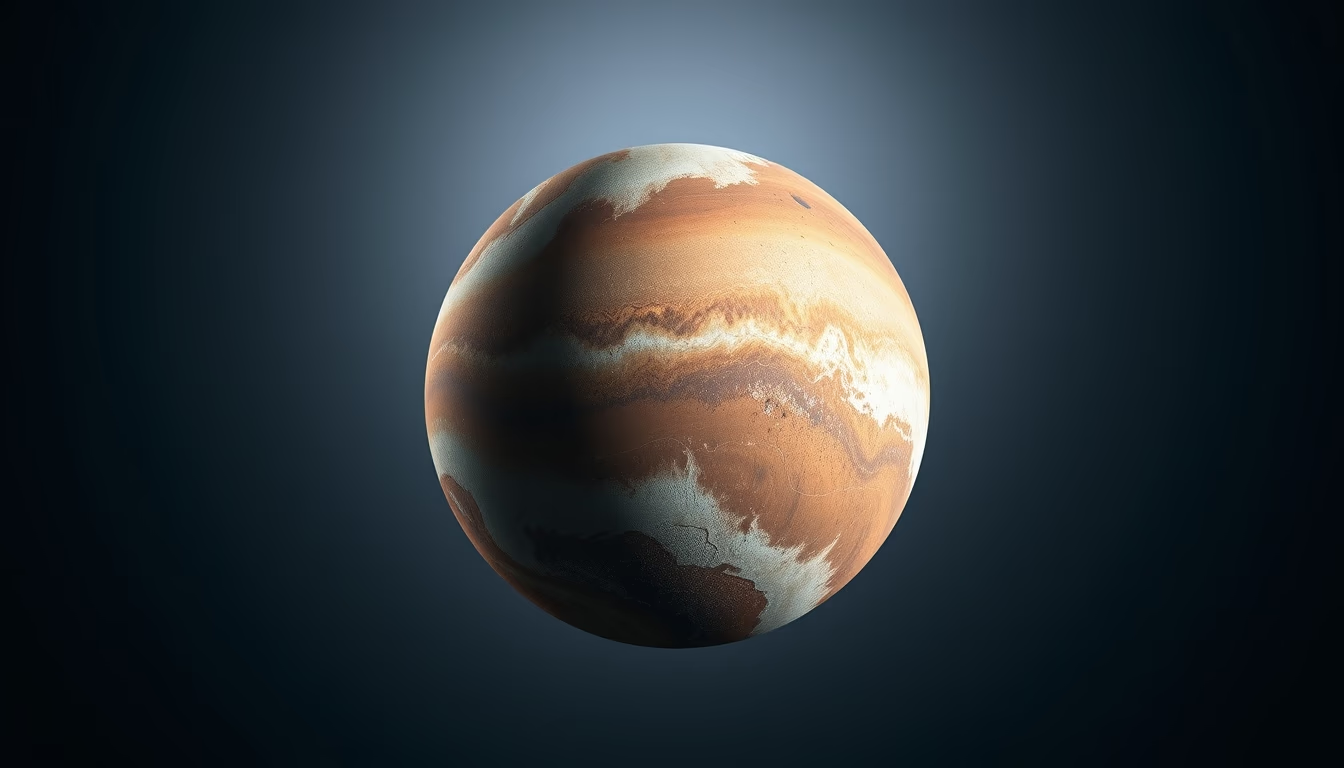
Tidally locked planets always keep the same face toward their star, a phenomenon known as tidal locking that shapes their extreme environments.
About this subject
Tidal locking occurs when a planet's rotation matches its orbital period, causing one hemisphere to permanently face its star while the other remains in darkness. This effect is common among exoplanets orbiting close to red dwarf stars, such as those in the TRAPPIST-1 system, where all seven planets have orbits lasting days to weeks and are likely tidally locked. Proxima Centauri b, the closest exoplanet to Earth, is also believed to be tidally locked to its red dwarf star, Proxima Centauri. The direct consequence is an extreme temperature gradient: the dayside can be scorching hot while the nightside freezes, leaving a narrow band of potential habitability along the terminator line between the two hemispheres. For the search for life, this challenges the traditional habitable zone concept, as liquid water might exist only in that strip or under a thick atmosphere that redistributes heat, similar to Venus, although Venus is not tidally locked. Recent studies suggest that tidally locked exoplanets could maintain stable atmospheres if they have global oceans or thick cloud cover, but climate modeling remains uncertain. A familiar example of tidal locking in the Solar System is the Moon, always facing Earth, and Mercury, which rotates three times for every two orbits (a 3:2 resonance), not fully locked. The Kepler space telescope's discovery of thousands of exoplanets revealed that tidally locked planets are extremely common, possibly the majority of rocky planets in the habitable zones of red dwarfs. These worlds, often depicted in scientific illustrations with one bright side and one dark side, challenge our understanding of habitability and underscore the need for telescopes like the James Webb Space Telescope, which can detect atmospheric signatures on them. Research continues to distinguish between scenarios of a frozen hell or a potentially temperate world.
Frequently Asked Questions
What is tidal locking?
Tidal locking occurs when a planet or moon always shows the same face to the body it orbits, due to gravitational forces that synchronize its rotation with its orbit.
Which known exoplanets are tidally locked?
Many planets in the TRAPPIST-1 system, Proxima Centauri b, and numerous Kepler candidates in short orbits around red dwarfs are considered likely tidally locked.
Could life exist on a tidally locked planet?
Yes, it is possible. Life could exist near the terminator line where temperatures are milder, or in subsurface oceans, provided the planet has a thick enough atmosphere to redistribute heat.
Direct URL
https://pub-c7d6a6ea828543ac903a74a341ccb2e1.r2.dev/imagens/tidal-locked-planet-studio-editorial-portrait-fresh17.avifHow to credit
Include a visible link back to UtilizAí. Copy one of the snippets below:
<a href="https://xn--utiliza-eza.com/en/midia/imagens/tidal-locked-planet-studio-editorial-portrait-fresh17">Tidal locked planet</a> by <a href="https://xn--utiliza-eza.com">UtilizAí</a>, licensed under <a href="https://creativecommons.org/licenses/by/4.0/">CC BY 4.0</a>.
[Tidal locked planet](https://xn--utiliza-eza.com/en/midia/imagens/tidal-locked-planet-studio-editorial-portrait-fresh17) by [UtilizAí](https://xn--utiliza-eza.com), CC BY 4.0
License: CC-BY-4.0