Trappist-1 system art
1344×768 · AVIF · CC BY 4.0
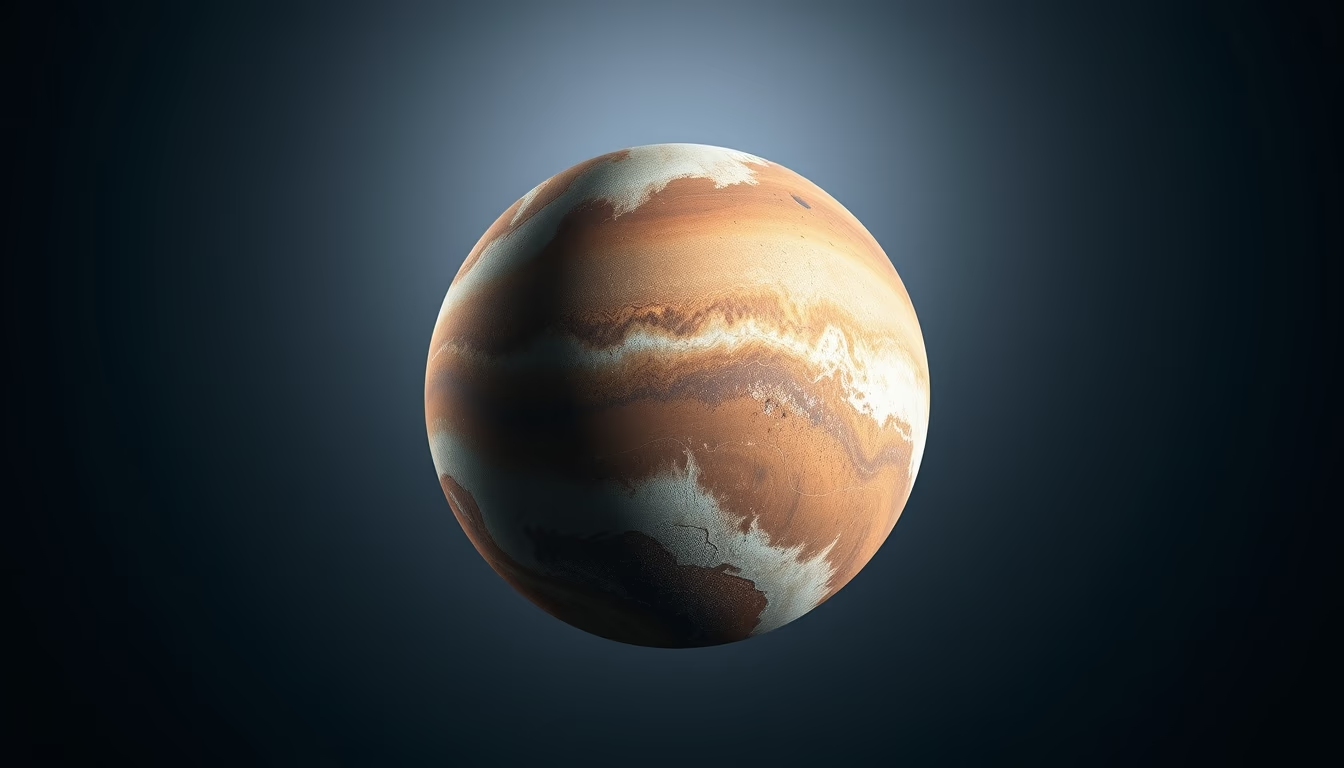
The Trappist-1 system, located 40 light-years from Earth, hosts seven rocky Earth-sized planets, three within the habitable zone.
About this subject
Discovered in 2016 using the TRAPPIST telescope at the La Silla Observatory in Chile, the Trappist-1 system orbits an ultracool dwarf star with a mass just 8% that of the Sun. The star, smaller than Jupiter, emits little light, but the planets orbit so close to it that their entire system fits within Mercury's orbit. All seven planets were detected via the transit method, observing tiny dips in stellar brightness caused by their passage.
The planets b, c, d, e, f, g, and h have masses and sizes similar to Earth, with the four innermost likely tidally locked, perpetually showing one side to the star. Three of them, e, f, and g, lie in the habitable zone, where temperatures could allow liquid water on the surface. Research suggests some planets may host global oceans or thick carbon dioxide atmospheres reminiscent of Venus.
For astrobiologists, Trappist-1 is one of the most promising targets in the search for extraterrestrial life. The James Webb Space Telescope (JWST) has begun spectroscopic observations to analyze the atmospheric compositions of these worlds. Detecting water vapor, methane, or oxygen could hint at biological activity.
Artistic renderings of the system, like the one in this image, help the public visualize planetary alignments and hypothetical landscapes. They blend scientific data with imagination, sparking discussions about the diversity of planetary systems in the universe.
Frequently Asked Questions
How many planets does the Trappist-1 system have?
The Trappist-1 system has seven rocky planets, all similar in size and mass to Earth.
How far is the Trappist-1 system from Earth?
The Trappist-1 system is about 40 light-years (roughly 380 trillion kilometers) away, located in the constellation Aquarius.
Could there be life on any Trappist-1 planet?
Three planets (e, f, and g) are in the habitable zone, where temperatures could allow liquid water. Whether life exists is unknown, but telescopes like JWST are analyzing their atmospheres for biosignatures.
Direct URL
https://pub-c7d6a6ea828543ac903a74a341ccb2e1.r2.dev/imagens/trappist-1-system-art-commercial-product-photography-fresh6.avifHow to credit
Include a visible link back to UtilizAí. Copy one of the snippets below:
<a href="https://xn--utiliza-eza.com/en/midia/imagens/trappist-1-system-art-commercial-product-photography-fresh6">Trappist-1 system art</a> by <a href="https://xn--utiliza-eza.com">UtilizAí</a>, licensed under <a href="https://creativecommons.org/licenses/by/4.0/">CC BY 4.0</a>.
[Trappist-1 system art](https://xn--utiliza-eza.com/en/midia/imagens/trappist-1-system-art-commercial-product-photography-fresh6) by [UtilizAí](https://xn--utiliza-eza.com), CC BY 4.0
License: CC-BY-4.0