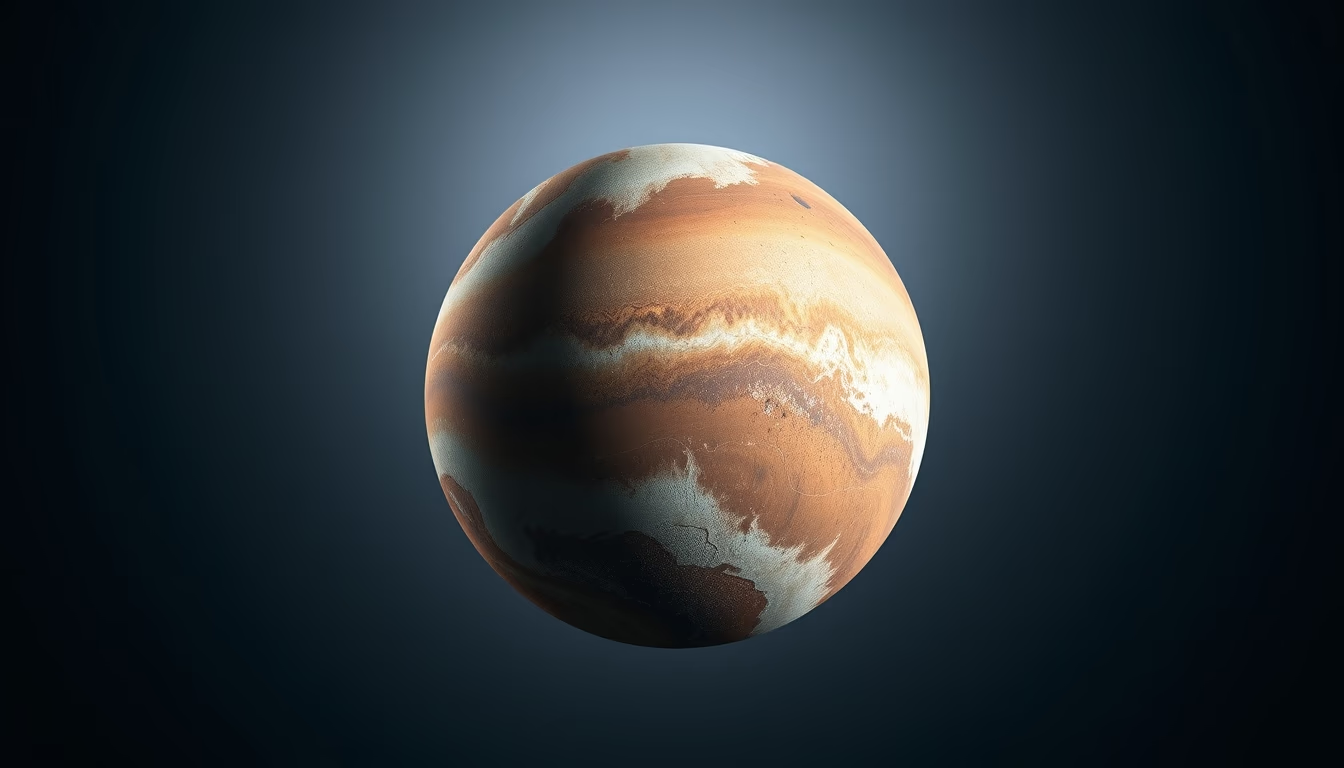
Tidal locked planet
1344×768 · AVIF · CC BY 4.0
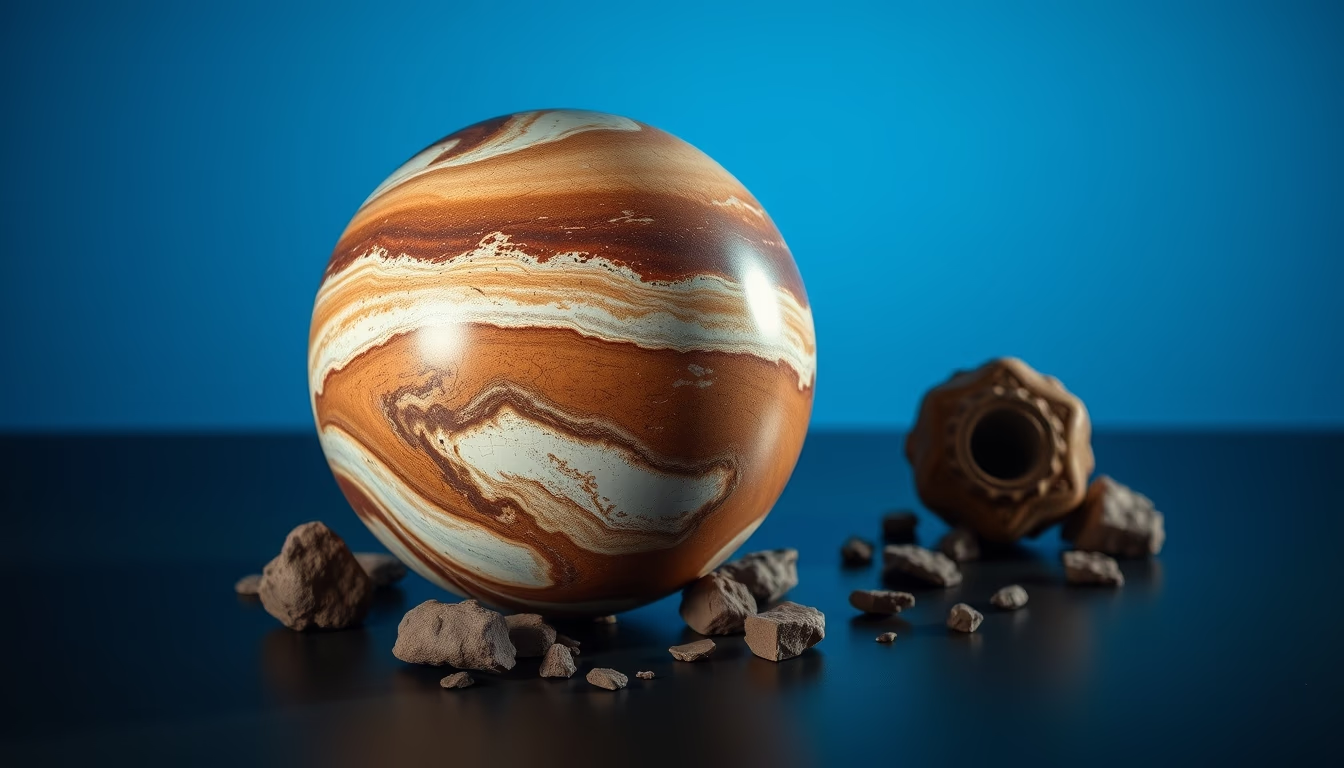
Tidally locked planets, synchronous rotators, reveal extreme orbital dynamics and exotic climates.
About this subject
Tidal locking, or synchronous rotation, is an orbital phenomenon where a celestial body always shows the same face to its gravitational partner. This occurs because tidal forces dissipate rotational energy over time until the rotation period equals the orbital period. The classic example in the Solar System is Earth's Moon, which permanently faces Earth. Among exoplanets, hot Jupiters, gas giants orbiting extremely close to their stars, are strong candidates for tidal locking, with orbital periods of just a few Earth days.
Tidal locking creates extreme thermal contrasts. The dayside can reach temperatures above 2,000 °C, while the nightside freezes hundreds of degrees below zero. This drives violent winds that transport heat from the hot side to the cold side, as observed on exoplanet HD 189733b, where winds up to 8,700 km/h were inferred. Climate models suggest that on rocky planets in the habitable zone of red dwarfs (like TRAPPIST-1e), a twilight ring between hemispheres could allow liquid water and potentially life.
Interestingly, tidal locking is not absolute. Variations in orbital eccentricity or the presence of other bodies can cause librations, exposing part of the far side over time. The Kepler Space Telescope identified hundreds of candidate tidally locked planets, and future missions like James Webb will characterize their atmospheres. In the Solar System, besides the Moon, Mercury exhibits a 3:2 spin-orbit resonance, an intermediate case between free rotation and full locking.
Although the concept is often associated with exoplanets, it also applies to close binary stars and satellite systems. Understanding this process is crucial for determining the habitability of planets around small stars, which dominate the Milky Way's stellar population.
Frequently Asked Questions
What is a tidally locked planet?
It is a planet whose rotation period equals its orbital period, causing the same hemisphere to always face its star, resulting in a permanent dayside and a permanent nightside.
How does synchronous rotation affect the planet's climate?
It creates extreme temperatures: the dayside overheats and the nightside freezes. Intense winds transport heat between hemispheres, and the terminator region may host temperate conditions.
Are there tidally locked planets in the Solar System?
Not among the major planets. The Moon is locked to Earth, and Mercury has a 3:2 resonance. Among exoplanets, many hot Jupiters and candidates in red dwarf habitable zones are thought to be locked.
Direct URL
https://pub-c7d6a6ea828543ac903a74a341ccb2e1.r2.dev/imagens/tidal-locked-planet-studio-still-life-fresh9.avifHow to credit
Include a visible link back to UtilizAí. Copy one of the snippets below:
<a href="https://xn--utiliza-eza.com/en/midia/imagens/tidal-locked-planet-studio-still-life-fresh9">Tidal locked planet</a> by <a href="https://xn--utiliza-eza.com">UtilizAí</a>, licensed under <a href="https://creativecommons.org/licenses/by/4.0/">CC BY 4.0</a>.
[Tidal locked planet](https://xn--utiliza-eza.com/en/midia/imagens/tidal-locked-planet-studio-still-life-fresh9) by [UtilizAí](https://xn--utiliza-eza.com), CC BY 4.0
License: CC-BY-4.0