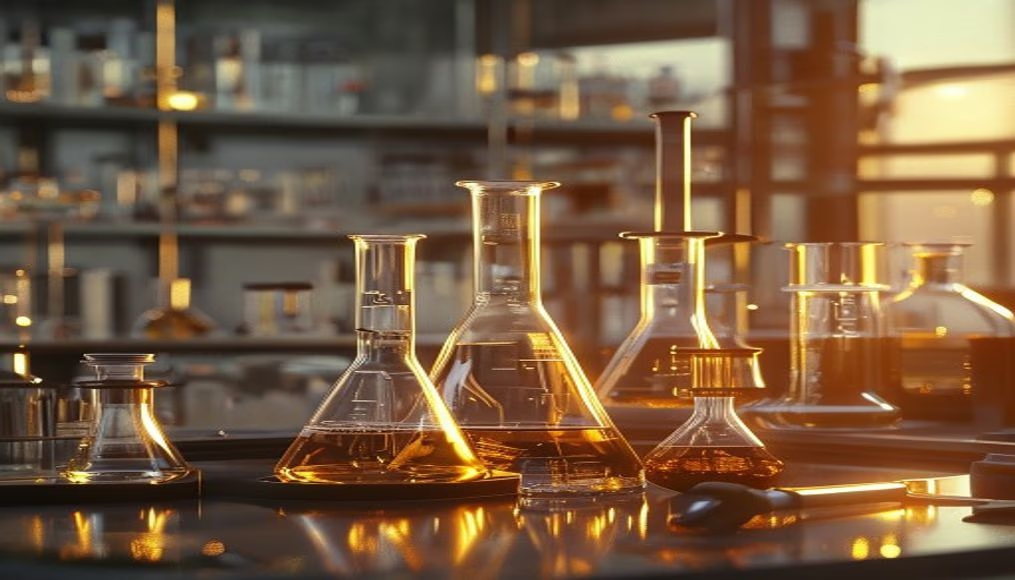
Science lab equipment glassware
1344×768 · AVIF · CC BY 4.0
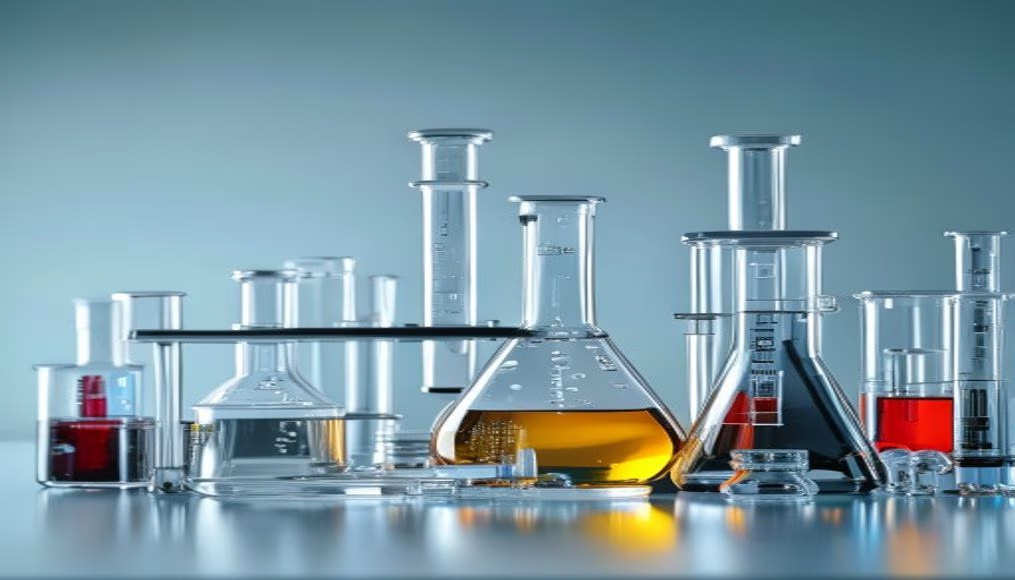
Science lab glassware is essential for precise experiments in chemistry, biology, and physics.
About this subject
Science lab glassware, including beakers, Erlenmeyer flasks, and test tubes, is essential for accurate experiments in chemistry, biology, and physics. Made primarily of borosilicate glass, they withstand high temperatures and thermal shock, ensuring safety and precision. The transparency of glass allows observation of chemical reactions, aiding measurements and analysis. Since Emil Erlenmeyer invented the Erlenmeyer flask in 1860, the design of these tools has evolved to meet specific experimental needs.
In educational settings, using glassware teaches students careful handling of instruments, avoiding contamination and accidents. Countries like Brazil and Germany have a tradition of manufacturing laboratory glassware, with globally recognized brands. Beyond classic shapes, there are graduated versions, narrow-neck, or flat-bottom types adapted to techniques such as titration, distillation, and volumetric analysis.
Glassblowing is used to create custom pieces. Modern labs also use disposable glassware to prevent cross-contamination. Borosilicate glass can be recycled but requires special processes due to boron and silica content. This sustainability is important for green lab policies.
Historically, since medieval alchemists used basic flasks to modern ISO standardization, lab glassware has enabled discoveries like penicillin and drug synthesis. Its role is irreplaceable in advancing science.
Frequently Asked Questions
What are the most common types of lab glassware?
Common types include beakers, Erlenmeyer flasks, test tubes, graduated cylinders, pipettes, and burettes. Each has a specific function: beakers for mixing, Erlenmeyers for titrations, and cylinders for volume measurements.
Why is borosilicate glass preferred in labs?
Borosilicate glass resists thermal shock and high temperatures, and is chemically inert. This prevents unwanted reactions with substances and ensures durability.
How should I clean and store lab glassware?
Wash with distilled water and mild detergent, use soft brushes, avoid abrasives. Dry naturally or in a low-temperature oven. Store in protected areas to prevent breakage.
Direct URL
https://pub-c7d6a6ea828543ac903a74a341ccb2e1.r2.dev/imagens/science-lab-equipment-glassware-commercial-product-photography-v9.avifHow to credit
Include a visible link back to UtilizAí. Copy one of the snippets below:
<a href="https://xn--utiliza-eza.com/en/midia/imagens/science-lab-equipment-glassware-commercial-product-photography-v9">Science lab equipment glassware</a> by <a href="https://xn--utiliza-eza.com">UtilizAí</a>, licensed under <a href="https://creativecommons.org/licenses/by/4.0/">CC BY 4.0</a>.
[Science lab equipment glassware](https://xn--utiliza-eza.com/en/midia/imagens/science-lab-equipment-glassware-commercial-product-photography-v9) by [UtilizAí](https://xn--utiliza-eza.com), CC BY 4.0
License: CC-BY-4.0