Science lab equipment glassware
1344×768 · AVIF · CC BY 4.0
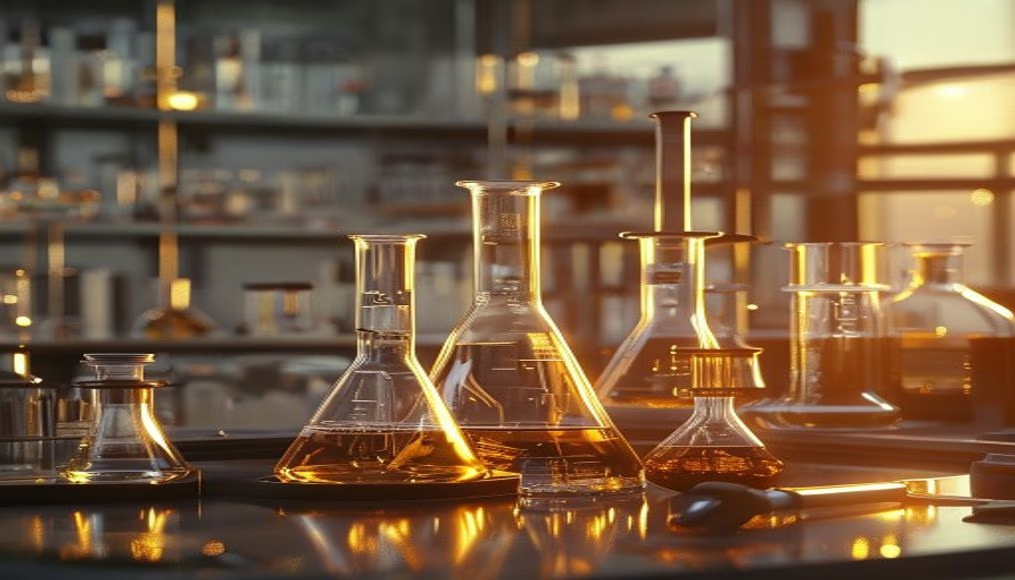
Sets of scientific lab glassware are essential for chemistry and biology experiments, used in educational and research institutions worldwide.
About this subject
Laboratory glassware includes instruments such as beakers, test tubes, volumetric flasks, Erlenmeyer flasks, and graduated cylinders, each with a specific role in analyses and reactions. Beakers are used for mixing and heating liquids, while volumetric flasks ensure precise volume measurements. Test tubes allow small-scale reactions, and Erlenmeyer flasks are ideal for titrations and microbial cultures. These pieces are mainly made of borosilicate glass, such as Pyrex, which withstands high temperatures and thermal shock. In Brazil, schools and universities use this glassware in practical chemistry and biology classes, forming the foundation of experimental learning. Proper handling is taught from high school onward, following ABNT and ISO standards for safety and accuracy. Historically, scientific glassware evolved from simple flasks used by 18th-century alchemists to today's standardized equipment. Domestic production by companies like Laborglas and Prolab meets local demand and exports to Latin America. In resource-limited settings, plastic alternatives are used, but glass remains preferred for its transparency and chemical inertness. Calibration of glassware is performed by gravimetric methods, ensuring that indicated volumes match actual ones, a critical factor in scientific research.
Frequently Asked Questions
What are the most common types of laboratory glassware?
The most common types include beakers, test tubes, volumetric flasks, Erlenmeyer flasks, graduated cylinders, pipettes, and burettes. Each has a specific function such as measuring volumes, heating substances, or performing reactions.
Why is borosilicate glass used in laboratory glassware?
Borosilicate glass, such as Pyrex, has a low coefficient of thermal expansion, resisting high temperatures and thermal shock. It is also chemically inert, not reacting with most substances.
How is laboratory glassware calibrated?
Calibration is done by gravimetric methods, measuring the mass of distilled water contained in the vessel and converting it to volume based on water density at a standard temperature.
Direct URL
https://pub-c7d6a6ea828543ac903a74a341ccb2e1.r2.dev/imagens/science-lab-equipment-glassware-travel-photography-v10.avifHow to credit
Include a visible link back to UtilizAí. Copy one of the snippets below:
<a href="https://xn--utiliza-eza.com/en/midia/imagens/science-lab-equipment-glassware-travel-photography-v10">Science lab equipment glassware</a> by <a href="https://xn--utiliza-eza.com">UtilizAí</a>, licensed under <a href="https://creativecommons.org/licenses/by/4.0/">CC BY 4.0</a>.
[Science lab equipment glassware](https://xn--utiliza-eza.com/en/midia/imagens/science-lab-equipment-glassware-travel-photography-v10) by [UtilizAí](https://xn--utiliza-eza.com), CC BY 4.0
License: CC-BY-4.0