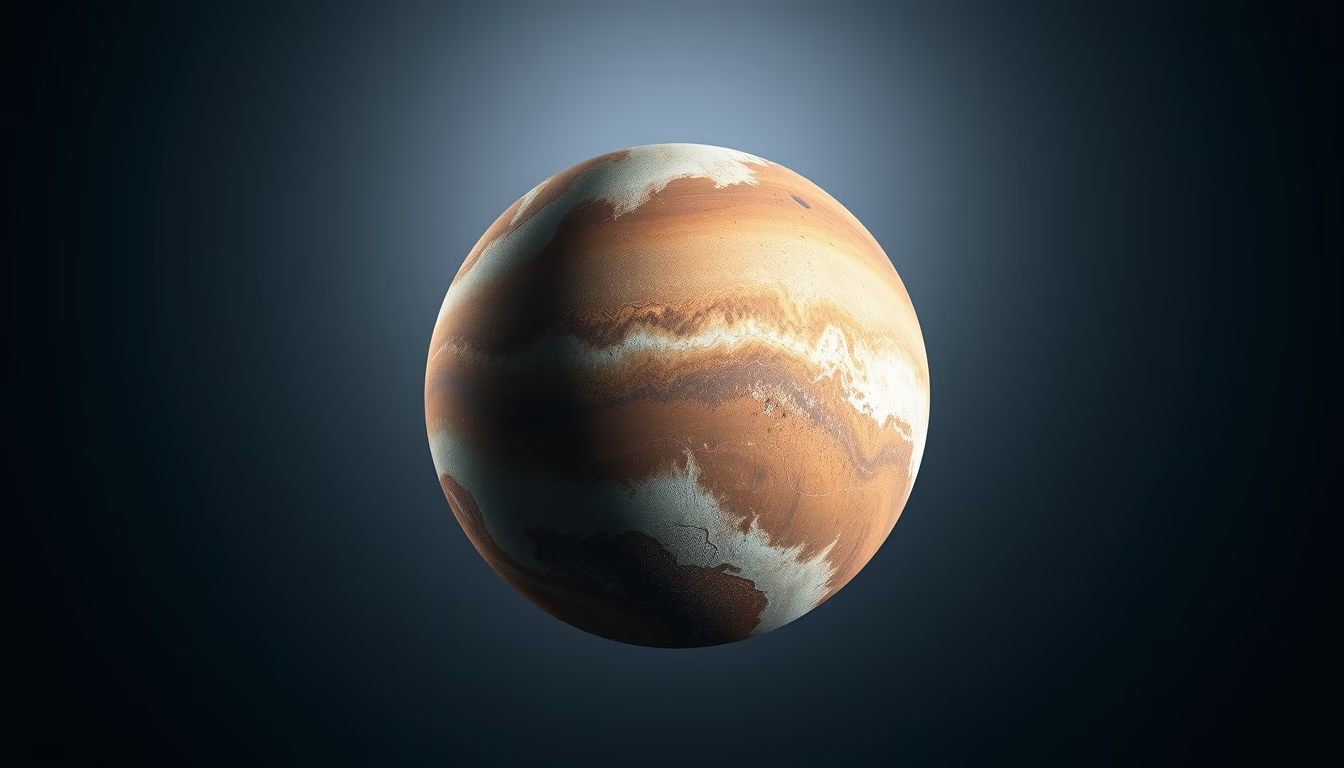
Rogue planet darkness
1344×768 · AVIF · CC BY 4.0

Rogue planets wander alone through interstellar space, not orbiting any star. Learn about their characteristics and how they are detected.
About this subject
Rogue planets, also known as interstellar or orphan planets, are celestial bodies with planetary mass that are not gravitationally bound to any star. They are thought to be ejected from their planetary systems during formation or later interactions with other planets or passing stars. Estimates suggest billions of them roam the Milky Way, outnumbering stars. Because they receive no starlight, these planets are extremely cold and dark, with surface temperatures near absolute zero. Their atmospheres, if present, consist mainly of hydrogen and helium, with possible layers of nitrogen, methane, or carbon dioxide ice.
Detecting rogue planets is challenging since they emit no visible light and reflect little starlight. The most successful method is gravitational microlensing, which exploits the bending of light from a background star when a rogue planet passes between it and Earth. This effect is temporary and rare, but has yielded dozens of candidate detections. Additionally, infrared telescopes like WISE and Spitzer capture the residual heat from the planet's formation, revealing objects such as WISE 0855-0714, a rogue planet only 7 light-years away.
Studying rogue planets is crucial for understanding planetary system formation and evolution. They represent a population of objects that may hold clues about the dynamical history of systems like our own. Some models suggest rogue planets could host moons with subsurface oceans heated by radioactive decay or tidal forces, creating potentially habitable environments. Future missions like the Nancy Grace Roman Space Telescope (formerly WFIRST) will be optimized to detect thousands of rogue planets via microlensing, revolutionizing our knowledge of these solitary worlds.
Frequently Asked Questions
What is a rogue planet?
A rogue planet is a planetary-mass object that does not orbit any star. It wanders through interstellar space, often ejected from its original system during formation or due to gravitational interactions.
How do scientists detect rogue planets?
The primary method is gravitational microlensing, which observes the temporary brightening of a distant star when a rogue planet passes in front of it. Infrared telescopes also detect residual heat from the planet's formation.
How many rogue planets are there in the Milky Way?
Estimates suggest billions of rogue planets in the Milky Way, possibly outnumbering stars. However, only a few dozen have been confirmed or are strong candidates due to detection challenges.
Direct URL
https://pub-c7d6a6ea828543ac903a74a341ccb2e1.r2.dev/imagens/rogue-planet-darkness-documentary-photography-fresh14.avifHow to credit
Include a visible link back to UtilizAí. Copy one of the snippets below:
<a href="https://xn--utiliza-eza.com/en/midia/imagens/rogue-planet-darkness-documentary-photography-fresh14">Rogue planet darkness</a> by <a href="https://xn--utiliza-eza.com">UtilizAí</a>, licensed under <a href="https://creativecommons.org/licenses/by/4.0/">CC BY 4.0</a>.
[Rogue planet darkness](https://xn--utiliza-eza.com/en/midia/imagens/rogue-planet-darkness-documentary-photography-fresh14) by [UtilizAí](https://xn--utiliza-eza.com), CC BY 4.0
License: CC-BY-4.0