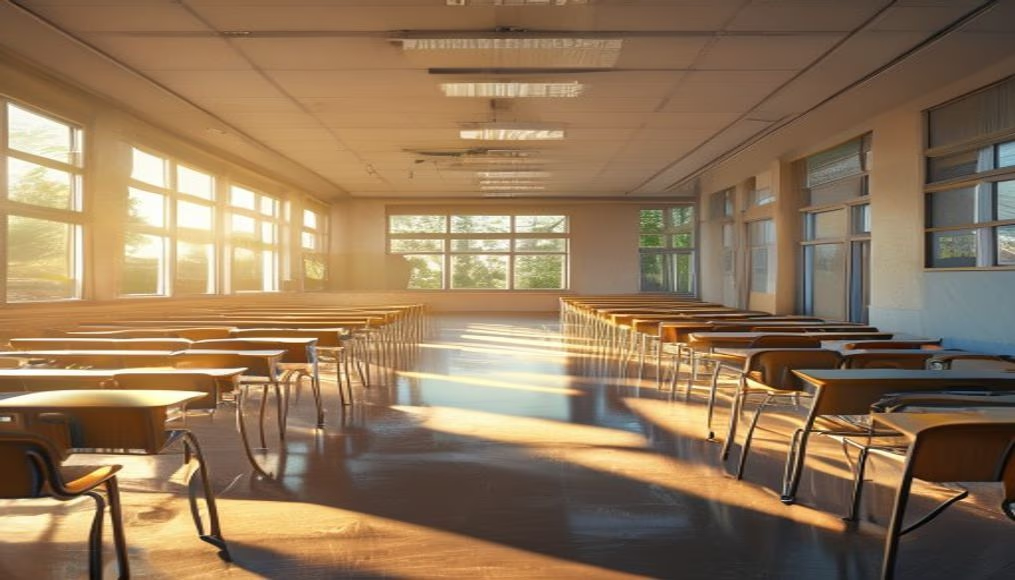
Modern classroom empty rows
1344×768 · AVIF · CC BY 4.0

A modern empty classroom with rows of desks and natural lighting reflects challenges in contemporary education.
About this subject
The modern classroom, with its neatly arranged rows of desks and interactive boards, symbolizes the contemporary educational system. While designed for collaborative learning, this space often reflects the isolation of standardized teaching. In Brazil, such classrooms are common in both public and private schools, especially in the South and Southeast regions, where infrastructure investment is higher. The linear desk arrangement, a legacy of the 19th-century industrial model, still prevails despite modern pedagogical studies advocating for more flexible layouts.
Natural lighting from large windows is crucial for student well-being. Research shows that daylight improves concentration and reduces eye strain, but many Brazilian schools still lack this resource. Data from the 2023 School Census indicate that only 60% of elementary schools in Brazil have adequate natural lighting. The absence of students in the image suggests transitional moments, such as breaks or teacher planning periods, common in the school routine.
Technology is also present: whiteboards and projectors have replaced chalk, but the challenge of digital inclusion persists. According to the Brazilian Internet Steering Committee, 40% of rural schools lack broadband internet access. This regional disparity contrasts with the idealized image of a modern classroom. The empty desks may also symbolize school dropout rates, which affect 5% of young people aged 15 to 17 in the country, according to IBGE.
Interestingly, classroom design varies globally. In Finland, for instance, desks are replaced by sofas and round tables to promote interaction. In Japan, rows are maintained but with a focus on discipline. Thus, the image is not just an architectural record but an invitation to reflect on how physical space influences education.
Frequently Asked Questions
Why do classrooms still use rows of desks?
The row model is a legacy of the 19th-century industrial education system, focused on discipline and knowledge transmission. Although modern studies recommend flexible layouts, many schools maintain the format due to space, cost, and tradition.
How important is natural lighting in schools?
Natural light improves concentration, regulates circadian rhythms, and reduces eye strain. Schools with good natural lighting tend to have more attentive students with better academic performance.
How does school dropout relate to empty classrooms?
Empty classrooms can symbolize school dropout, which in Brazil affects about 5% of youth aged 15 to 17. Factors such as the need to work, lack of interest, or access difficulties contribute to abandonment.
Direct URL
https://pub-c7d6a6ea828543ac903a74a341ccb2e1.r2.dev/imagens/modern-classroom-empty-rows-documentary-photography.avifHow to credit
Include a visible link back to UtilizAí. Copy one of the snippets below:
<a href="https://xn--utiliza-eza.com/en/midia/imagens/modern-classroom-empty-rows-documentary-photography">Modern classroom empty rows</a> by <a href="https://xn--utiliza-eza.com">UtilizAí</a>, licensed under <a href="https://creativecommons.org/licenses/by/4.0/">CC BY 4.0</a>.
[Modern classroom empty rows](https://xn--utiliza-eza.com/en/midia/imagens/modern-classroom-empty-rows-documentary-photography) by [UtilizAí](https://xn--utiliza-eza.com), CC BY 4.0
License: CC-BY-4.0