Gas giant ringed exoplanet
1344×768 · AVIF · CC BY 4.0
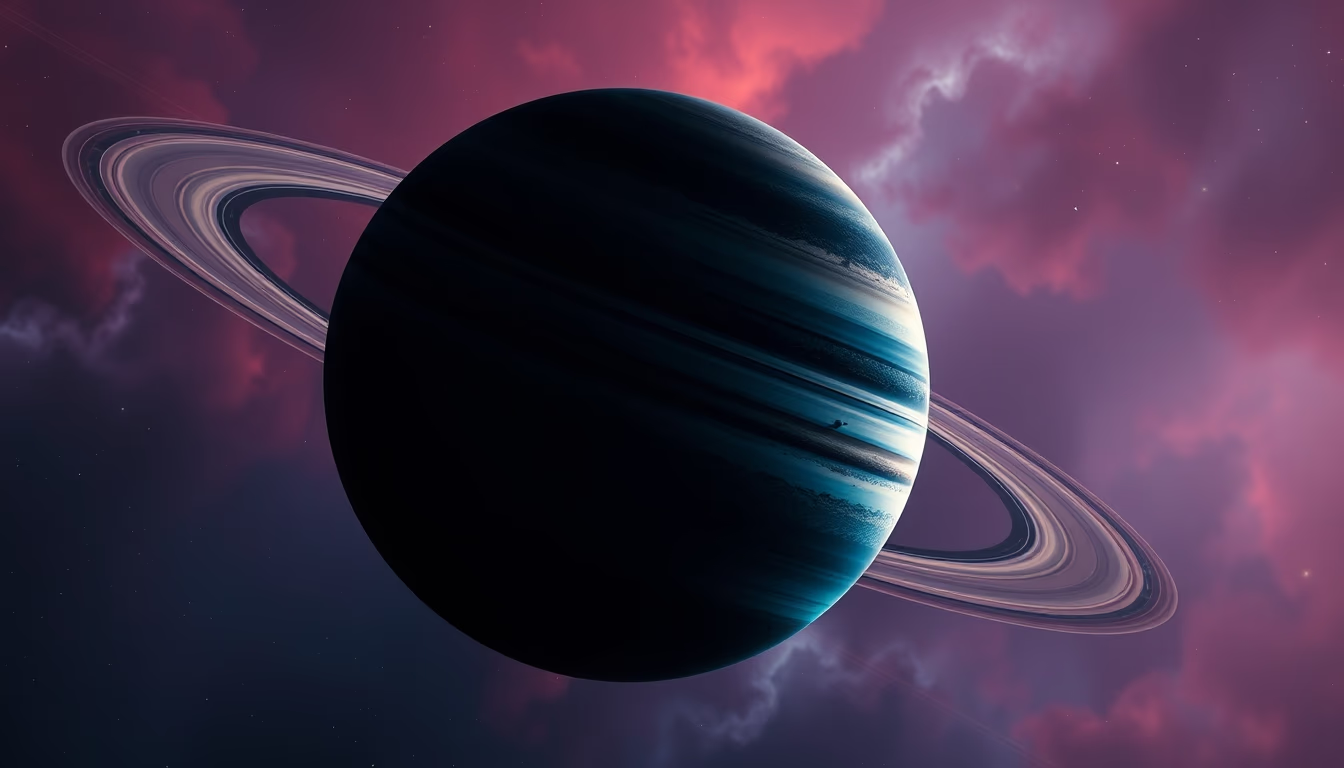
Ringed gas giants are rare in the known universe, but exoplanet J1407b hosts a ring system 200 times larger than Saturn's.
About this subject
Ringed gas giant exoplanets are a rare and captivating class of worlds beyond our solar system. Unlike Saturn's modest rings of ice and dust, some exoplanets, such as J1407b discovered in 2012, boast enormous ring systems. J1407b, located about 434 light-years away in the constellation Centaurus, has over 30 rings with a total diameter of roughly 120 million kilometers, 200 times larger than Saturn's rings. These rings are primarily composed of dust and rocky debris, and their structure suggests the formation of exomoons. Detecting rings around exoplanets is challenging and primarily achieved through transit photometry, where the planet and its rings pass in front of its host star, causing complex dimming patterns. The Kepler Space Telescope's data has revealed asymmetric light curves that indicate ring systems. Studies suggest that rings around gas giants may be relatively common, but they are short-lived on astronomical timescales (millions of years), making them rare to observe. Beyond J1407b, candidates like HIP 41378 f also show ring signatures. Understanding these systems sheds light on planetary formation and moon dynamics, as rings often evolve into moons. Gaps in the rings, as seen in J1407b, point to the presence of exomoons clearing paths, similar to Saturn's shepherd moons. Future observatories like the James Webb Space Telescope and the PLATO mission will likely uncover more details about these exotic ringed worlds.
Frequently Asked Questions
How do scientists detect rings on exoplanets?
Detection primarily uses the transit method. As the exoplanet passes in front of its star, the resulting light curve may show asymmetric dimming or multiple dips, indicating rings. The Kepler Space Telescope was instrumental in these discoveries.
What is the largest ring system found on an exoplanet?
The largest known is around exoplanet J1407b, with a ring system spanning about 120 million kilometers in diameter, roughly 200 times larger than Saturn's rings.
Can exoplanet rings form moons?
Yes. Gaps in the rings suggest the presence of forming exomoons that clear material around them, similar to Saturn's shepherd moons which maintain ring edges.
Direct URL
https://pub-c7d6a6ea828543ac903a74a341ccb2e1.r2.dev/imagens/gas-giant-ringed-exoplanet-long-exposure-fresh11.avifHow to credit
Include a visible link back to UtilizAí. Copy one of the snippets below:
<a href="https://xn--utiliza-eza.com/en/midia/imagens/gas-giant-ringed-exoplanet-long-exposure-fresh11">Gas giant ringed exoplanet</a> by <a href="https://xn--utiliza-eza.com">UtilizAí</a>, licensed under <a href="https://creativecommons.org/licenses/by/4.0/">CC BY 4.0</a>.
[Gas giant ringed exoplanet](https://xn--utiliza-eza.com/en/midia/imagens/gas-giant-ringed-exoplanet-long-exposure-fresh11) by [UtilizAí](https://xn--utiliza-eza.com), CC BY 4.0
License: CC-BY-4.0