Gas giant ringed exoplanet
1344×768 · AVIF · CC BY 4.0
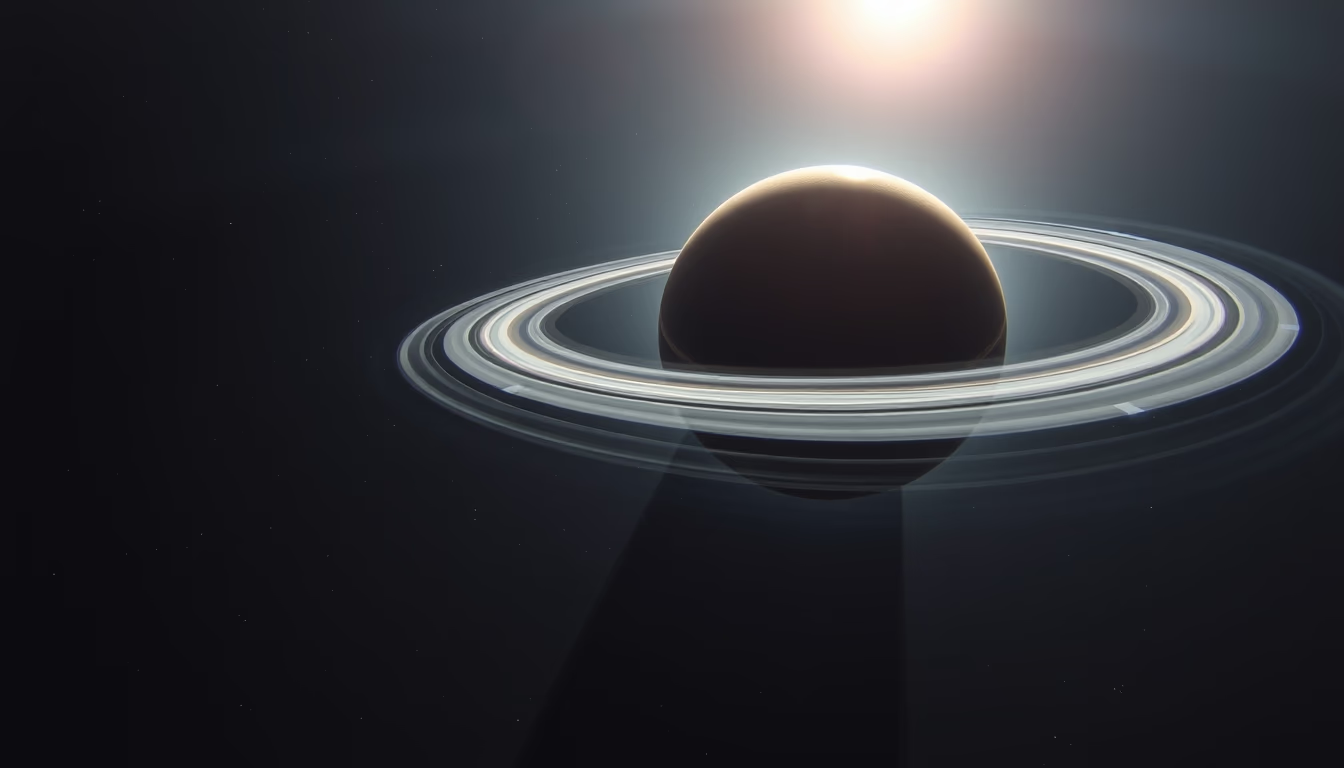
Gas giant exoplanets with rings, such as J1407b, challenge our understanding of planetary formation and circumplanetary disk dynamics.
About this subject
Gas giant exoplanets with ring systems are rare and fascinating objects. The most notable example is J1407b, located about 434 light-years away in the constellation Centaurus. Discovered in 2012, its ring system is roughly 200 times larger than Saturn’s, with gaps that suggest the presence of forming exomoons. The host star, J1407, underwent irregular eclipses over 56 days, revealing the complex ring structure as it passed in front.
Rings on extrasolar planets can form similarly to Saturn’s: from debris of moons or comets that break apart within the Roche limit. In young systems, rings may be remnants of the original circumplanetary disk. Detection is indirect, typically through light curves showing eclipses and transits with characteristic asymmetries. The Kepler space telescope and TESS have contributed to identifying several candidates.
Interestingly, the planet PDS 70 b, a forming gas giant, also shows evidence of a circumplanetary disk that may evolve into rings. Studies suggest that extensive rings can influence planetary migration and moon formation. The diversity of sizes and structures observed, such as eccentric or tilted rings, indicates these systems are dynamic and can be gravitationally disturbed by nearby companions.
The importance of studying these objects goes beyond curiosity. They offer clues about planetary system evolution, the role of rings in capturing material, and the possibility of habitable exomoons. With future telescopes like the James Webb and ELT, direct spectroscopy of rings will be possible, revealing their chemical and physical composition.
Frequently Asked Questions
How many ringed exoplanets have been discovered?
So far, only a few candidates have been identified, with J1407b being the most confirmed. Detection is difficult because rings must be aligned to cause visible eclipses. Many more are likely undetected.
How do exoplanet rings compare to Saturn's?
Exoplanet rings can be hundreds of times larger and more massive. For instance, J1407b has a system with 30 to 40 rings, some with gaps indicating exomoons. Saturn's rings are thin and well-defined, composed mainly of ice.
Could there be life on moons orbiting ringed planets?
Yes, if those moons lie in the star's habitable zone. Gaps in rings can be created by moons, which if rocky and liquid water exists, could harbor life. However, detecting biosignatures on such bodies is extremely challenging.
Direct URL
https://pub-c7d6a6ea828543ac903a74a341ccb2e1.r2.dev/imagens/gas-giant-ringed-exoplanet-fish-eye-wide-angle-fresh13.avifHow to credit
Include a visible link back to UtilizAí. Copy one of the snippets below:
<a href="https://xn--utiliza-eza.com/en/midia/imagens/gas-giant-ringed-exoplanet-fish-eye-wide-angle-fresh13">Gas giant ringed exoplanet</a> by <a href="https://xn--utiliza-eza.com">UtilizAí</a>, licensed under <a href="https://creativecommons.org/licenses/by/4.0/">CC BY 4.0</a>.
[Gas giant ringed exoplanet](https://xn--utiliza-eza.com/en/midia/imagens/gas-giant-ringed-exoplanet-fish-eye-wide-angle-fresh13) by [UtilizAí](https://xn--utiliza-eza.com), CC BY 4.0
License: CC-BY-4.0