Gas giant ringed exoplanet
1344×768 · AVIF · CC BY 4.0
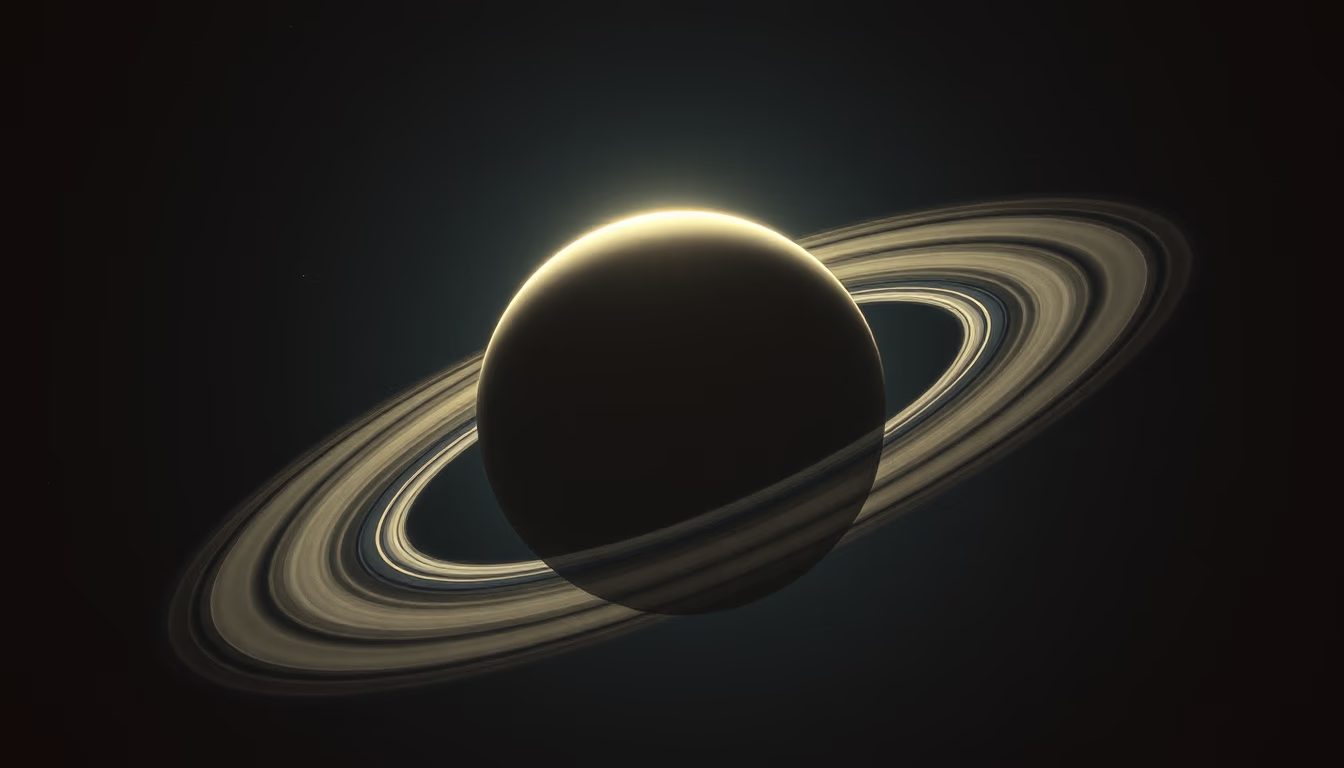
Gas giant exoplanets with rings are fascinating worlds that challenge our understanding of planetary formation.
About this subject
Gas giant exoplanets with rings are a rare and intriguing class of worlds outside our Solar System. Unlike rocky planets, these giants are composed mainly of hydrogen and helium, with thick, turbulent atmospheres. The presence of rings, like those of Jupiter and Saturn in our system, suggests that ring systems may be common around massive planets, but detecting them around exoplanets is extremely challenging due to current technological limitations.
The discovery of candidate ringed exoplanets, such as J1407b, has brought new perspectives. J1407b has a ring system that, if placed around Saturn, would dominate Earth's sky. These rings may be composed of dust, ice, and rocky debris, and their structure and evolution provide clues about the planet's history and environment. Rings are believed to form from the destruction of moons or the capture of material from the protoplanetary disk.
Observation of ringed exoplanets is primarily done through the transit method, where the planet's passage in front of its star causes a dip in starlight. Asymmetric patterns in the light curve can indicate the presence of rings. However, confirmation requires detailed models and multi-wavelength observations, such as in infrared, where rings are brighter.
Studying these worlds helps understand the diversity of planetary systems in the galaxy. With the launch of more advanced telescopes like the James Webb Space Telescope, more ringed exoplanets are expected to be identified, revealing physical processes we do not yet fully comprehend. Each new discovery expands our knowledge of planetary formation and evolution.
Frequently Asked Questions
How are rings of gas giant exoplanets detected?
Primarily through the transit method, analyzing the star's light curve. Rings cause asymmetric patterns and multiple brightness dips during transit, which can be modeled to infer their presence and structure.
What is the most famous ringed exoplanet discovered?
J1407b, discovered in 2012, is known for its enormous ring system, about 200 times the diameter of Saturn's rings. Its complex structure suggests the presence of moons and gaps in the system.
Are exoplanet rings permanent?
Not necessarily. Rings can be temporary, formed by events like moon collisions or material capture. Over time, they may dissipate or coalesce into new moons, as happens around Saturn.
Direct URL
https://pub-c7d6a6ea828543ac903a74a341ccb2e1.r2.dev/imagens/gas-giant-ringed-exoplanet-film-grain-authentic-fresh8.avifHow to credit
Include a visible link back to UtilizAí. Copy one of the snippets below:
<a href="https://xn--utiliza-eza.com/en/midia/imagens/gas-giant-ringed-exoplanet-film-grain-authentic-fresh8">Gas giant ringed exoplanet</a> by <a href="https://xn--utiliza-eza.com">UtilizAí</a>, licensed under <a href="https://creativecommons.org/licenses/by/4.0/">CC BY 4.0</a>.
[Gas giant ringed exoplanet](https://xn--utiliza-eza.com/en/midia/imagens/gas-giant-ringed-exoplanet-film-grain-authentic-fresh8) by [UtilizAí](https://xn--utiliza-eza.com), CC BY 4.0
License: CC-BY-4.0