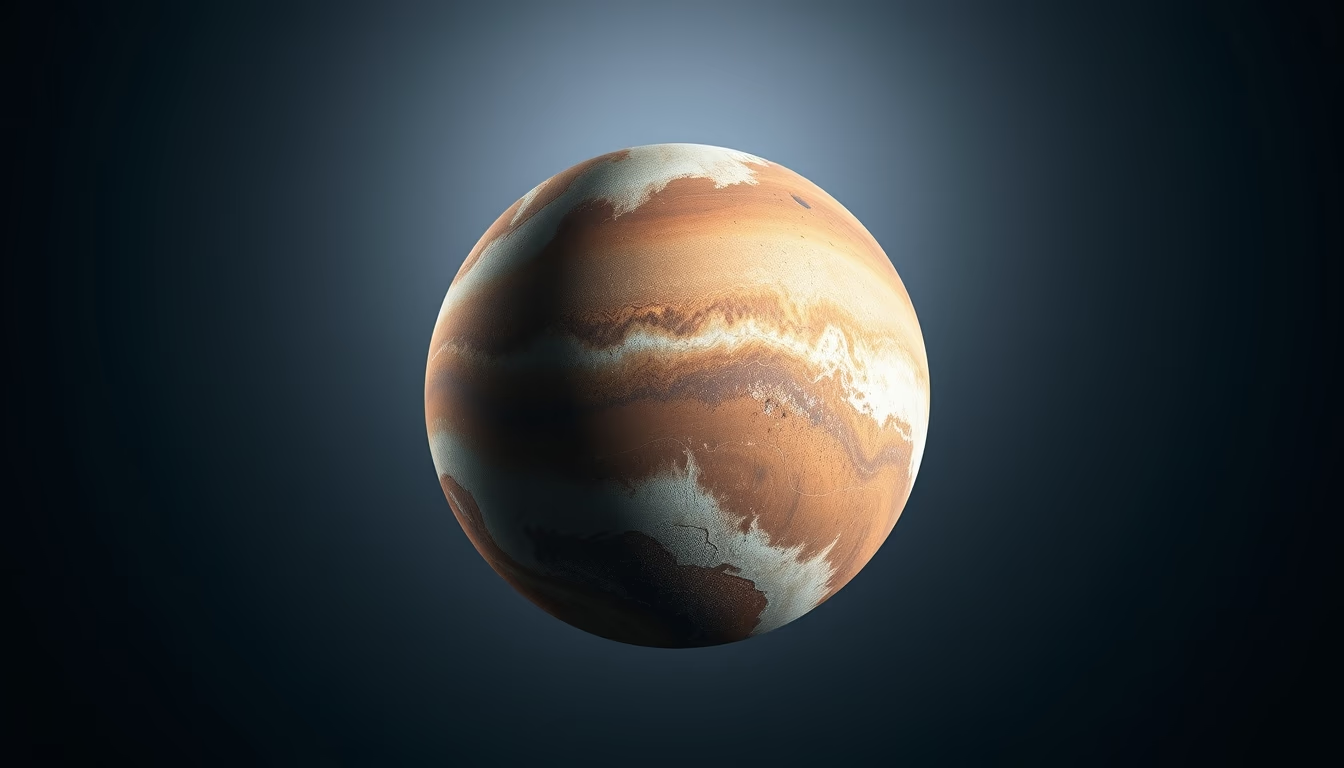
Gas giant ringed exoplanet
1344×768 · AVIF · CC BY 4.0

Discover gas giant exoplanets with rings, distant worlds that challenge our understanding of planetary systems.
About this subject
Gas giant exoplanets with rings are a fascinating class of celestial bodies that possess extensive ring systems, similar to Saturn's but often larger and more massive. A notable example is J1407b, located about 434 light-years away in the constellation Centaurus. Discovered in 2012, this planet has a ring system with over 30 individual rings, totaling approximately 120 million kilometers in diameter, 200 times larger than Saturn's rings. If those rings were around Saturn, they would dominate Earth's sky.
The formation of these rings may be linked to the capture or fragmentation of moons or asteroids, or remnants of protoplanetary disks. Studies indicate that ring systems around exoplanets are more common than previously thought, with at least 40 candidates identified by the Kepler telescope and other observatories. Detection is primarily done via the transit method, where starlight is attenuated in complex patterns as the planet and its rings pass in front of the star.
Besides J1407b, other candidates like HIP 41378 f and some planets around the star PDS 70 also show signs of rings. The presence of these rings provides clues about the system's evolutionary history, including planetary migration and collisions between celestial bodies. On geological timescales, rings may disappear or transform into moons, offering a natural laboratory to study orbital dynamics.
Interestingly, the study of ringed exoplanets also aids in understanding phenomena such as eclipses and stellar brightness variations, as well as inspiring the search for life on moons that could orbit these gas giants, the so-called habitable exomoons. Although we do not yet have high-resolution direct images, next-generation computer simulations and observations promise to reveal details never seen before.
Frequently Asked Questions
How do scientists detect rings on exoplanets?
Detection is primarily done via the transit method, when the planet passes in front of its star. The resulting light curve shows complex dimming patterns that indicate the presence of rings. High-precision observations with telescopes like Kepler and TESS are essential to identify these patterns.
What is the largest known ring system on an exoplanet?
The largest known ring system belongs to J1407b, with an estimated diameter of 120 million kilometers. It contains over 30 individual rings and is about 200 times larger than Saturn's rings.
Is there a possibility of life on moons orbiting ringed exoplanets?
Yes, it is an intriguing possibility. Moons orbiting gas giants in the habitable zone could, in theory, harbor liquid water and conditions favorable for life. However, no exomoon has been confirmed yet, and studying their environments remains speculative.
Direct URL
https://pub-c7d6a6ea828543ac903a74a341ccb2e1.r2.dev/imagens/gas-giant-ringed-exoplanet-architectural-photography-fresh7.avifHow to credit
Include a visible link back to UtilizAí. Copy one of the snippets below:
<a href="https://xn--utiliza-eza.com/en/midia/imagens/gas-giant-ringed-exoplanet-architectural-photography-fresh7">Gas giant ringed exoplanet</a> by <a href="https://xn--utiliza-eza.com">UtilizAí</a>, licensed under <a href="https://creativecommons.org/licenses/by/4.0/">CC BY 4.0</a>.
[Gas giant ringed exoplanet](https://xn--utiliza-eza.com/en/midia/imagens/gas-giant-ringed-exoplanet-architectural-photography-fresh7) by [UtilizAí](https://xn--utiliza-eza.com), CC BY 4.0
License: CC-BY-4.0