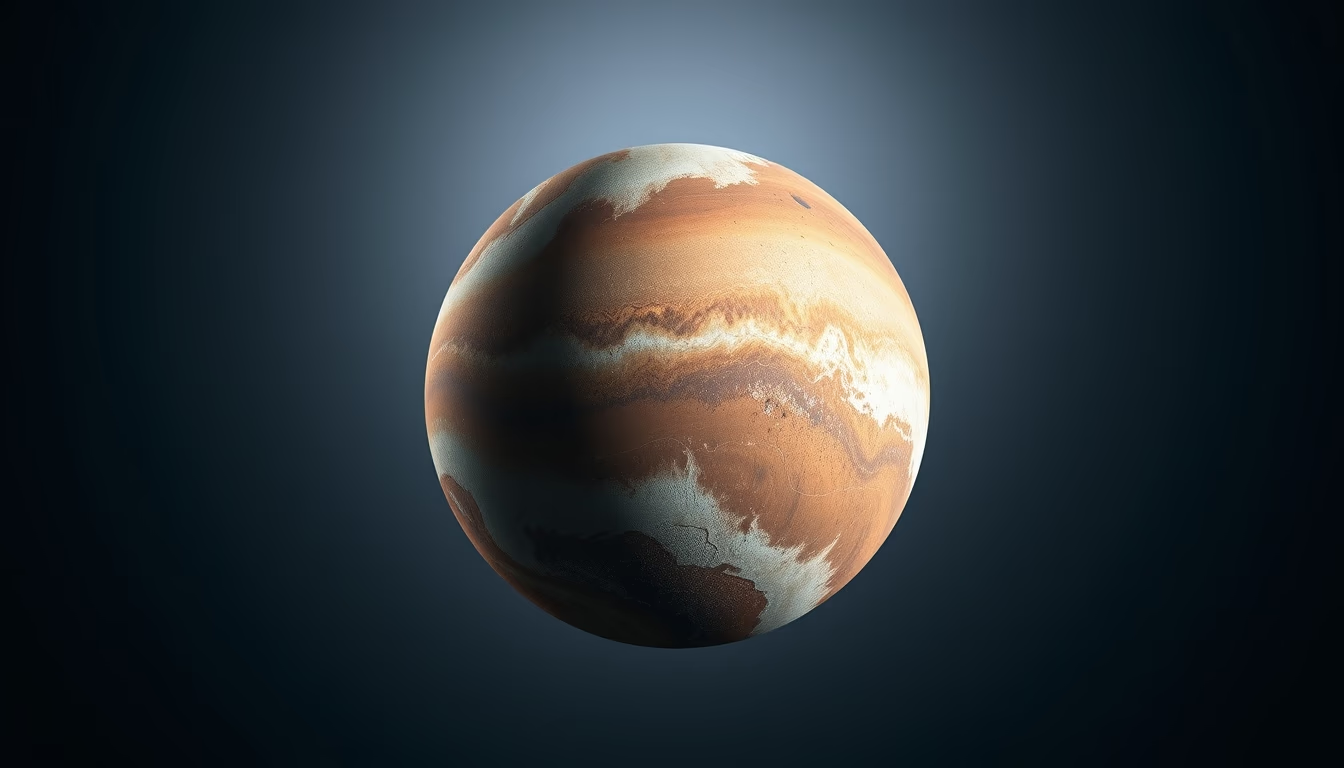
Binary star sunset
1344×768 · AVIF · CC BY 4.0

Double sunset on an exoplanet orbiting a binary star system, revealing unique colors and shadows cast by two light sources.
About this subject
Binary star systems are common in the universe, representing about half of all stars in the Milky Way. They consist of two suns orbiting a common center of mass, classified as visual, spectroscopic, or eclipsing binaries depending on distance and detection method. When an exoplanet orbits such a system, the sky displays rare phenomena, such as double sunsets, varying in color and intensity as the stars align. The planet's temperature depends on orbital configuration: in close binary systems, the stars can heat the planet irregularly, while in wide systems, each star illuminates different hemispheres.
The first confirmed exoplanet in a binary system was Kepler-16b, discovered in 2011 by the Kepler mission, orbiting two orange dwarfs about 200 light-years from Earth. Nicknamed 'Tatooine' after Star Wars, Kepler-16b is a gas giant similar in size to Saturn, completing an orbit every 229 days. Its discovery proved that circumbinary planets (orbiting both stars) can form and remain stable for billions of years. Currently, more than a dozen circumbinary planets are known, such as Kepler-47c and TOI-1338b, expanding our understanding of planetary system diversity.
The appearance of a binary sunset depends on the spectral types of the stars. Cooler stars (red dwarfs) produce orange hues, while hotter stars (yellow or blue dwarfs) emit white or blue light. Shadows cast on a planet with two suns are more complex: objects can cast two distinct shadows that move and elongate non-linearly during twilight. Additionally, the sunset duration may be longer, as the stars set at different times, creating a prolonged spectacle. These scenarios fuel scientific imagination and discussions about the habitability of planets in multiple-star systems.
From an astrobiological perspective, the habitable zone in binary systems is more restricted. For a planet to receive stable light and heat, its orbit must avoid extreme temperature variations. In close binary systems, the habitable zone is similar to that of a single star with the same total luminosity. In wide systems, the planet may orbit just one star, depending on separation. Theoretical studies indicate that rocky planets could exist in these regions, but long-term orbital stability depends on factors like eccentricity and resonances. The search for atmospheres on circumbinary exoplanets is a next step with telescopes like James Webb.
Frequently Asked Questions
Are there known exoplanets orbiting binary star systems?
Yes, the first was Kepler-16b discovered in 2011. Today, more than a dozen are known, such as Kepler-47c and TOI-1338b, mainly detected by the Kepler mission.
What would life be like on a planet with two suns?
It would depend on orbital stability and temperature. Days and nights could be irregular, and shadows would be double. The habitable zone is narrower, but rocky planets could exist if the orbit is suitable.
Why does a binary sunset have different colors?
Colors depend on the spectral types of the stars. Cooler stars (type M) emit reddish light, while hotter stars (type A or B) produce bluish tones. The planet's atmosphere also affects light scattering.
Direct URL
https://pub-c7d6a6ea828543ac903a74a341ccb2e1.r2.dev/imagens/binary-star-sunset-aerial-drone-shot-fresh0.avifHow to credit
Include a visible link back to UtilizAí. Copy one of the snippets below:
<a href="https://xn--utiliza-eza.com/en/midia/imagens/binary-star-sunset-aerial-drone-shot-fresh0">Binary star sunset</a> by <a href="https://xn--utiliza-eza.com">UtilizAí</a>, licensed under <a href="https://creativecommons.org/licenses/by/4.0/">CC BY 4.0</a>.
[Binary star sunset](https://xn--utiliza-eza.com/en/midia/imagens/binary-star-sunset-aerial-drone-shot-fresh0) by [UtilizAí](https://xn--utiliza-eza.com), CC BY 4.0
License: CC-BY-4.0