Trappist-1 system art
1344×768 · AVIF · CC BY 4.0

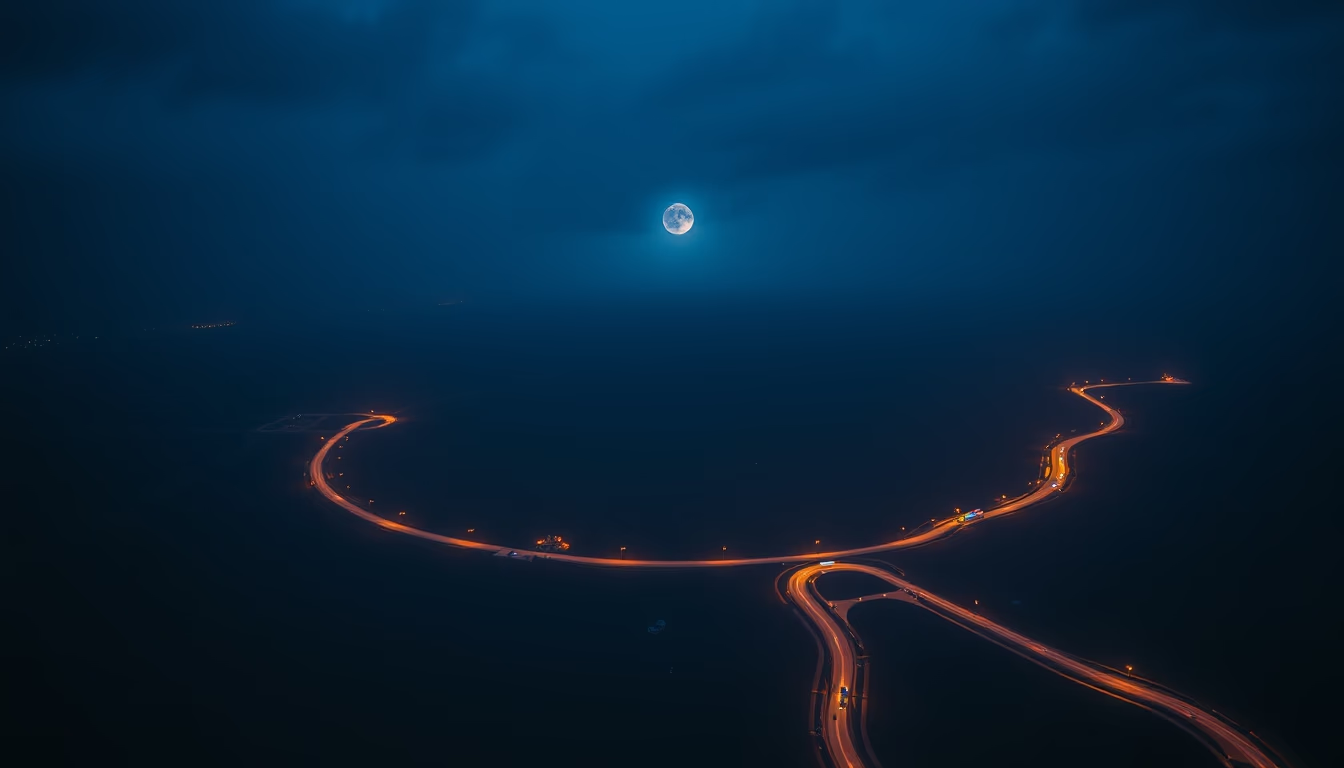
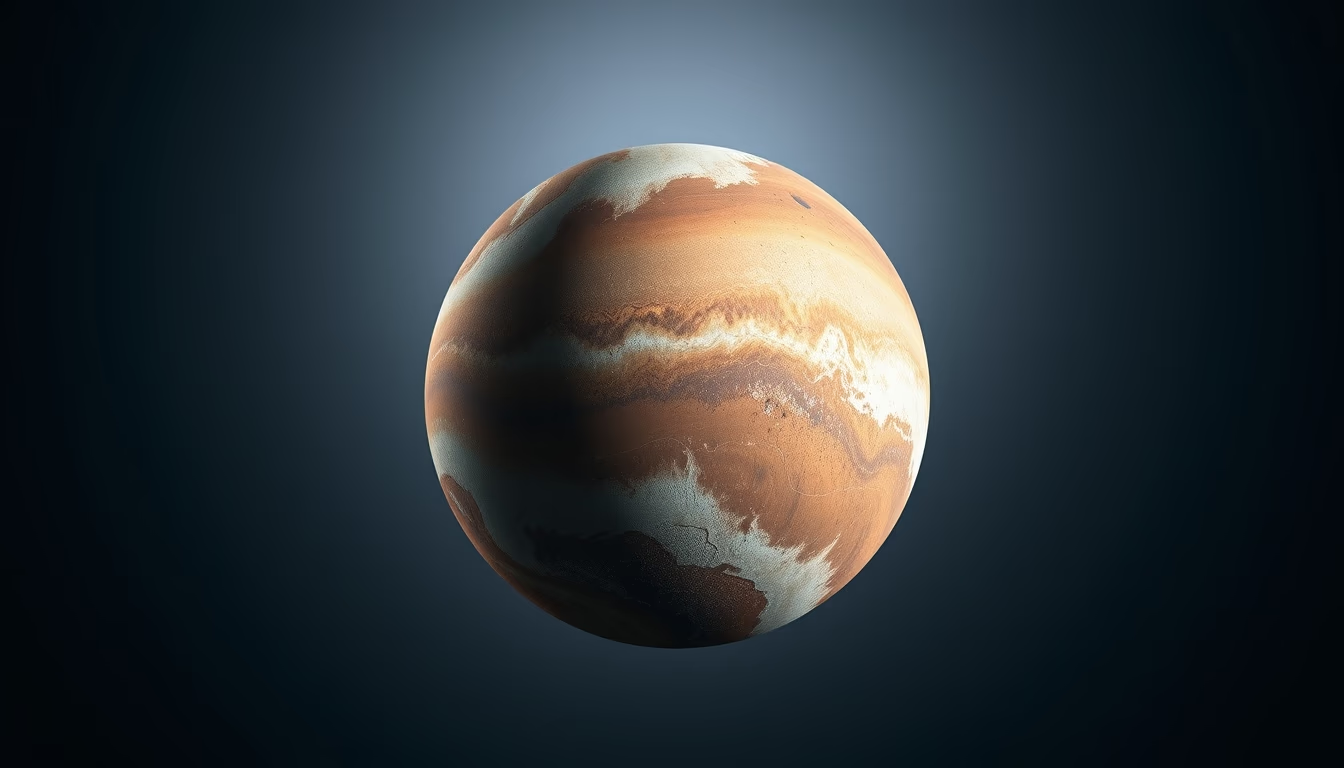
The Trappist-1 system, 40 light-years away, hosts seven Earth-sized rocky planets, three in the habitable zone.
About this subject
The Trappist-1 system orbits an ultracool dwarf star of spectral type M8, located in the constellation Aquarius. Discovered in 2016 by the TRAPPIST (Transiting Planets and Planetesimals Small Telescope) at the La Silla Observatory in Chile, it quickly became one of the most important systems in the search for potentially habitable exoplanets. Its parent star has only 8% of the Sun's mass and emits little light, but the planets are so close that they complete their orbits in a few days.
All seven planets of the Trappist-1 system are rocky and have sizes and masses very similar to Earth. Three of them (Trappist-1e, f, and g) lie in the habitable zone, where temperatures allow liquid water on the surface. The others are either too hot or too cold. Initial observations suggest some planets may have global oceans, while others could be covered by molten rock or thick atmospheres.
The greatest importance of the Trappist-1 system is the unique opportunity to study the atmospheres of rocky exoplanets. Because the planets frequently transit their star, spectroscopy can analyze the light passing through their atmospheres. The James Webb Space Telescope has already observed Trappist-1b and c, searching for signs of atmospheres and gases like carbon dioxide or water vapor. Additionally, the planets are very close to each other, with gravitational interactions that may influence their orbits and climate.
The Trappist-1 system serves as a natural laboratory to test models of planetary formation and atmospheric evolution. Measured densities suggest compositions rich in iron and silicates, similar to Earth. Future missions, such as the Nancy Grace Roman Space Telescope and the ELT observatory, will further characterize these worlds, bringing us closer to answering the question of habitability beyond the Solar System.
Frequently Asked Questions
Where is the Trappist-1 system located?
The Trappist-1 system is about 40 light-years from Earth, in the constellation Aquarius. It is one of the closest exoplanetary systems to us.
How many planets does the Trappist-1 system have?
The system has seven confirmed rocky planets, all with sizes and masses similar to Earth. They are designated Trappist-1b through h.
Could any of these planets harbor life?
Three planets (Trappist-1e, f, and g) are in the habitable zone, where temperatures allow liquid water. However, it is not yet known if they have stable atmospheres and chemical compositions suitable for life as we know it.
Direct URL
https://pub-c7d6a6ea828543ac903a74a341ccb2e1.r2.dev/imagens/trappist-1-system-art-long-exposure-fresh13.avifHow to credit
Include a visible link back to UtilizAí. Copy one of the snippets below:
<a href="https://xn--utiliza-eza.com/en/midia/imagens/trappist-1-system-art-long-exposure-fresh13">Trappist-1 system art</a> by <a href="https://xn--utiliza-eza.com">UtilizAí</a>, licensed under <a href="https://creativecommons.org/licenses/by/4.0/">CC BY 4.0</a>.
[Trappist-1 system art](https://xn--utiliza-eza.com/en/midia/imagens/trappist-1-system-art-long-exposure-fresh13) by [UtilizAí](https://xn--utiliza-eza.com), CC BY 4.0
License: CC-BY-4.0