Trappist-1 system art
1344×768 · AVIF · CC BY 4.0

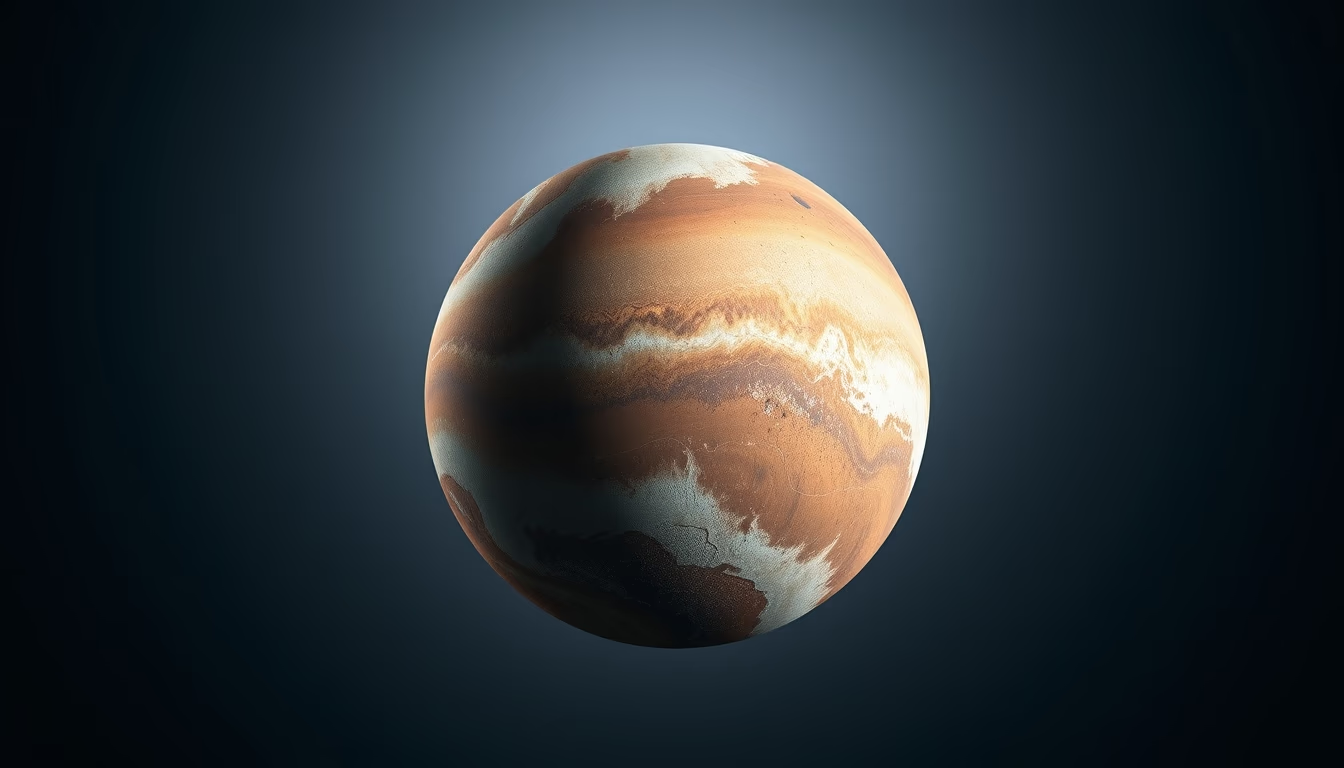
The TRAPPIST-1 system, 40 light-years away, hosts seven Earth-sized rocky planets, three within the habitable zone.
About this subject
Discovered in 2016 by the TRAPPIST (Transiting Planets and Planetesimals Small Telescope) at La Silla Observatory in Chile, the TRAPPIST-1 system stands as one of the most remarkable exoplanetary systems ever found. Its star, an ultracool red dwarf of spectral type M, has only 8% of the Sun's mass and glows dimly in red light. The seven planets, labeled TRAPPIST-1b through h, complete extremely short orbits: the innermost takes 1.5 days, the outermost 18.8 days. All are closer to their star than Mercury is to the Sun, but because the star is cool, three of them (e, f, g) lie within the habitable zone, where liquid water could exist on the surface. Observations by the James Webb Space Telescope have hinted that some planets may retain atmospheres, though intense stellar radiation could strip them away. The planets' high densities suggest a rocky composition, similar to Earth's. This system has become a prime target in the search for biosignatures, as its relative proximity (40 light-years) enables detailed studies. The discovery also spurred new techniques for analyzing exoplanet atmospheres. Interestingly, the name TRAPPIST honors Belgian Trappist monks, brewers of beer, and is also an acronym for the telescope. The system serves as a natural laboratory for understanding planet formation around low-mass stars, the most common type in the Milky Way.
Frequently Asked Questions
How many planets does the TRAPPIST-1 system have?
The TRAPPIST-1 system has seven rocky, Earth-sized planets, designated TRAPPIST-1b through h.
Are any TRAPPIST-1 planets habitable?
Three planets (e, f, g) orbit within the habitable zone, where liquid water could exist. Habitability also depends on factors like atmosphere and stellar radiation.
Where is the TRAPPIST-1 system located?
It is located in the constellation Aquarius, approximately 40 light-years from Earth.
Direct URL
https://pub-c7d6a6ea828543ac903a74a341ccb2e1.r2.dev/imagens/trappist-1-system-art-lo-fi-disposable-camera-fresh11.avifHow to credit
Include a visible link back to UtilizAí. Copy one of the snippets below:
<a href="https://xn--utiliza-eza.com/en/midia/imagens/trappist-1-system-art-lo-fi-disposable-camera-fresh11">Trappist-1 system art</a> by <a href="https://xn--utiliza-eza.com">UtilizAí</a>, licensed under <a href="https://creativecommons.org/licenses/by/4.0/">CC BY 4.0</a>.
[Trappist-1 system art](https://xn--utiliza-eza.com/en/midia/imagens/trappist-1-system-art-lo-fi-disposable-camera-fresh11) by [UtilizAí](https://xn--utiliza-eza.com), CC BY 4.0
License: CC-BY-4.0