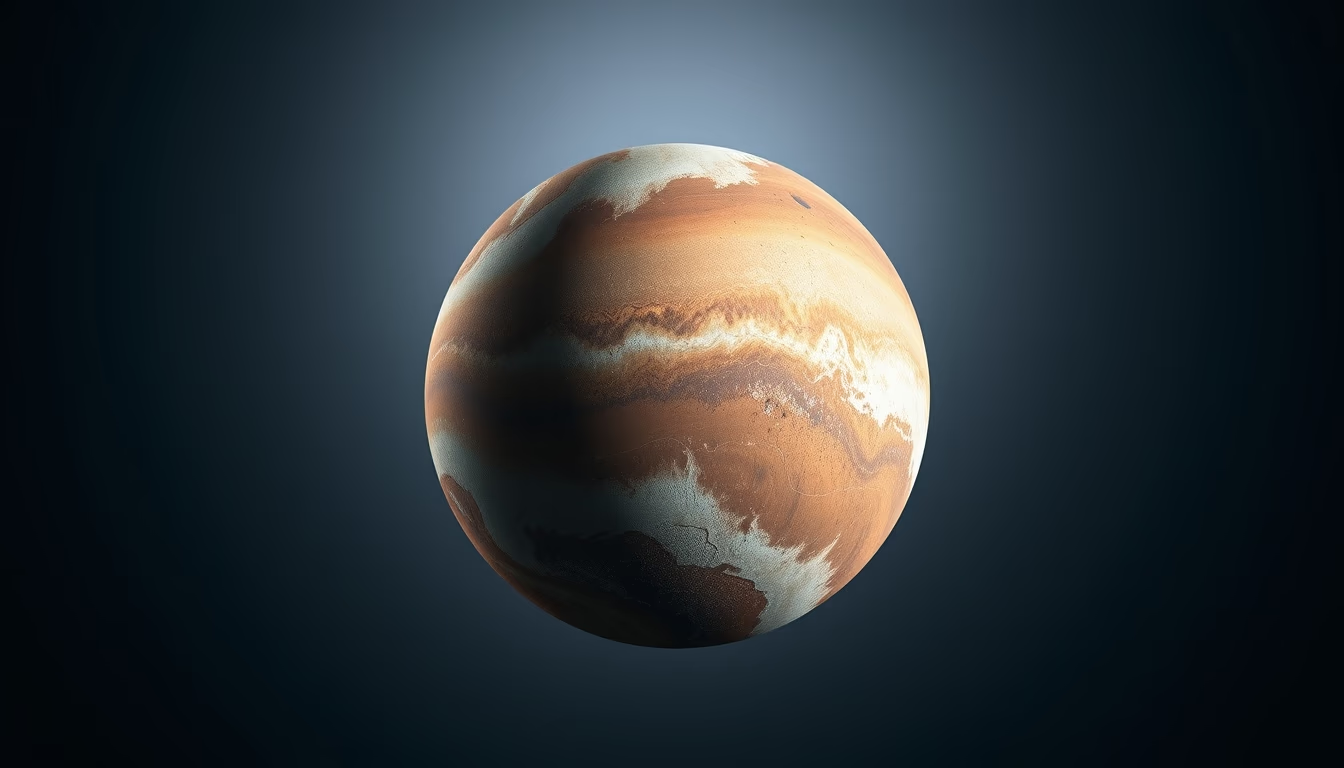
Rogue planet darkness
1344×768 · AVIF · CC BY 4.0

Rogue planets, or interstellar planets, drift through the Milky Way without a host star. Learn how they are detected, formed, and their astronomical significance.
About this subject
Rogue planets, also called interstellar or orphan planets, are celestial bodies that do not orbit any star. They drift freely through interstellar space, immersed in perpetual darkness without a sun. Their existence was only confirmed in the last few decades, and estimates suggest the Milky Way may contain billions of these solitary worlds, outnumbering the stars in the galaxy.
Rogue planets can originate in two main ways. The first is star-like formation, through the collapse of gas and dust clouds, but on scales too small to ignite nuclear fusion, these are called sub-brown dwarfs. The second, more common path occurs when a planet formed in a stellar system gets ejected by gravitational interactions with larger planets or the star itself. Simulations indicate that young, turbulent systems can expel up to half of their planets during the first few million years.
Detecting a rogue planet is extremely challenging because they emit no light and are cold. Astronomers use gravitational microlensing: when a massive object passes in front of a distant star, its gravity bends and magnifies the star's light, revealing the planet's presence. Upcoming missions like NASA's Roman Space Telescope and the Vera Rubin Observatory are expected to discover thousands of these objects in the next decade. Some rogue planets might even harbor subsurface oceans heated by radioactive decay, raising the possibility of extraterrestrial life in complete darkness.
Frequently Asked Questions
How can a rogue planet be habitable without starlight?
Some rogue planets may have subsurface oceans heated by radioactive decay of elements like uranium and thorium, or by tidal forces if they have moons. This heat source, combined with a thick atmosphere, could maintain liquid water and support chemosynthetic life.
What is the difference between a rogue planet and a sub-brown dwarf?
Sub-brown dwarfs form like stars but with insufficient mass for nuclear fusion (between 13 and 80 Jupiter masses). Rogue planets typically have masses below 13 Jupiter masses and may have formed around a star before being ejected.
How many rogue planets are there in the Milky Way?
Estimates vary, but studies suggest there may be more rogue planets than stars, possibly billions. A 2017 survey indicated that for every star in the Milky Way, there could be at least one rogue planet.
Direct URL
https://pub-c7d6a6ea828543ac903a74a341ccb2e1.r2.dev/imagens/rogue-planet-darkness-studio-still-life-fresh8.avifHow to credit
Include a visible link back to UtilizAí. Copy one of the snippets below:
<a href="https://xn--utiliza-eza.com/en/midia/imagens/rogue-planet-darkness-studio-still-life-fresh8">Rogue planet darkness</a> by <a href="https://xn--utiliza-eza.com">UtilizAí</a>, licensed under <a href="https://creativecommons.org/licenses/by/4.0/">CC BY 4.0</a>.
[Rogue planet darkness](https://xn--utiliza-eza.com/en/midia/imagens/rogue-planet-darkness-studio-still-life-fresh8) by [UtilizAí](https://xn--utiliza-eza.com), CC BY 4.0
License: CC-BY-4.0