Aboriginal dot painting
1344×768 · AVIF · CC BY 4.0
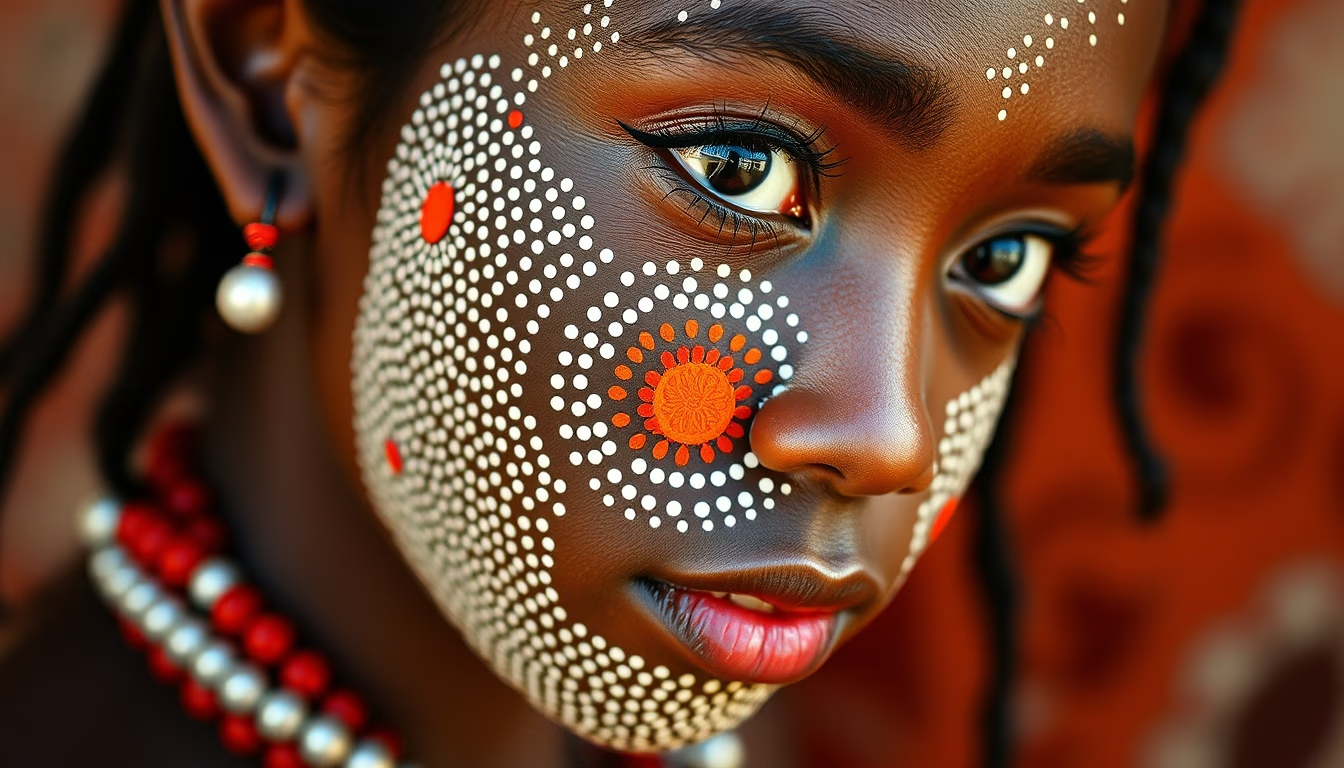
Aboriginal dot painting is an Indigenous Australian art form that uses dot patterns to represent Dreamtime stories and sacred knowledge.
About this subject
Aboriginal dot painting, also known as dot art, originated from the Papunya Tula movement in the early 1970s in the remote community of Papunya, Northern Territory, Australia. Led by artist Kaapa Mbitjana Tjampitjinpa, the movement emerged as a way for the Anangu peoples (Pitjantjatjara and Yankunytjatjara) to express their cultural stories on Western supports like canvas and acrylic paint after being displaced from their traditional lands. Dot paintings evolved from ancient sand painting and rock art practices but serve a crucial function: the dots conceal sacred symbols and ceremonial secrets, making the works accessible to uninitiated audiences without violating cultural taboos.
The dot patterns are not random; each dot and its colour carry specific meanings tied to the Dreamtime, the Aboriginal cosmology that narrates the creation of the world, living beings, and social laws. For example, concentric circles can represent a waterhole or a campfire, while wavy lines indicate ancestral paths or rivers. Colours are traditionally derived from natural pigments such as red, yellow, and white ochre, and charcoal for black. Commercially, modern acrylic paints are widely used, but palettes vary by region: in the Central Desert, earthy tones dominate, while in the Kimberley region, dot paintings often incorporate brighter blues and greens.
The technique demands precision and patience: artists apply small dots with fine brushes, sticks, or even fingers, building layers that create texture and depth. Each artwork is unique and often associated with a specific 'dreaming' or story belonging to the artist, who holds the right to depict it through inheritance or initiation. Since the 1980s, Aboriginal dot painting has gained international recognition, with exhibitions at museums such as the Musée du Quai Branly in Paris and the Smithsonian Institution. Contemporary artists like Emily Kame Kngwarreye and Clifford Possum Tjapaltjarri are celebrated for pushing the boundaries of the technique while keeping alive a tradition that connects past and present.
Frequently Asked Questions
What do the dots in Aboriginal dot painting symbolize?
The dots represent natural elements such as stars, water, fire, and also mark the location of animals or Dreamtime events. Each pattern is specific to a story or clan, and the exact meanings are often kept confidential by the artists.
How are dot paintings traditionally made?
Traditionally, artists use natural pigments (ochre and charcoal) ground and mixed with water or resin. Dots are applied with fingers, sticks, or fine brushes onto surfaces like bark or, today, canvas. Modern acrylic paint is common, but the manual technique remains the same.
Can non-Indigenous people create dot paintings?
While there is no legal prohibition, the practice is discouraged for cultural reasons. The symbols and stories are intellectual property of specific clans, and unauthorized appropriation is considered disrespectful. Many Aboriginal artists encourage appreciation but not replication without permission.
Direct URL
https://pub-c7d6a6ea828543ac903a74a341ccb2e1.r2.dev/imagens/aboriginal-dot-painting-film-grain-authentic-fresh12.avifHow to credit
Include a visible link back to UtilizAí. Copy one of the snippets below:
<a href="https://xn--utiliza-eza.com/en/midia/imagens/aboriginal-dot-painting-film-grain-authentic-fresh12">Aboriginal dot painting</a> by <a href="https://xn--utiliza-eza.com">UtilizAí</a>, licensed under <a href="https://creativecommons.org/licenses/by/4.0/">CC BY 4.0</a>.
[Aboriginal dot painting](https://xn--utiliza-eza.com/en/midia/imagens/aboriginal-dot-painting-film-grain-authentic-fresh12) by [UtilizAí](https://xn--utiliza-eza.com), CC BY 4.0
License: CC-BY-4.0