University lecture hall empty
1344×768 · AVIF · CC BY 4.0
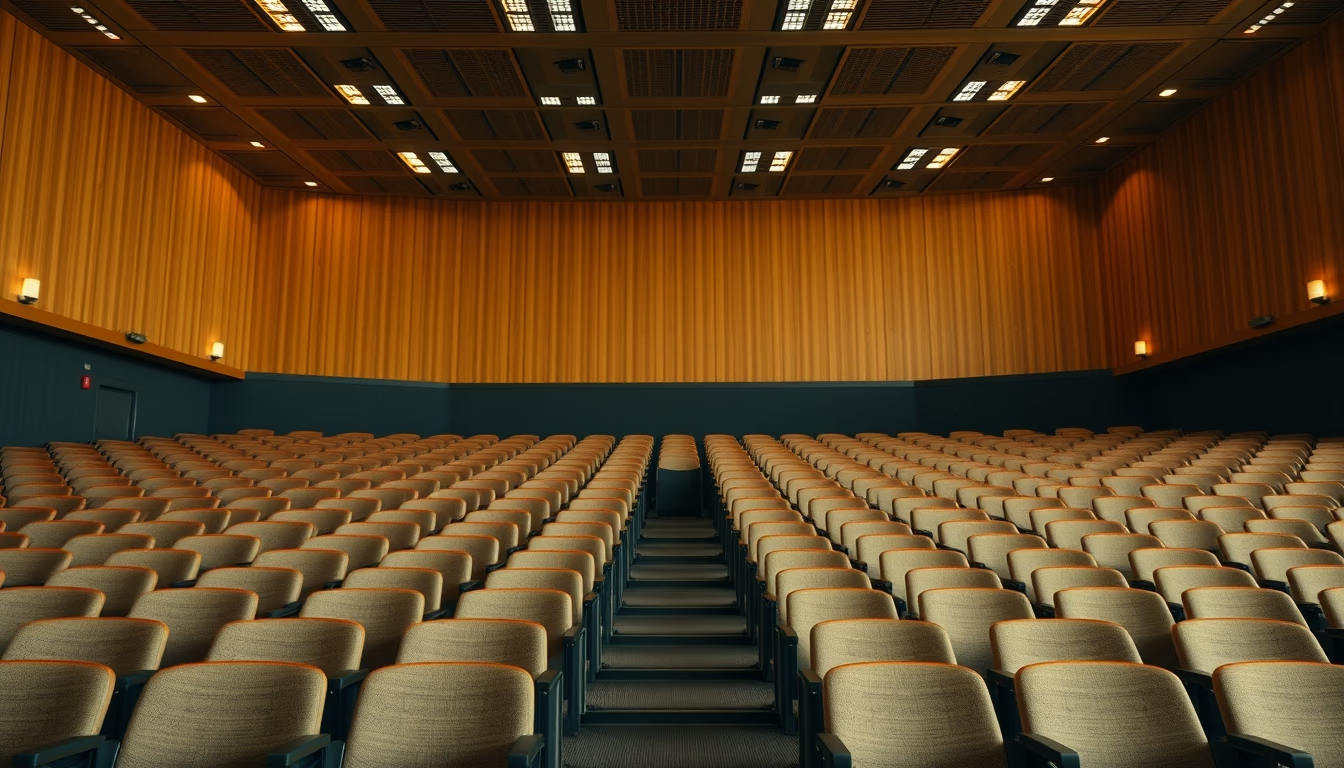
A spacious empty university lecture hall, with rows of blue upholstered seats and a blackboard in the background, evokes the silence that precedes knowledge.
About this subject
University lecture halls are spaces designed for large-scale knowledge transmission. This particular model, with blue upholstered seats and foldable desks, is typical of Brazilian universities built from the 1970s onward, when higher education expanded rapidly. The stepped arrangement ensures visibility for all students, while the central blackboard and lectern mark the professor's focal point.
The silence of an empty room contrasts with the bustle of term time, when hundreds of students occupy every seat. In many institutions, such as the University of São Paulo (USP) or the Federal University of Rio de Janeiro (UFRJ), similar auditoriums host basic discipline classes in the early years of courses like Engineering, Medicine, and Law. Average capacity ranges from 100 to 300 seats, depending on architectural design.
Fluorescent lighting and carefully planned acoustics are essential technical elements. The absence of windows in some models aims to reduce distractions, but also sparks debates about environmental health. Interestingly, studies show that straight-row seating can inhibit student participation, unlike semicircular or group layouts, more common in active learning methodologies.
Despite the emptiness, the room carries the memory of countless lectures, debates, and discoveries. Each scratch on the desk, each chalk mark on the board, tells a story of learning. For many university students, the image of an empty lecture hall represents both the anticipation of the semester's start and the nostalgia of intense study days.
Frequently Asked Questions
What is the average capacity of a university lecture hall like this?
Capacity ranges from 100 to 300 seats, depending on the design. Larger halls used for lectures can hold up to 500 seats.
Why do some auditoriums have no windows?
The absence of windows aims to reduce visual distractions and better control lighting for projections. However, it can impair natural ventilation and occupant well-being.
How does seating arrangement influence learning?
Straight rows, as in the image, favor one-way teacher exposition but may inhibit student interaction. Semicircular or island layouts promote greater participation and group work.
Direct URL
https://pub-c7d6a6ea828543ac903a74a341ccb2e1.r2.dev/imagens/university-lecture-hall-empty-cinematic-wide-shot-v2.avifHow to credit
Include a visible link back to UtilizAí. Copy one of the snippets below:
<a href="https://xn--utiliza-eza.com/en/midia/imagens/university-lecture-hall-empty-cinematic-wide-shot-v2">University lecture hall empty</a> by <a href="https://xn--utiliza-eza.com">UtilizAí</a>, licensed under <a href="https://creativecommons.org/licenses/by/4.0/">CC BY 4.0</a>.
[University lecture hall empty](https://xn--utiliza-eza.com/en/midia/imagens/university-lecture-hall-empty-cinematic-wide-shot-v2) by [UtilizAí](https://xn--utiliza-eza.com), CC BY 4.0
License: CC-BY-4.0