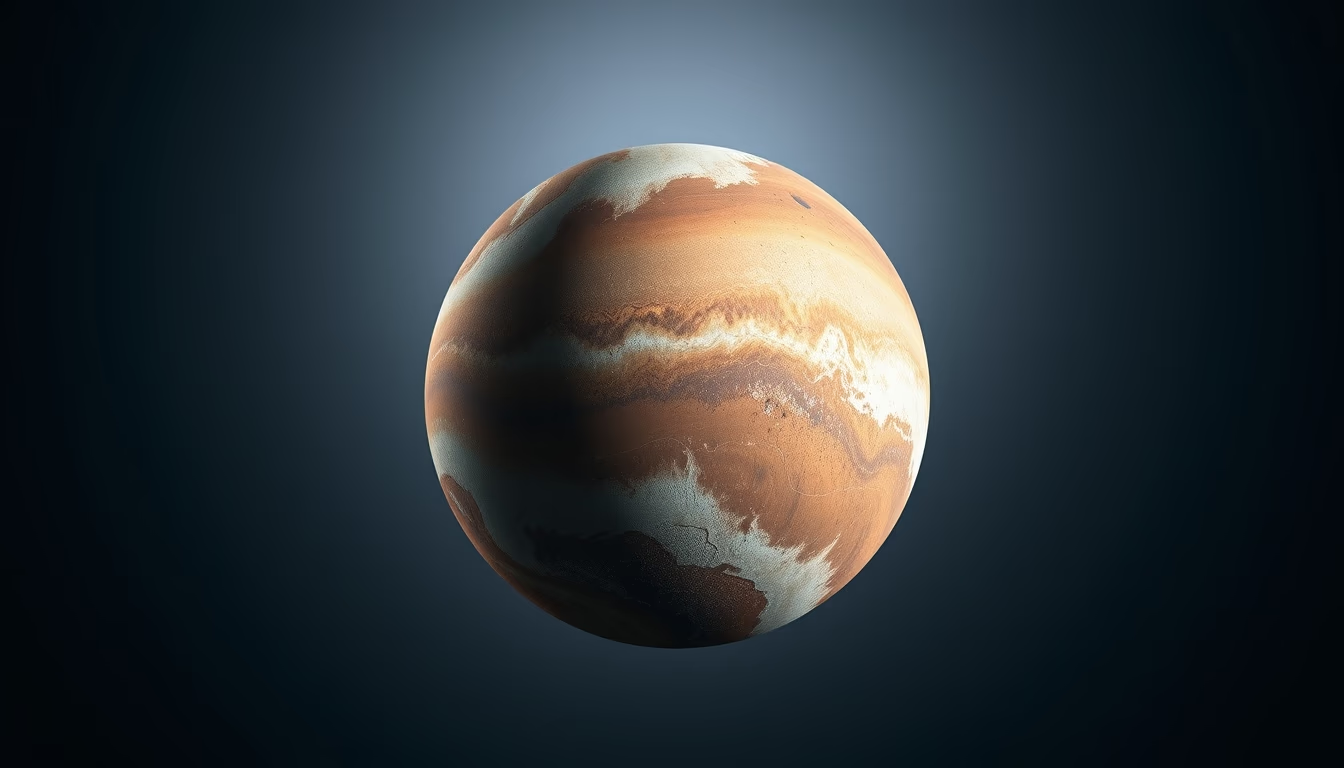
Rogue planet darkness
1344×768 · AVIF · CC BY 4.0

Rogue planets, also known as interstellar planets, drift through the darkness of space without orbiting any star.
About this subject
Rogue planets, also called interstellar planets, are planetary-mass objects that are not gravitationally bound to any star. They drift freely through the Milky Way, bathed in cosmic darkness. These solitary worlds are thought to be incredibly numerous, estimates suggest they may outnumber stars in the galaxy, reaching billions or even trillions. Their origins vary: many form within planetary systems but are ejected by gravitational interactions with other planets or their host star. Others may form directly in interstellar molecular clouds, like brown dwarfs, but with smaller masses.
Detecting rogue planets is challenging because they emit no visible light and are far from stars. The primary method is gravitational microlensing, which observes a temporary brightening of a background star when a planet passes in front of it. Additionally, infrared telescopes like WISE (Wide-field Infrared Survey Explorer) capture the residual heat of these bodies. In 2013, PSO J318.5-22 was one of the first confirmed rogue planets, with a mass about six times that of Jupiter and a surface temperature of around 1,200 K. Another notable example is WISE 0855-0714, one of the coldest objects ever detected outside the Solar System, at roughly 250 K.
These worlds experience extreme conditions. Without stellar heat, their surfaces are icy and dark, with temperatures approaching absolute zero. However, some models suggest that rogue planets with radioactive cores or geothermal activity may harbor subsurface liquid oceans, heated by tidal forces. This raises the possibility of microbial life in such environments, though the lack of light prevents photosynthesis. Studying these objects helps scientists understand planet formation, system dynamics, and the abundance of matter in the universe.
Frequently Asked Questions
What is a rogue planet?
A rogue planet is a planetary-mass object that does not orbit any star, wandering freely through interstellar space. It may have been ejected from its original system or formed directly in interstellar clouds.
How are rogue planets detected?
Primarily through gravitational microlensing, which measures the temporary brightening of a background star. Infrared telescopes like WISE also detect the residual heat of these objects.
Can rogue planets harbor life?
Yes, in theory. Some may have subsurface oceans heated by geothermal or radioactive activity, where microorganisms could survive, even without sunlight for photosynthesis.
Direct URL
https://pub-c7d6a6ea828543ac903a74a341ccb2e1.r2.dev/imagens/rogue-planet-darkness-isometric-flat-lay-fresh10.avifHow to credit
Include a visible link back to UtilizAí. Copy one of the snippets below:
<a href="https://xn--utiliza-eza.com/en/midia/imagens/rogue-planet-darkness-isometric-flat-lay-fresh10">Rogue planet darkness</a> by <a href="https://xn--utiliza-eza.com">UtilizAí</a>, licensed under <a href="https://creativecommons.org/licenses/by/4.0/">CC BY 4.0</a>.
[Rogue planet darkness](https://xn--utiliza-eza.com/en/midia/imagens/rogue-planet-darkness-isometric-flat-lay-fresh10) by [UtilizAí](https://xn--utiliza-eza.com), CC BY 4.0
License: CC-BY-4.0