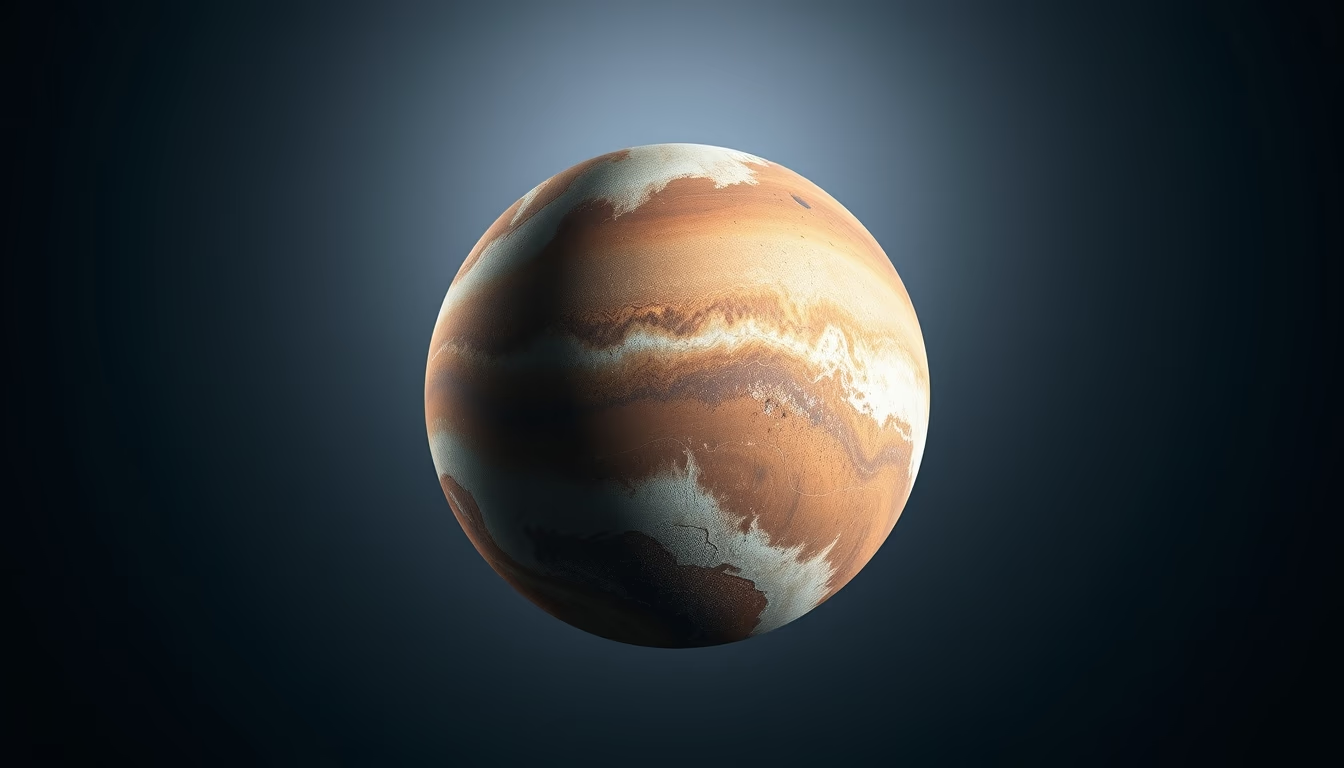
Rogue planet darkness
1344×768 · AVIF · CC BY 4.0

Rogue planets are celestial bodies that drift through interstellar space without orbiting any star, challenging traditional definitions of a planet.
About this subject
Rogue planets, also known as interstellar or orphan planets, are planetary-mass objects that are not gravitationally bound to any star. They drift freely through the galaxy, illuminated only by the faint light of distant stars. Estimates suggest billions of such solitary worlds exist in the Milky Way alone, potentially outnumbering stars. Their origins likely involve ejection from planetary systems during formation or due to gravitational interactions with other planets or stars.
Detecting these objects is extremely challenging because they emit no visible light and are small. Techniques like gravitational microlensing, which measures the bending of light from a background star caused by the rogue planet's gravity, have identified several candidates. The first confirmed rogue planet, PSO J318.5-22, was discovered in 2013 via its residual infrared glow from formation heat. It lies about 80 light-years away and has roughly eight times Jupiter's mass.
These worlds could host moons with subsurface oceans heated by tidal forces, raising astrobiological possibilities. However, without a parent star, surface life is unlikely due to extremely low temperatures. Studying rogue planets helps understand the dynamics of planetary systems and ejection rates, refining models of planet formation. NASA's Roman mission, scheduled for the mid-2020s, is expected to significantly increase detections using microlensing.
Frequently Asked Questions
How are rogue planets detected if they emit no light?
They are mainly detected by gravitational microlensing, which observes a temporary brightening of a background star as the planet's gravity bends its light. Some are also seen in infrared via residual heat from formation.
What is the difference between a rogue planet and a failed star (brown dwarf)?
The main difference is mass. Brown dwarfs have masses between 13 and 80 times Jupiter's and can fuse deuterium, while rogue planets are below that threshold and do not undergo nuclear fusion.
Can rogue planets harbor life?
Surface life is unlikely due to extreme cold. However, if they have moons with tidal heating, subsurface oceans could exist where microbial life might survive, similar to icy moons of Jupiter and Saturn.
Direct URL
https://pub-c7d6a6ea828543ac903a74a341ccb2e1.r2.dev/imagens/rogue-planet-darkness-film-grain-authentic-fresh6.avifHow to credit
Include a visible link back to UtilizAí. Copy one of the snippets below:
<a href="https://xn--utiliza-eza.com/en/midia/imagens/rogue-planet-darkness-film-grain-authentic-fresh6">Rogue planet darkness</a> by <a href="https://xn--utiliza-eza.com">UtilizAí</a>, licensed under <a href="https://creativecommons.org/licenses/by/4.0/">CC BY 4.0</a>.
[Rogue planet darkness](https://xn--utiliza-eza.com/en/midia/imagens/rogue-planet-darkness-film-grain-authentic-fresh6) by [UtilizAí](https://xn--utiliza-eza.com), CC BY 4.0
License: CC-BY-4.0