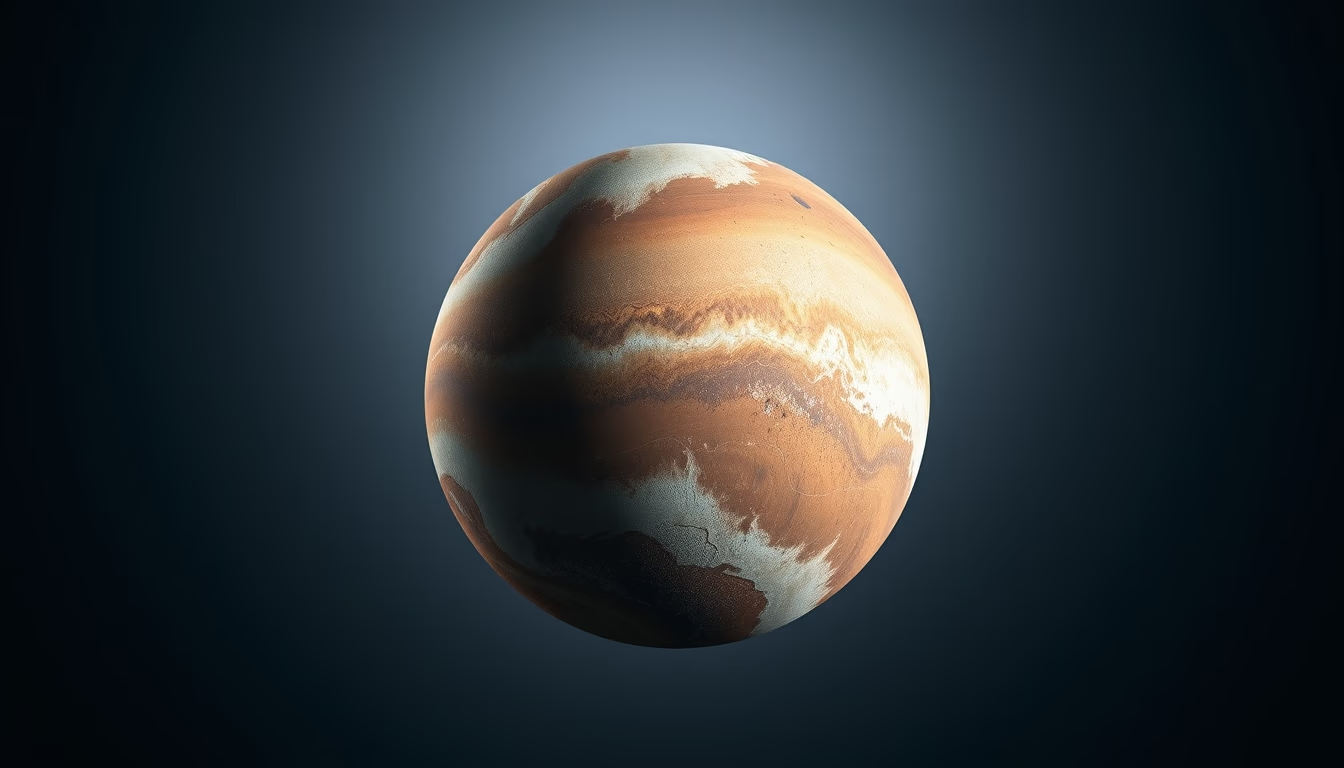
Kepler 186f earthlike concept
1344×768 · AVIF · CC BY 4.0

Kepler-186f was the first Earth-sized exoplanet discovered in the habitable zone of a red dwarf star, opening new frontiers in the search for potentially habitable worlds.
About this subject
Kepler-186f is an exoplanet discovered in 2014 by NASA's Kepler space telescope. It orbits the star Kepler-186, a red dwarf located approximately 490 light-years from Earth in the constellation Cygnus. With a radius about 1.1 times that of Earth, it is classified as a likely rocky planet, lying within the habitable zone of its system, where conditions could allow liquid water on the surface. Its orbital period is 130 days, and because the star is cooler and dimmer than the Sun, the planet receives only about one-third of the energy Earth receives, similar to what Mars receives in our solar system.
The significance of Kepler-186f lies in being the first Earth-sized exoplanet confirmed in a habitable zone. Although not the most Earth-like in terms of host star (others like the TRAPPIST-1 planets are closer), it marked a milestone in astrobiology. The discovery demonstrated that rocky planets can exist in the temperate regions of red dwarfs, the most common stars in the Milky Way, vastly expanding the number of potential candidates for the search of extraterrestrial life.
Curiously, the exact characteristics of Kepler-186f remain uncertain. Models suggest it could be either an ocean world or a desert, depending on water abundance and greenhouse effects. Its atmosphere, if any, is unknown, but the star's low luminosity implies that hypothetical photosynthesis would be very different, based on infrared light. The planet may also be tidally locked, with one side always facing the star, creating huge temperature contrasts. Future telescopes such as the James Webb Space Telescope may analyze its atmospheric composition and search for biosignatures.
Frequently Asked Questions
What is Kepler-186f?
Kepler-186f is a rocky exoplanet about the size of Earth that orbits a red dwarf star 490 light-years away. Discovered in 2014, it was the first Earth-sized planet confirmed in the habitable zone of its star.
Why is Kepler-186f important?
It proved that Earth-sized planets can exist in habitable zones around red dwarf stars, which are the most common in the galaxy. This dramatically increased the number of potential locations for the search for life beyond the solar system.
Is Kepler-186f habitable?
Habitability depends on unknown factors like atmosphere and composition. It lies in the habitable zone, but could be very different from Earth, perhaps with one side always hot and the other frozen, or with global oceans.
Direct URL
https://pub-c7d6a6ea828543ac903a74a341ccb2e1.r2.dev/imagens/kepler-186f-earthlike-concept-minimalist-composition-fresh4.avifHow to credit
Include a visible link back to UtilizAí. Copy one of the snippets below:
<a href="https://xn--utiliza-eza.com/en/midia/imagens/kepler-186f-earthlike-concept-minimalist-composition-fresh4">Kepler 186f earthlike concept</a> by <a href="https://xn--utiliza-eza.com">UtilizAí</a>, licensed under <a href="https://creativecommons.org/licenses/by/4.0/">CC BY 4.0</a>.
[Kepler 186f earthlike concept](https://xn--utiliza-eza.com/en/midia/imagens/kepler-186f-earthlike-concept-minimalist-composition-fresh4) by [UtilizAí](https://xn--utiliza-eza.com), CC BY 4.0
License: CC-BY-4.0