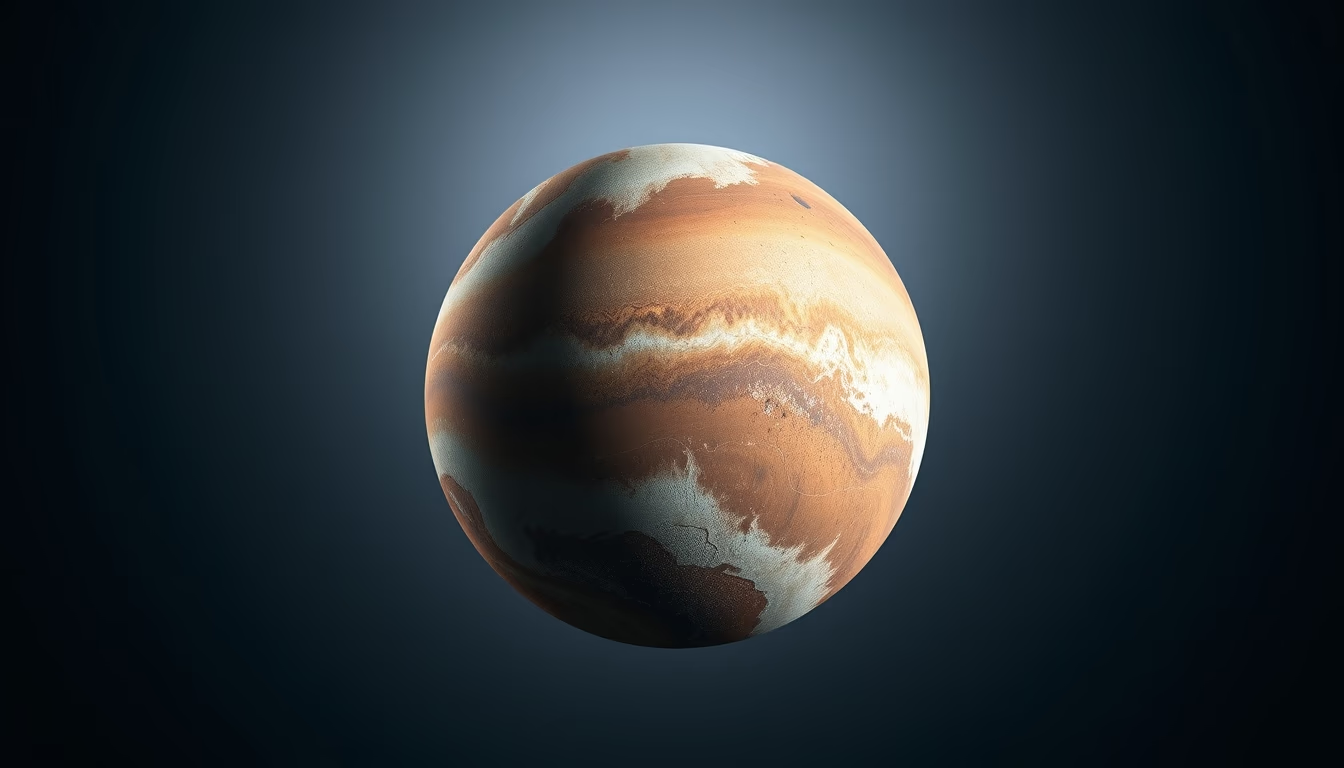
Kepler 186f earthlike concept
1344×768 · AVIF · CC BY 4.0

Kepler-186f was the first Earth-size planet found in the habitable zone of its star, a red dwarf 500 light-years away.
About this subject
Kepler-186f is an exoplanet located about 500 light-years from Earth in the constellation Cygnus. Discovered in 2014 by NASA's Kepler space telescope, it was the first Earth-size planet found orbiting within the habitable zone of its star, the red dwarf Kepler-186. The habitable zone, also known as the Goldilocks region, is the optimal distance where liquid water can exist on a planet's surface, a key condition for life as we know it.
The planet has a radius about 1.1 times that of Earth, making it a likely rocky world. However, its star, Kepler-186, is much cooler and dimmer than the Sun, with about half the mass and size. To reside in the habitable zone, Kepler-186f orbits its star at only 0.36 AU, or 36% of the Earth-Sun distance, completing a revolution every 130 days. Despite this proximity, the light it receives is similar to what Venus gets from the Sun, but with a redder spectrum, which affects photosynthesis and the color of any vegetation.
Interestingly, being so close to an active star, Kepler-186f may suffer from stellar flares and intense solar winds that can erode its atmosphere. It is unknown whether it has an atmosphere or protective magnetic fields. Modeling studies suggest that depending on atmospheric composition, the climate could range from temperate to a runaway greenhouse effect. The discovery of Kepler-186f paved the way for the search for even more Earth-like planets, such as those in the TRAPPIST-1 system, and reinforced the idea that small, rocky planets are common in the universe.
Since then, Kepler and other instruments have identified thousands of exoplanets, but Kepler-186f remains a milestone as the first Earth-sized world in a habitable zone. It represents an important step in astrobiology and the search for extraterrestrial life, even though we lack the technology to directly observe its surface. Future missions, like the James Webb Space Telescope, could study its atmosphere if it transits again, but no additional transits have been confirmed so far.
Frequently Asked Questions
Is Kepler-186f truly habitable?
It lies in the habitable zone of its star, meaning temperatures could allow liquid water. But actual habitability depends on atmospheric composition, magnetic field, and other factors, which are still unknown.
How far is Kepler-186f from Earth?
Kepler-186f is about 500 light-years away, in the constellation Cygnus. This distance makes it impossible to visit with current technology.
How was Kepler-186f discovered?
It was discovered by NASA's Kepler space telescope using the transit method, which detects tiny dips in the star's brightness when the planet passes in front of it.
Direct URL
https://pub-c7d6a6ea828543ac903a74a341ccb2e1.r2.dev/imagens/kepler-186f-earthlike-concept-isometric-flat-lay-fresh15.avifHow to credit
Include a visible link back to UtilizAí. Copy one of the snippets below:
<a href="https://xn--utiliza-eza.com/en/midia/imagens/kepler-186f-earthlike-concept-isometric-flat-lay-fresh15">Kepler 186f earthlike concept</a> by <a href="https://xn--utiliza-eza.com">UtilizAí</a>, licensed under <a href="https://creativecommons.org/licenses/by/4.0/">CC BY 4.0</a>.
[Kepler 186f earthlike concept](https://xn--utiliza-eza.com/en/midia/imagens/kepler-186f-earthlike-concept-isometric-flat-lay-fresh15) by [UtilizAí](https://xn--utiliza-eza.com), CC BY 4.0
License: CC-BY-4.0