Gas giant ringed exoplanet
1344×768 · AVIF · CC BY 4.0
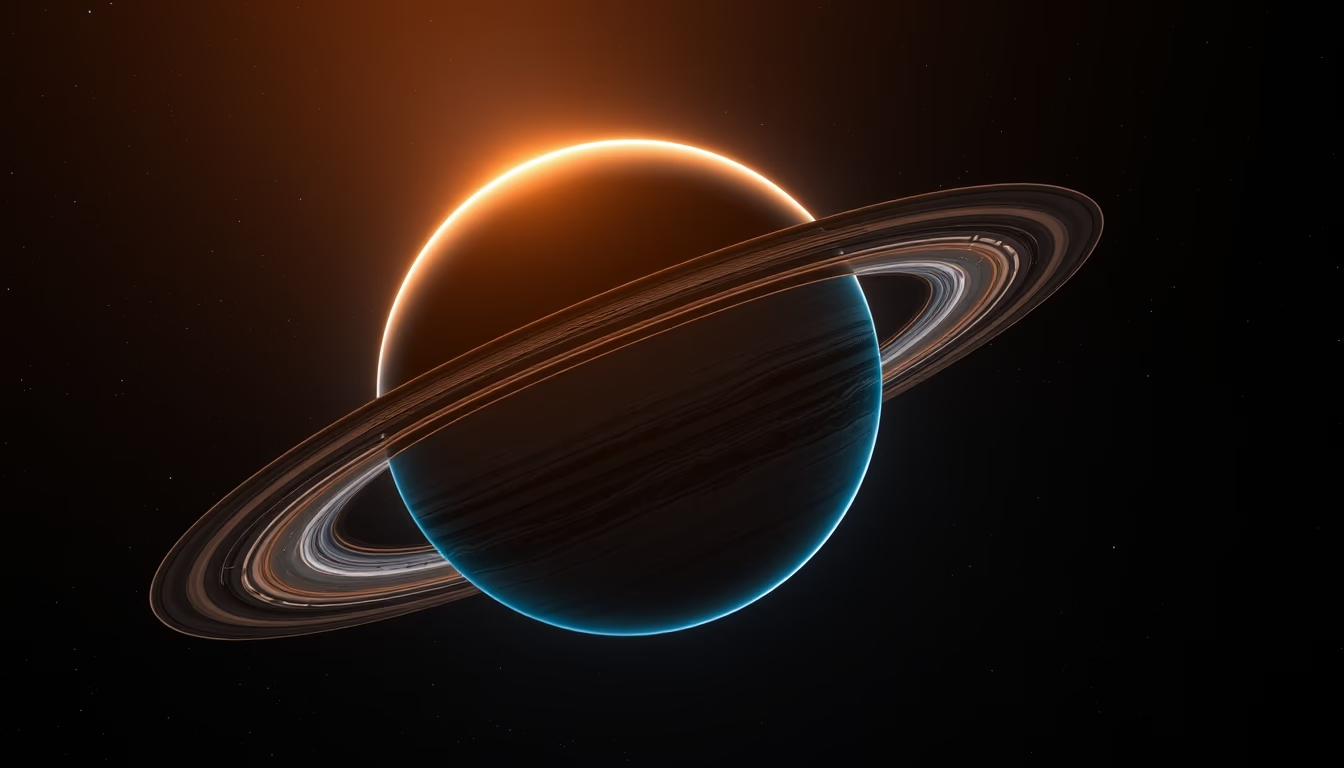
A gas giant with a ring system like Saturn's, but orbiting a distant star: this is the reality of ringed exoplanets, worlds that challenge our understanding of planetary formation.
About this subject
Exoplanet gas giants, composed mostly of hydrogen and helium, are common in the Milky Way. Some of them, such as J1407b, possess ring systems that far exceed Saturn's rings. Discovered in 2012, J1407b orbits a young star about 434 light-years away in the constellation Centaurus. Its rings extend approximately 0.6 astronomical units, about 90 million kilometers, which is 200 times the diameter of Saturn's rings. This ring system is so vast that if placed around Saturn, it would dominate Earth's night sky.
Detection of rings around exoplanets is mainly done through light curve analysis during planetary transits. When a planet passes in front of its star, the decrease in stellar brightness can show irregular patterns or asymmetries indicating the presence of rings. For J1407b, the rings cause complex and repetitive eclipses lasting up to 56 days. The composition of exoplanetary rings is varied: they may contain dust, ice, debris from moons, or material left over from system formation. The structure and evolution of these rings provide clues about the planet's dynamical history and the possible existence of exomoons.
Beyond J1407b, other candidate ringed exoplanets have been identified, such as HIP 41378 f, whose light variations suggest rings or a dust cloud. Studying these systems is important because it helps understand accretion and planetary formation processes. Comparisons with Saturn reveal fundamental differences: rings around young exoplanets like J1407b may be remnants of the protoplanetary nebula, while Saturn's rings are relatively young. Space telescopes like the James Webb promise to observe these rings at higher resolution, enabling measurements of their composition and temperature. To date, over 5,500 exoplanets have been confirmed, but only a handful show solid evidence of ring systems, making each discovery a rare and valuable event for astronomy.
Frequently Asked Questions
What is a ringed gas giant?
It is an exoplanet composed mainly of hydrogen and helium, surrounded by a ring system similar to Saturn's, but often on much larger scales. The most notable example is J1407b.
How are exoplanet rings detected?
Through light curve analysis during planetary transits: irregularities in stellar brightness reveal the presence of rings. Time-series observations and spectroscopy also help confirm the ring structure.
What are known examples of ringed exoplanets?
The most famous is J1407b, with enormous rings. Other candidates include HIP 41378 f and 1SWASP J1407 b (confirmed). They remain rare, with fewer than ten well-documented cases.
Direct URL
https://pub-c7d6a6ea828543ac903a74a341ccb2e1.r2.dev/imagens/gas-giant-ringed-exoplanet-fine-art-photography-fresh2.avifHow to credit
Include a visible link back to UtilizAí. Copy one of the snippets below:
<a href="https://xn--utiliza-eza.com/en/midia/imagens/gas-giant-ringed-exoplanet-fine-art-photography-fresh2">Gas giant ringed exoplanet</a> by <a href="https://xn--utiliza-eza.com">UtilizAí</a>, licensed under <a href="https://creativecommons.org/licenses/by/4.0/">CC BY 4.0</a>.
[Gas giant ringed exoplanet](https://xn--utiliza-eza.com/en/midia/imagens/gas-giant-ringed-exoplanet-fine-art-photography-fresh2) by [UtilizAí](https://xn--utiliza-eza.com), CC BY 4.0
License: CC-BY-4.0