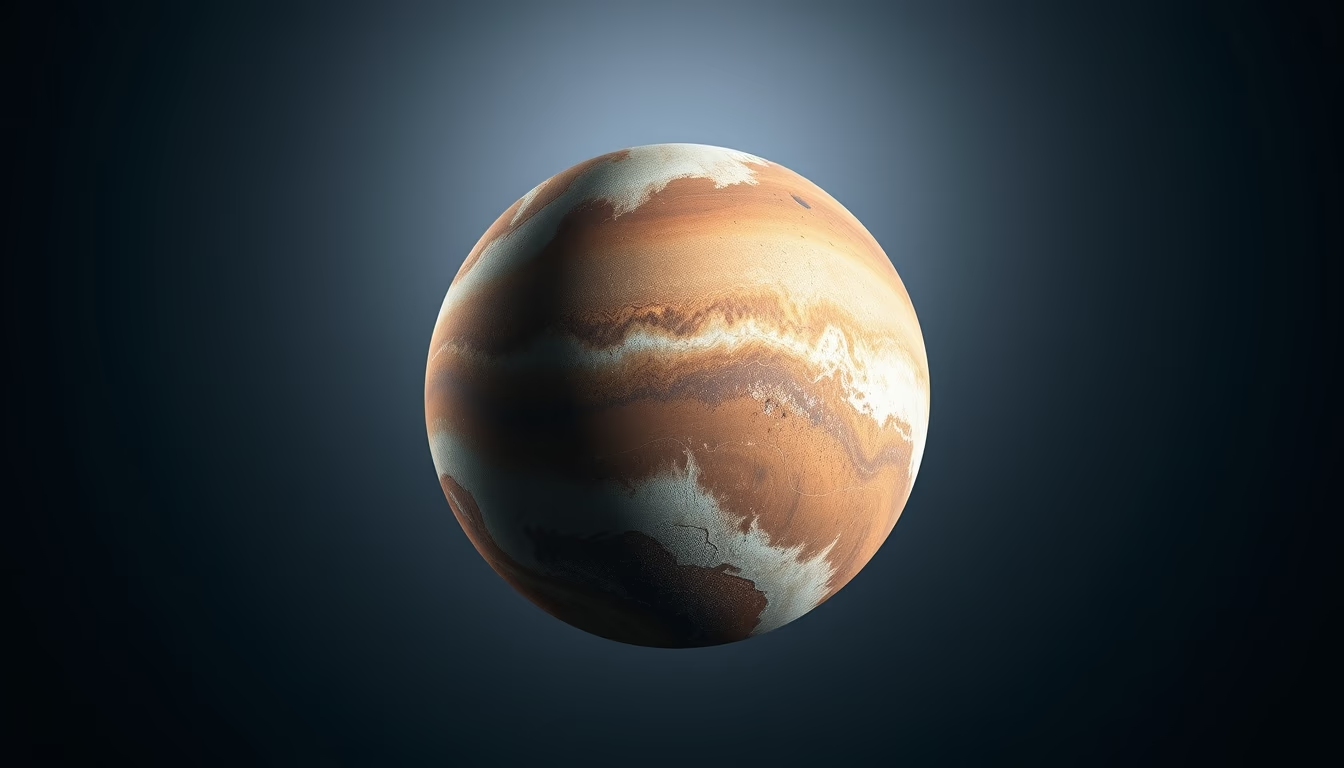
Trappist-1 system art
1344×768 · AVIF · CC BY 4.0

Discovered in 2016, the Trappist-1 system hosts seven Earth-sized rocky planets orbiting an ultracool dwarf star.
About this subject
The Trappist-1 system is located approximately 40 light-years from Earth in the constellation Aquarius. Its central star is an ultracool dwarf of spectral type M8V, with a surface temperature of about 2,550 Kelvin and a mass only 8% that of the Sun. Discovered by the TRAPPIST telescope (Transiting Planets and Planetesimals Small Telescope) at the La Silla Observatory in Chile, the system gained prominence for hosting the largest number of Earth-sized rocky planets in a habitable zone found outside our solar system.
The seven planets, designated Trappist-1b through Trappist-1h, have sizes and masses similar to Earth. Their orbital periods range from 1.5 to 20 Earth days, meaning they orbit extremely close to their star. However, because the star is very dim, the habitable zone is also very close, and at least three of the planets (e, f, and g) lie within this zone where temperatures could allow liquid water on the surface.
One of the most exciting aspects of Trappist-1 is the potential for detailed atmospheric studies with telescopes like the James Webb Space Telescope (JWST). Due to the relatively large size of the planets compared to the star, it is possible to detect the composition of their atmospheres through transmission spectroscopy. This analysis can reveal gases such as oxygen, methane, and carbon dioxide, which are potential biosignatures.
The system is a top priority in the search for extraterrestrial life. Its compact arrangement and the nature of the ultracool dwarf star lead to planetary evolution scenarios different from our own solar system. For instance, the planets are likely tidally locked, with one side always facing the star, creating extreme temperature contrasts. Nonetheless, the possibility of stable oceans and atmospheres on these worlds keeps the scientific community eager for the next observational data to confirm whether Trappist-1 could truly be a home for life.
Frequently Asked Questions
How many planets are in the Trappist-1 system?
The Trappist-1 system has seven rocky planets, designated Trappist-1b through Trappist-1h.
How far is the Trappist-1 system from Earth?
The Trappist-1 system is about 40 light-years away from Earth, located in the constellation Aquarius.
Could there be life on Trappist-1's planets?
It is possible. Three of the planets (e, f, and g) lie in the habitable zone where temperatures allow liquid water, a key ingredient for life as we know it.
Direct URL
https://pub-c7d6a6ea828543ac903a74a341ccb2e1.r2.dev/imagens/trappist-1-system-art-tilt-shift-miniature-fresh16.avifHow to credit
Include a visible link back to UtilizAí. Copy one of the snippets below:
<a href="https://xn--utiliza-eza.com/en/midia/imagens/trappist-1-system-art-tilt-shift-miniature-fresh16">Trappist-1 system art</a> by <a href="https://xn--utiliza-eza.com">UtilizAí</a>, licensed under <a href="https://creativecommons.org/licenses/by/4.0/">CC BY 4.0</a>.
[Trappist-1 system art](https://xn--utiliza-eza.com/en/midia/imagens/trappist-1-system-art-tilt-shift-miniature-fresh16) by [UtilizAí](https://xn--utiliza-eza.com), CC BY 4.0
License: CC-BY-4.0