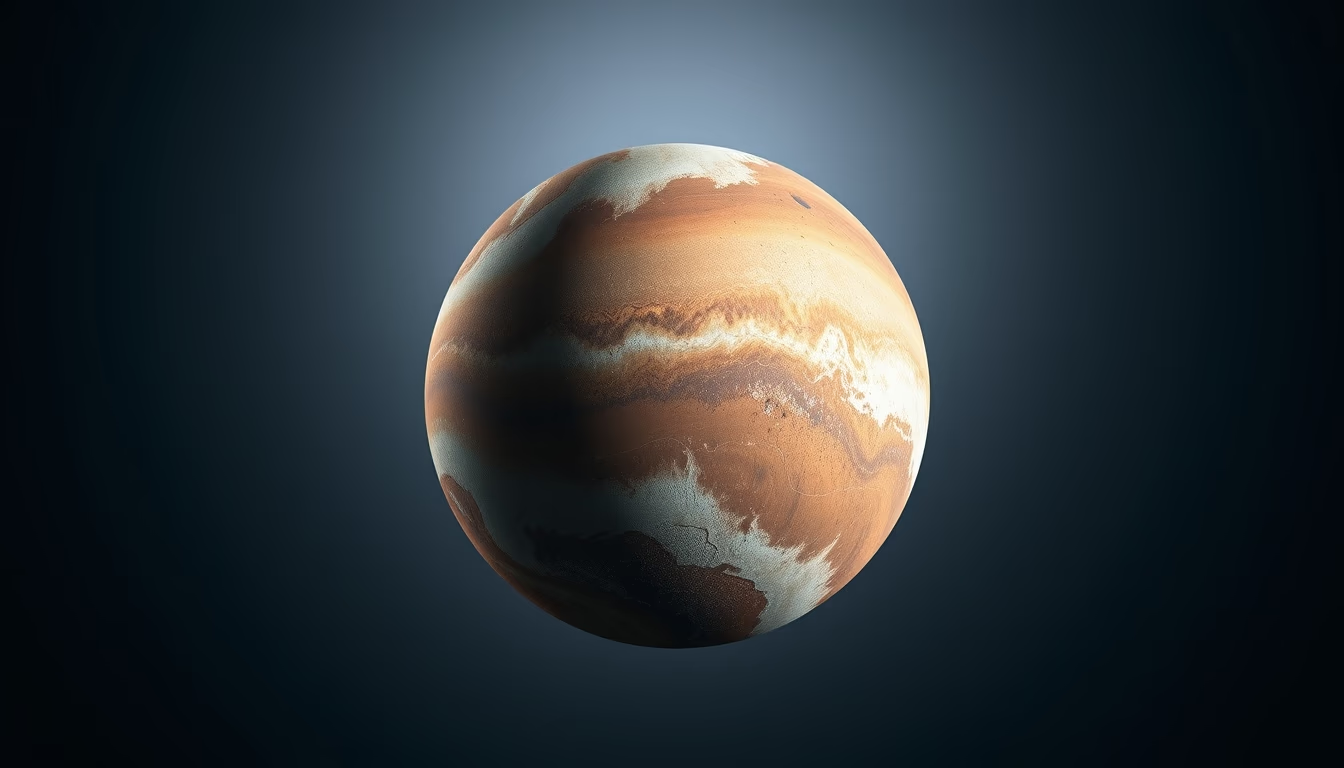
Trappist-1 system art
1344×768 · AVIF · CC BY 4.0

The TRAPPIST-1 system, discovered in 2016, hosts seven Earth-sized rocky planets in the habitable zone of an ultracool dwarf star 40 light-years away.
About this subject
The TRAPPIST-1 system consists of an ultracool dwarf star located in the constellation Aquarius, approximately 40 light-years from Earth. It was discovered by the TRAPPIST telescope (Transiting Planets and Planetesimals Small Telescope) in 2016 and has since become one of the most studied planetary systems outside the Solar System. The star, with only 8% of the Sun's mass, hosts seven Earth-sized rocky planets, three of which (TRAPPIST-1e, 1f, and 1g) orbit within the habitable zone, where temperatures allow liquid water to exist on the surface.
The planets are extraordinarily close to each other, much closer than the planets in our Solar System. For instance, all seven would fit within Mercury's orbit. This compactness causes strong gravitational interactions, leading to transits and eclipses that enable detailed atmospheric studies. The James Webb Space Telescope has already observed the system and detected hints of atmospheres on some planets, such as carbon dioxide, although definitive biosignatures have not yet been confirmed.
The system's significance for astrobiology is immense. As a multi-planet system with potentially habitable worlds relatively close to Earth, it is a prime target for the search for biosignatures on exoplanets. Moreover, its discovery boosted the study of ultracool dwarfs as planet hosts, as they were previously thought less likely to form planets. Interestingly, the name TRAPPIST refers to the Belgian Trappist beer, a playful nod by the astronomers who discovered the first planets.
The system was detected via the transit method, where small dips in the star's brightness indicate planet passages. Subsequent observations with telescopes like Spitzer and Hubble refined the planets' masses and densities, revealing they are rocky, though some may contain large amounts of water. TRAPPIST-1 remains under continuous monitoring, and new James Webb observations promise unparalleled insights into atmospheric composition and the potential for life.
Frequently Asked Questions
How many planets are in the TRAPPIST-1 system?
The TRAPPIST-1 system has seven rocky planets, all similar in size to Earth, orbiting an ultracool dwarf star.
How far is the TRAPPIST-1 system from Earth?
The system is about 40 light-years away, in the constellation Aquarius.
Why is the TRAPPIST-1 system important for the search for extraterrestrial life?
Because it contains three planets in the habitable zone, where liquid water could exist, and is relatively close, allowing detailed atmospheric studies with telescopes like the James Webb Space Telescope.
Direct URL
https://pub-c7d6a6ea828543ac903a74a341ccb2e1.r2.dev/imagens/trappist-1-system-art-documentary-nature-style-fresh7.avifHow to credit
Include a visible link back to UtilizAí. Copy one of the snippets below:
<a href="https://xn--utiliza-eza.com/en/midia/imagens/trappist-1-system-art-documentary-nature-style-fresh7">Trappist-1 system art</a> by <a href="https://xn--utiliza-eza.com">UtilizAí</a>, licensed under <a href="https://creativecommons.org/licenses/by/4.0/">CC BY 4.0</a>.
[Trappist-1 system art](https://xn--utiliza-eza.com/en/midia/imagens/trappist-1-system-art-documentary-nature-style-fresh7) by [UtilizAí](https://xn--utiliza-eza.com), CC BY 4.0
License: CC-BY-4.0