Trappist-1 system art
1344×768 · AVIF · CC BY 4.0

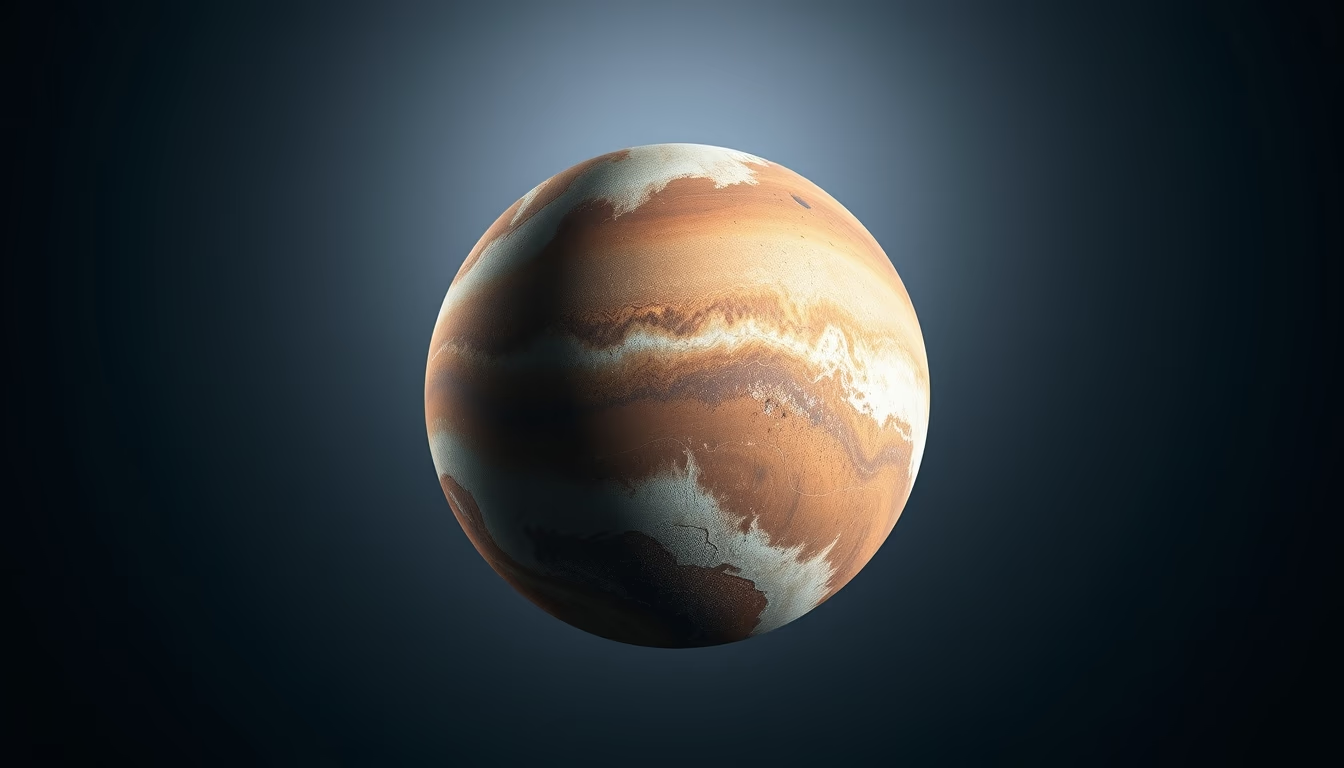
The TRAPPIST-1 system, an ultracool red dwarf 40 light-years away, hosts seven Earth-sized rocky planets, three in the habitable zone.
About this subject
The TRAPPIST-1 system stands as one of modern astronomy's most remarkable finds. Located in the constellation Aquarius about 40 light-years away, it consists of an ultracool red dwarf star (spectral type M8V) with only 8% the Sun's mass. In 2016, the TRAPPIST telescope (Transiting Planets and Planetesimals Small Telescope) in Chile detected the first three planets; subsequent observations with the Spitzer Space Telescope raised the total to seven, all comparable in size and mass to Earth.
The planets orbit extremely close to the star, the innermost completes a lap every 1.5 Earth days. Yet because TRAPPIST-1 is so cool (about 2,500 K), the outermost worlds receive stellar radiation similar to Earth's solar flux. Three of them (TRAPPIST-1e, f, and g) lie within the habitable zone, where liquid water could exist on the surface. Density studies suggest some planets are predominantly rocky, while others may contain up to 5% water by mass, far more than Earth.
The system's significance goes beyond its record number of planets. Being relatively near and with frequent transits, TRAPPIST-1 is an ideal laboratory for studying exoplanet atmospheres with telescopes like the James Webb Space Telescope. Since 2017, JWST has already detected signatures of carbon dioxide and methane on TRAPPIST-1e, hinting at a potentially thick atmosphere. However, stellar activity (flares and winds) may pose challenges to habitability. The discovery has inspired countless artistic renderings that help the public visualize alien planetary systems and fuel the search for life beyond our Solar System.
Frequently Asked Questions
How many planets does the TRAPPIST-1 system have?
The system has seven confirmed planets, all Earth-sized. They are designated TRAPPIST-1b through h, in order of increasing distance from the star.
Could any TRAPPIST-1 planet be habitable?
Three planets (e, f, g) lie in the habitable zone where liquid water could exist. However, strong stellar activity and possible thick atmospheres remain unknowns.
How was the TRAPPIST-1 system discovered?
It was detected via the transit method using the TRAPPIST telescope in Chile, which observed tiny dips in the star's brightness as planets crossed in front of it.
Direct URL
https://pub-c7d6a6ea828543ac903a74a341ccb2e1.r2.dev/imagens/trappist-1-system-art-architectural-photography-fresh9.avifHow to credit
Include a visible link back to UtilizAí. Copy one of the snippets below:
<a href="https://xn--utiliza-eza.com/en/midia/imagens/trappist-1-system-art-architectural-photography-fresh9">Trappist-1 system art</a> by <a href="https://xn--utiliza-eza.com">UtilizAí</a>, licensed under <a href="https://creativecommons.org/licenses/by/4.0/">CC BY 4.0</a>.
[Trappist-1 system art](https://xn--utiliza-eza.com/en/midia/imagens/trappist-1-system-art-architectural-photography-fresh9) by [UtilizAí](https://xn--utiliza-eza.com), CC BY 4.0
License: CC-BY-4.0