Tidal locked planet
1344×768 · AVIF · CC BY 4.0

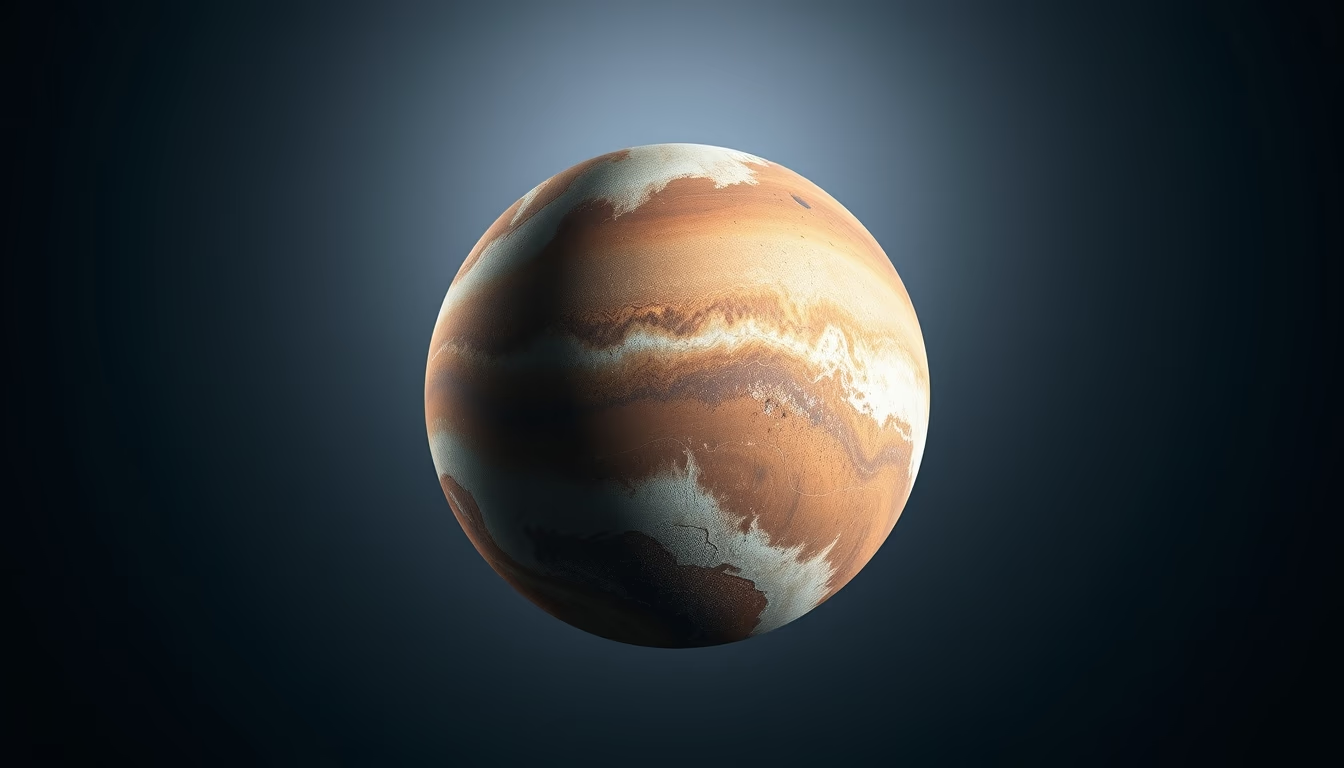
Tidally locked planets have one side permanently facing their star and the other in eternal darkness, a common phenomenon among close-in exoplanets.
About this subject
Tidal locking is a gravitational phenomenon that occurs when a celestial body's rotation synchronizes with its orbit around another, causing the same hemisphere to always face the central object. The most familiar example is the Moon, which always shows the same face to Earth. In exoplanetary systems, tidal locking is especially common for planets orbiting very close to red dwarf stars (M-type), where tidal forces are strong. Under these conditions, the planet's rotation period matches its orbital period, creating a permanent dayside and a perpetual nightside.
The habitable zone around red dwarfs often coincides with the region where tidal locking is expected. This presents unique challenges for the possibility of life. On the dayside, temperatures can be extremely high, evaporating entire oceans, while on the nightside, extreme cold freezes any atmosphere. The terminator line, the narrow ring between the two hemispheres where twilight is permanent, is considered the most promising region for moderate conditions. Climate models suggest that, if a thick atmosphere exists, winds can transport heat from the dayside to the nightside, smoothing out temperature differences.
Exoplanets such as Proxima Centauri b, TRAPPIST-1e, and the planets of the Gliese 581 system are strong candidates for being tidally locked. Studying these worlds is crucial for understanding the diversity of planetary environments. Future observations with telescopes like the James Webb Space Telescope could analyze atmospheric composition and search for biosignatures in the terminator zone. Culturally, these planets are often depicted in science fiction as "eyeball planets," with a bright spot at the center of the dayside. The dramatic lighting, with long shadows and intense contrasts, inspired the term "Rembrandt lighting" in artistic depictions of these celestial bodies.
Interestingly, tidal locking is not permanent. Changes in orbit or rotation can break the synchrony over billions of years. Additionally, some planets may be in spin-orbit resonances, like Mercury, which completes three rotations for every two orbits, an intermediate state. Studying these phenomena helps refine models of planetary evolution and understand the role of tides in the formation of solar systems.
Frequently Asked Questions
What is a tidally locked planet?
A tidally locked planet has its rotation period equal to its orbital period, causing one side to permanently face its star (dayside) and the other side to be in perpetual darkness (nightside).
Which known exoplanets are tidally locked?
Exoplanets such as Proxima Centauri b, TRAPPIST-1e, and the planets of the Gliese 581 system are strong candidates for tidal locking due to their close orbits around red dwarf stars.
Could life exist on a tidally locked planet?
Yes, but only in the terminator zone, the region between the dayside and nightside where temperatures may be moderate. A thick atmosphere could distribute heat and make habitability more feasible.
Direct URL
https://pub-c7d6a6ea828543ac903a74a341ccb2e1.r2.dev/imagens/tidal-locked-planet-rembrandt-lighting-dramatic-shadows-fresh14.avifHow to credit
Include a visible link back to UtilizAí. Copy one of the snippets below:
<a href="https://xn--utiliza-eza.com/en/midia/imagens/tidal-locked-planet-rembrandt-lighting-dramatic-shadows-fresh14">Tidal locked planet</a> by <a href="https://xn--utiliza-eza.com">UtilizAí</a>, licensed under <a href="https://creativecommons.org/licenses/by/4.0/">CC BY 4.0</a>.
[Tidal locked planet](https://xn--utiliza-eza.com/en/midia/imagens/tidal-locked-planet-rembrandt-lighting-dramatic-shadows-fresh14) by [UtilizAí](https://xn--utiliza-eza.com), CC BY 4.0
License: CC-BY-4.0