Tidal locked planet
1344×768 · AVIF · CC BY 4.0

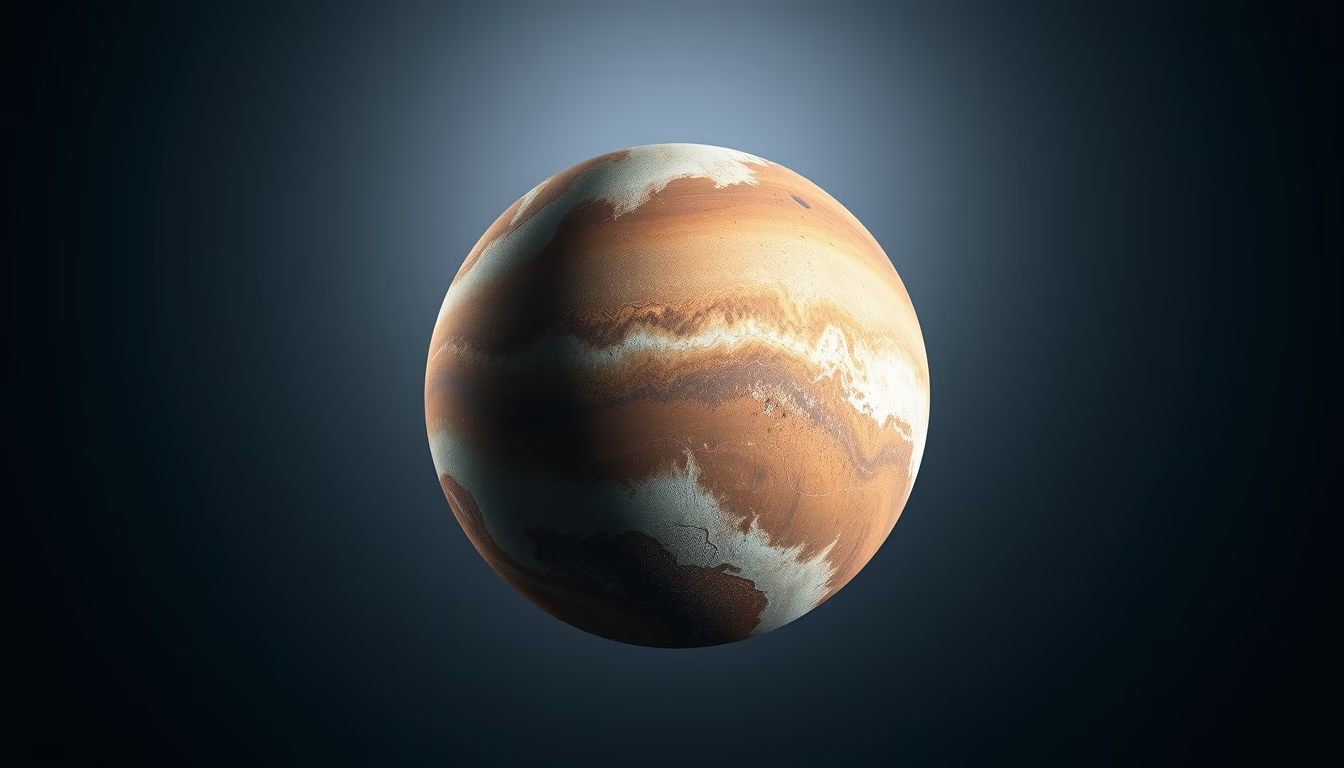
Tidally locked planets always show the same face to their star, creating extreme thermal contrasts between the day and night sides.
About this subject
Tidally locked planets are celestial bodies whose rotation period exactly matches their orbital period around the host star. This phenomenon occurs due to gravitational forces acting on the planet over billions of years, eventually synchronizing its rotation with its orbit. As a result, one hemisphere permanently faces the star (dayside), while the other hemisphere is in eternal darkness (nightside). This imbalance creates extreme temperatures: the dayside can reach hundreds of degrees Celsius, while the nightside can drop near absolute zero.
Among the exoplanets likely to be tidally locked are rocky worlds in the habitable zone of red dwarf stars, such as the planets of the TRAPPIST-1 system and Proxima Centauri b. These planets orbit very close to their stars, where tidal forces are strongest. The concept of the habitable zone becomes complex in such cases: mild temperatures may exist only in a narrow band between the two hemispheres, called the terminator or twilight zone. In this region, liquid water and potentially life could exist, provided the atmosphere can efficiently redistribute heat.
Recent observations with telescopes like the James Webb Space Telescope (JWST) have begun studying the atmospheres of potentially tidally locked exoplanets. Three-dimensional climate models suggest that, depending on atmospheric composition and pressure, heat can be transported to the nightside, mitigating extreme differences. Additionally, the possibility of global oceans or permanent glaciations directly influences the planet's reflectivity and its ability to regulate temperature. The study of these extreme worlds helps understand the limits of habitability and the diversity of planetary environments in the universe.
Frequently Asked Questions
What causes tidal locking on a planet?
Tidal locking is caused by differential gravitational forces from the star on the planet. The gravity gradient slows the planet's rotation until one hemisphere permanently faces the star, a process similar to the Moon's relation to Earth.
Can life exist on a tidally locked planet?
Yes, it is possible, especially along the terminator zone where temperatures may be mild. A thick atmosphere can redistribute heat and provide protection against radiation, creating conditions for liquid water and potentially life. However, habitability depends on many still poorly understood factors.
What are known examples of tidally locked planets?
Likely examples include the planets of the TRAPPIST-1 system (TRAPPIST-1b, c, d, e, f, g, h) and Proxima Centauri b, all orbiting red dwarfs. Additionally, many exoplanets discovered by the Kepler telescope, such as Kepler-186f, may also be tidally locked.
Direct URL
https://pub-c7d6a6ea828543ac903a74a341ccb2e1.r2.dev/imagens/tidal-locked-planet-film-grain-authentic-fresh7.avifHow to credit
Include a visible link back to UtilizAí. Copy one of the snippets below:
<a href="https://xn--utiliza-eza.com/en/midia/imagens/tidal-locked-planet-film-grain-authentic-fresh7">Tidal locked planet</a> by <a href="https://xn--utiliza-eza.com">UtilizAí</a>, licensed under <a href="https://creativecommons.org/licenses/by/4.0/">CC BY 4.0</a>.
[Tidal locked planet](https://xn--utiliza-eza.com/en/midia/imagens/tidal-locked-planet-film-grain-authentic-fresh7) by [UtilizAí](https://xn--utiliza-eza.com), CC BY 4.0
License: CC-BY-4.0