Rogue planet darkness
1344×768 · AVIF · CC BY 4.0
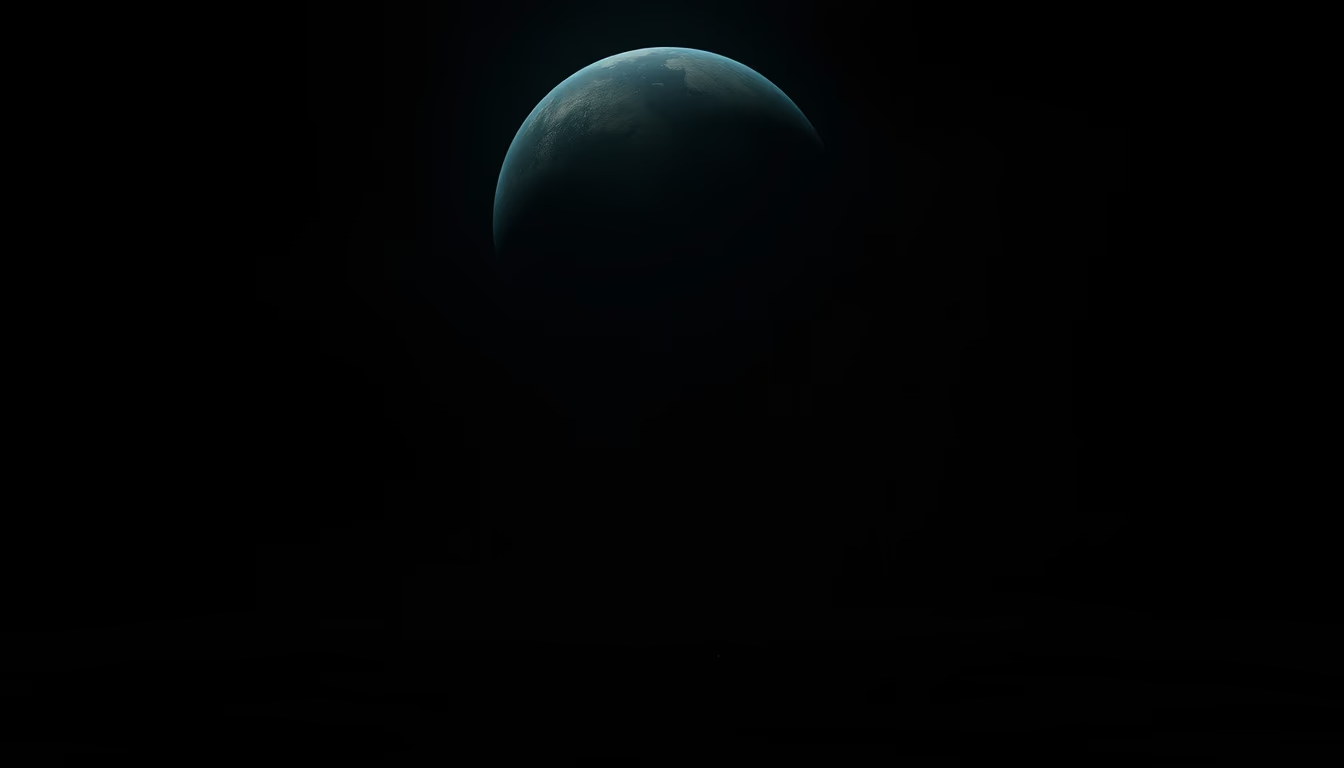
Rogue planets, also known as free-floating planets, are solitary worlds adrift in interstellar space, shrouded in everlasting darkness.
About this subject
Rogue planets are celestial bodies of planetary mass that are not gravitationally bound to any star. They may have been ejected from their original systems during planetary formation or may have formed independently, through the direct collapse of gas and dust clouds, much like miniature brown dwarfs. The Milky Way is estimated to contain billions of these worlds, possibly outnumbering stars. Their existence has been confirmed in recent decades through indirect detection techniques, primarily gravitational microlensing, which observes the bending of light from distant stars caused by the planet's gravity.
The first confirmed discovery of a rogue planet occurred in 2011, but major advances came from surveys like the OGLE (Optical Gravitational Lensing Experiment) and the Kepler space telescope. In 2020, astronomers announced the detection of a Mars-sized planet, the smallest ever found, traveling freely through the galaxy. These planets are extremely cold, with surface temperatures near absolute zero, and receive no starlight, rendering them virtually invisible at optical wavelengths. However, they emit faint infrared radiation due to residual heat from their formation, allowing detection by sensitive telescopes.
Studying rogue planets is crucial for understanding the dynamics of planetary systems and how often planets are ejected. They also raise astrobiological questions: even without starlight, could they harbor life in subsurface oceans heated by geothermal sources? The possibility is remote but not ruled out. Future research, using the James Webb Space Telescope and the Vera Rubin Observatory, promises to significantly increase the number of known rogue planets, helping to map this invisible population roaming the depths of interstellar space.
Frequently Asked Questions
How are rogue planets detected if they do not emit light?
They are primarily detected through gravitational microlensing, which observes the temporary brightening of a distant star caused by the planet's gravitational field. They are also detected through faint infrared emission, visible with sensitive space telescopes.
Could rogue planets support life?
Theoretically, yes, if they possess subsurface oceans heated by geothermal activity or radioactivity, similar to Europa or Enceladus. However, the lack of light and extremely low temperatures make surface life unlikely.
How many rogue planets exist in the Milky Way?
Estimates suggest there could be billions of rogue planets in the Milky Way, possibly outnumbering stars. Recent studies indicate there may be roughly one rogue planet for every star in the galaxy.
Direct URL
https://pub-c7d6a6ea828543ac903a74a341ccb2e1.r2.dev/imagens/rogue-planet-darkness-rembrandt-lighting-dramatic-shadows-fresh13.avifHow to credit
Include a visible link back to UtilizAí. Copy one of the snippets below:
<a href="https://xn--utiliza-eza.com/en/midia/imagens/rogue-planet-darkness-rembrandt-lighting-dramatic-shadows-fresh13">Rogue planet darkness</a> by <a href="https://xn--utiliza-eza.com">UtilizAí</a>, licensed under <a href="https://creativecommons.org/licenses/by/4.0/">CC BY 4.0</a>.
[Rogue planet darkness](https://xn--utiliza-eza.com/en/midia/imagens/rogue-planet-darkness-rembrandt-lighting-dramatic-shadows-fresh13) by [UtilizAí](https://xn--utiliza-eza.com), CC BY 4.0
License: CC-BY-4.0