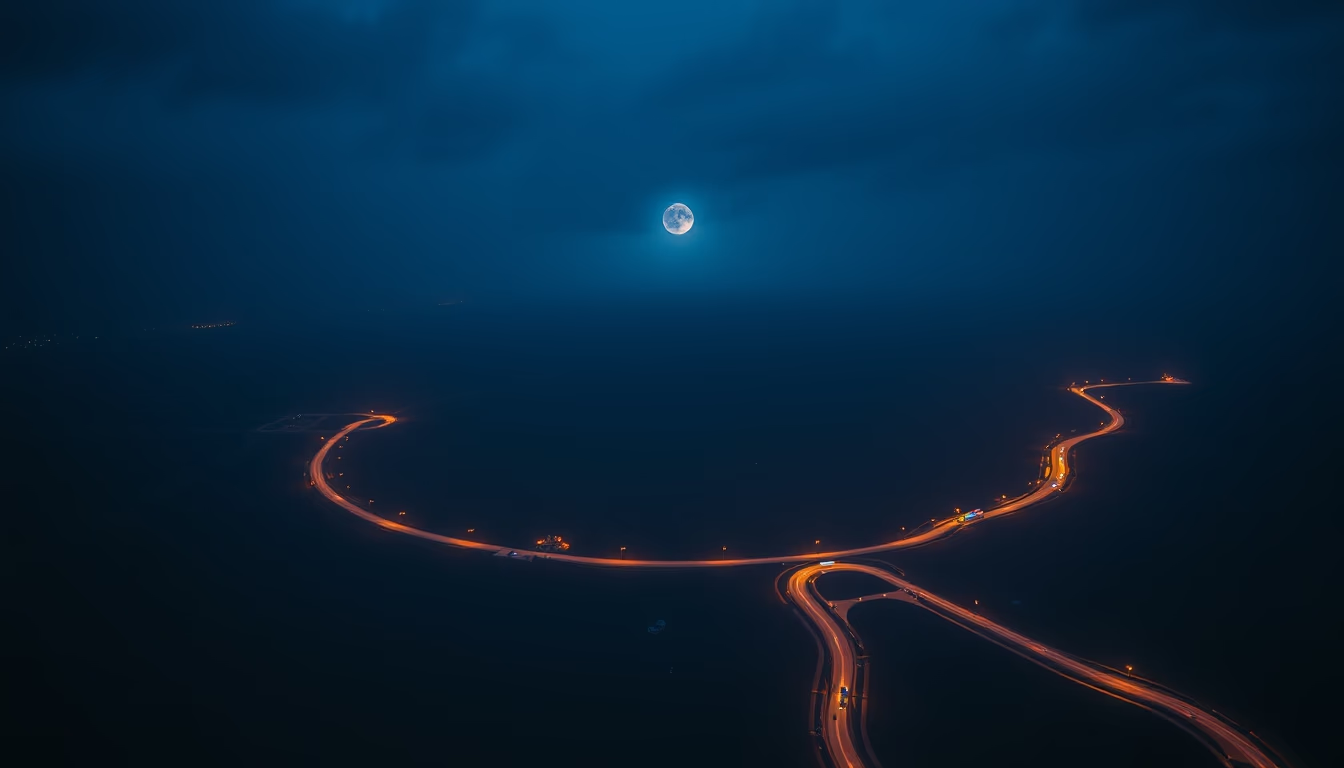
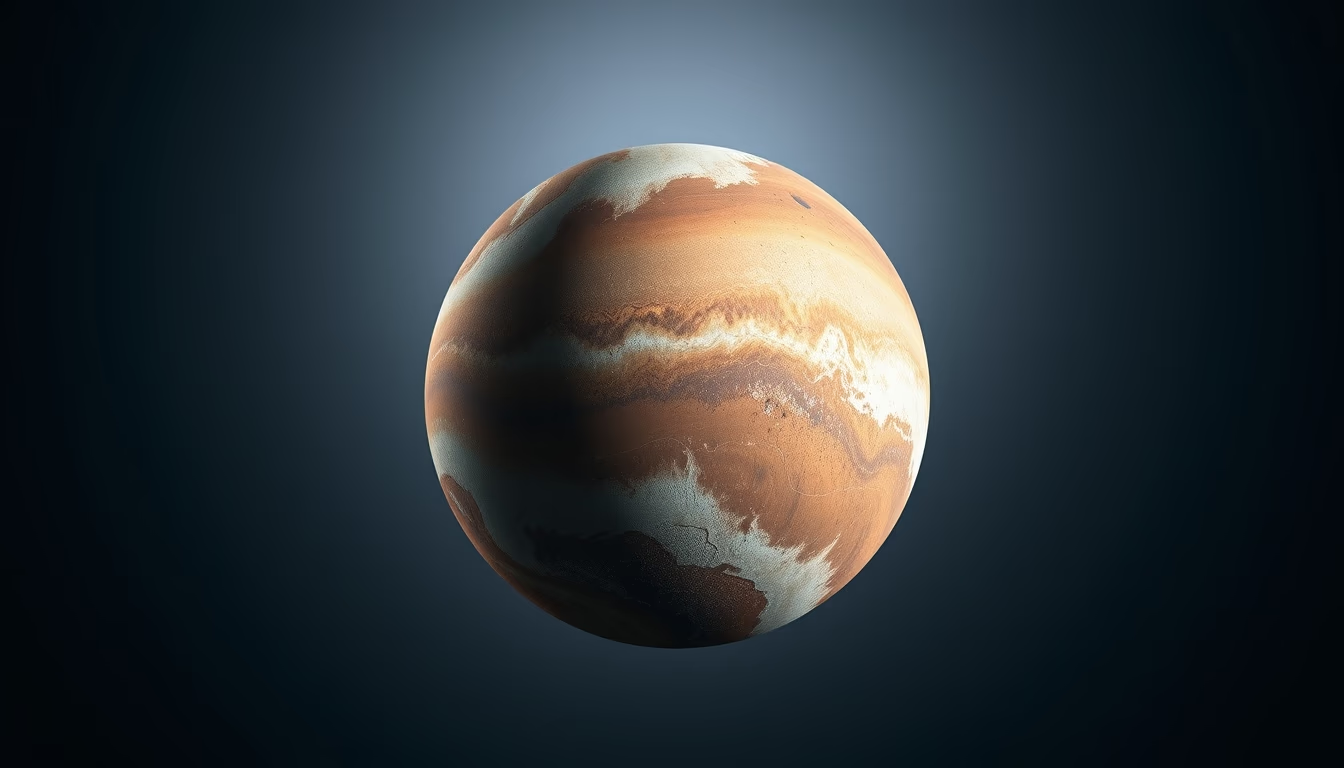
Rogue planet darkness
1344×768 · AVIF · CC BY 4.0

Rogue planets, also known as free-floating planets, are lonely worlds drifting through interstellar space without a parent star, challenging traditional definitions of planetary systems.
About this subject
Rogue planets, also called interstellar or free-floating planets, are celestial bodies of planetary mass that are not gravitationally bound to any star. They drift freely through the galaxy, in the darkness of interstellar space. Unlike regular planets that orbit stars and receive stellar light and heat, these solitary worlds emit only a faint infrared glow residual from their formation or, in rare cases, from internal geothermal processes. The existence of such objects was theoretically predicted decades ago, but only in the last two decades have confirmed observations been made, thanks to techniques like gravitational microlensing and deep infrared surveys conducted by telescopes such as Hubble and Spitzer.
The origin of rogue planets is varied. Many likely formed in protoplanetary disks around young stars but were ejected due to gravitational interactions with larger planets or with the star itself. Simulations suggest that unstable planetary systems can expel one or more of their members over millions of years. Another hypothesis is that some rogues form directly from the collapse of interstellar gas clouds, analogous to star formation but on a much smaller scale, resulting in objects with masses between a few and a few tens of Jupiter masses, so-called sub-brown dwarfs.
It is estimated that the Milky Way may contain billions of rogue planets, possibly outnumbering stars. Recent studies suggest that for every star, there could be up to two interstellar planets. These dark worlds have extremely low surface temperatures, in the range of a few kelvins, making their direct detection highly challenging. However, the possibility that some might retain enough internal heat to sustain subsurface liquid oceans, warmed by tidal processes or radioactive decay, raises intriguing questions about habitability in environments without starlight. NASA's Roman mission, scheduled for the mid-2020s, is expected to revolutionize the census of rogue planets using gravitational microlensing.
Frequently Asked Questions
How are rogue planets detected if they don't emit visible light?
They are mainly detected via gravitational microlensing, where the planet's gravity magnifies the light of a distant star as it passes in front. They are also observed in infrared, as they emit residual heat from their formation.
What is the difference between a rogue planet and a brown dwarf?
Brown dwarfs have masses between 13 and 80 Jupiter masses and can briefly fuse deuterium, while rogue planets have masses below this threshold (typically up to 13 Jupiter masses) and do not undergo nuclear fusion.
Is there a possibility of life on a rogue planet?
Yes, theoretically. If the planet has sufficient internal heat (e.g., from radioactive decay or tidal effects), subsurface oceans could remain liquid, allowing chemosynthetic life forms similar to those found at hydrothermal vents on Earth.
Direct URL
https://pub-c7d6a6ea828543ac903a74a341ccb2e1.r2.dev/imagens/rogue-planet-darkness-high-fashion-editorial-fresh4.avifHow to credit
Include a visible link back to UtilizAí. Copy one of the snippets below:
<a href="https://xn--utiliza-eza.com/en/midia/imagens/rogue-planet-darkness-high-fashion-editorial-fresh4">Rogue planet darkness</a> by <a href="https://xn--utiliza-eza.com">UtilizAí</a>, licensed under <a href="https://creativecommons.org/licenses/by/4.0/">CC BY 4.0</a>.
[Rogue planet darkness](https://xn--utiliza-eza.com/en/midia/imagens/rogue-planet-darkness-high-fashion-editorial-fresh4) by [UtilizAí](https://xn--utiliza-eza.com), CC BY 4.0
License: CC-BY-4.0