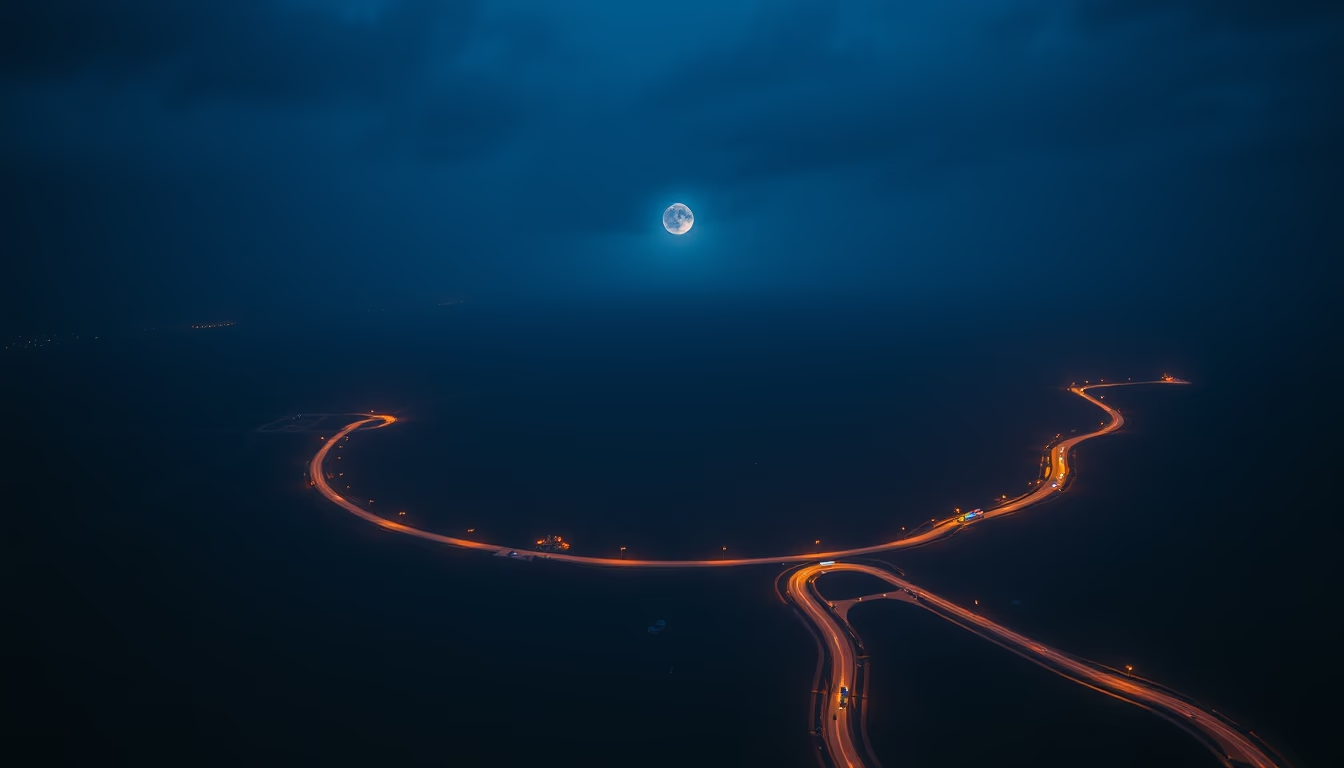
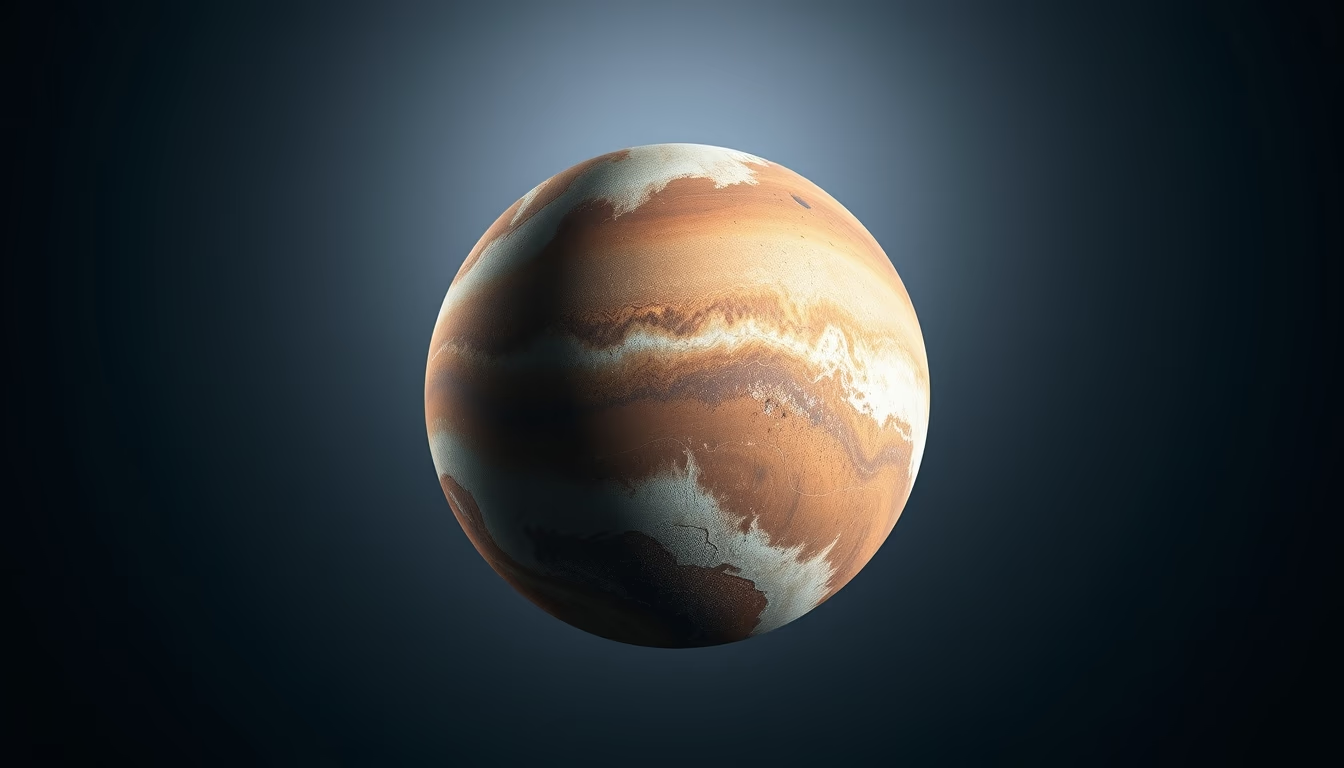
Rogue planet darkness
1344×768 · AVIF · CC BY 4.0

Rogue planets, solitary worlds drifting through the galaxy without a parent star, shrouded in eternal darkness. Learn how they are detected and what they reveal about planetary formation.
About this subject
Rogue planets, also known as interstellar or free-floating planets, are celestial bodies with planetary mass that are not gravitationally bound to any star. They may have been ejected from their original planetary systems during formation or formed independently via direct collapse of gas and dust clouds, similarly to star formation but on a smaller scale. The Milky Way is estimated to contain billions of such solitary worlds, possibly outnumbering stars.
Detecting rogue planets is extremely challenging because they emit no light of their own and reflect none from a nearby star. The most effective method is gravitational microlensing, where the gravity of a massive object (like a rogue planet) bends and magnifies the light from a background star. This technique has led to the discovery of candidate interstellar planets, such as PSO J318.5-22, an object with about 6 to 15 Jupiter masses located roughly 80 light-years away. Another example is OGLE-2016-BLG-1928, an Earth-mass rogue planet discovered in 2021.
Despite extreme darkness and cold (surface temperatures near absolute zero), some rogue planets may harbor subsurface liquid water oceans kept warm by internal geothermal activity. This raises intriguing possibilities about the potential habitability of these worlds. Additionally, studying rogue planets provides valuable clues about planetary formation dynamics and ejection frequency, helping refine theoretical models. Unlike exoplanets orbiting stars, these objects offer a natural laboratory to understand planetary atmospheric and interior evolution without intense stellar radiation.
Interestingly, rogue planets can also be detected through their thermal infrared emissions, thanks to residual heat from formation. Future missions like the Nancy Grace Roman Space Telescope (formerly WFIRST) promise to revolutionize the search for these worlds, with the ability to detect thousands of microlensing candidates. Each new discovery blurs the line between planets and brown dwarfs, expanding our understanding of a far more populous and diverse galaxy than previously imagined.
Frequently Asked Questions
How does a planet become rogue?
A rogue planet can be ejected from its star system by gravitational interactions with other planets or stars, or it can form independently via the collapse of a gas and dust cloud, never having orbited a star.
Could a rogue planet harbor life?
Yes, in theory. Despite a dark and cold surface, subsurface oceans heated by geothermal activity could potentially host microbial life, similar to deep-ocean ecosystems on Earth.
How many rogue planets exist in the Milky Way?
Billions are estimated to exist in the Milky Way, possibly outnumbering stars. Most remain undetected due to limitations in current observational methods.
Direct URL
https://pub-c7d6a6ea828543ac903a74a341ccb2e1.r2.dev/imagens/rogue-planet-darkness-documentary-nature-style-fresh3.avifHow to credit
Include a visible link back to UtilizAí. Copy one of the snippets below:
<a href="https://xn--utiliza-eza.com/en/midia/imagens/rogue-planet-darkness-documentary-nature-style-fresh3">Rogue planet darkness</a> by <a href="https://xn--utiliza-eza.com">UtilizAí</a>, licensed under <a href="https://creativecommons.org/licenses/by/4.0/">CC BY 4.0</a>.
[Rogue planet darkness](https://xn--utiliza-eza.com/en/midia/imagens/rogue-planet-darkness-documentary-nature-style-fresh3) by [UtilizAí](https://xn--utiliza-eza.com), CC BY 4.0
License: CC-BY-4.0