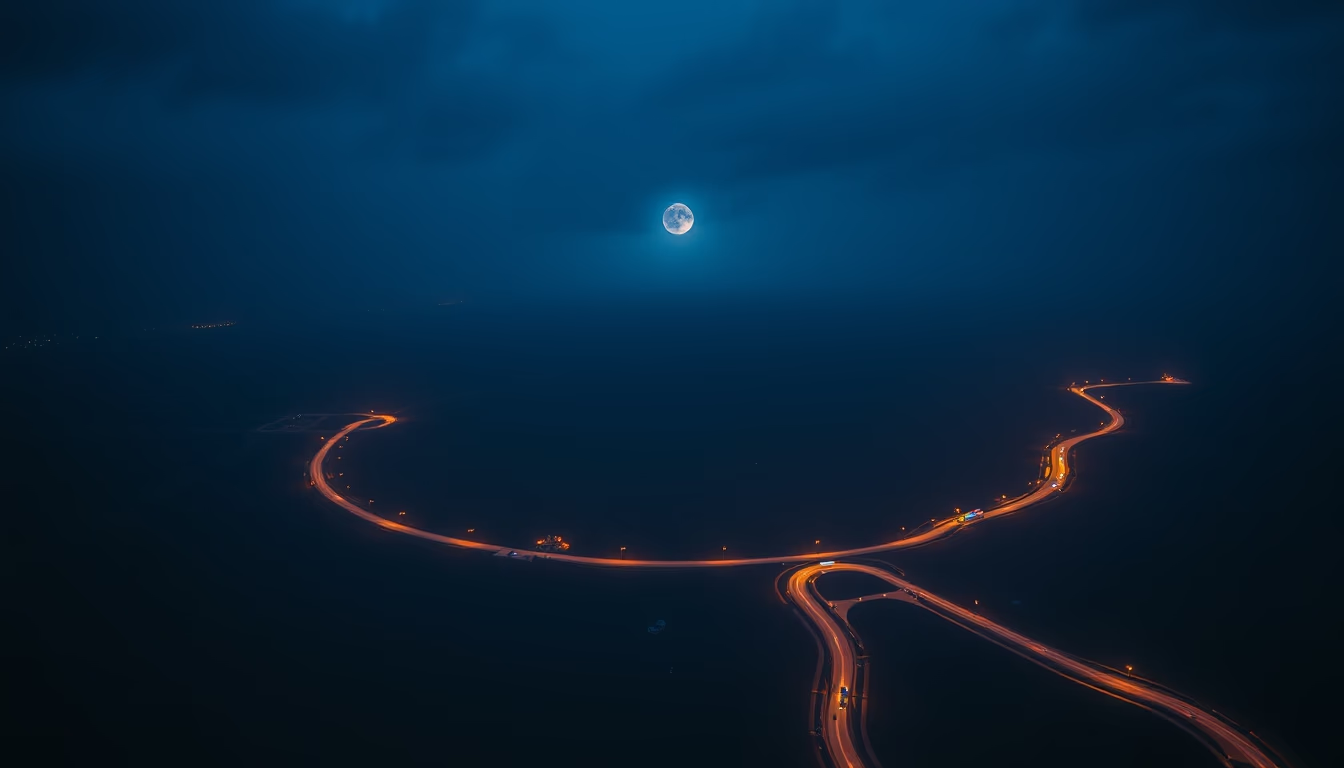
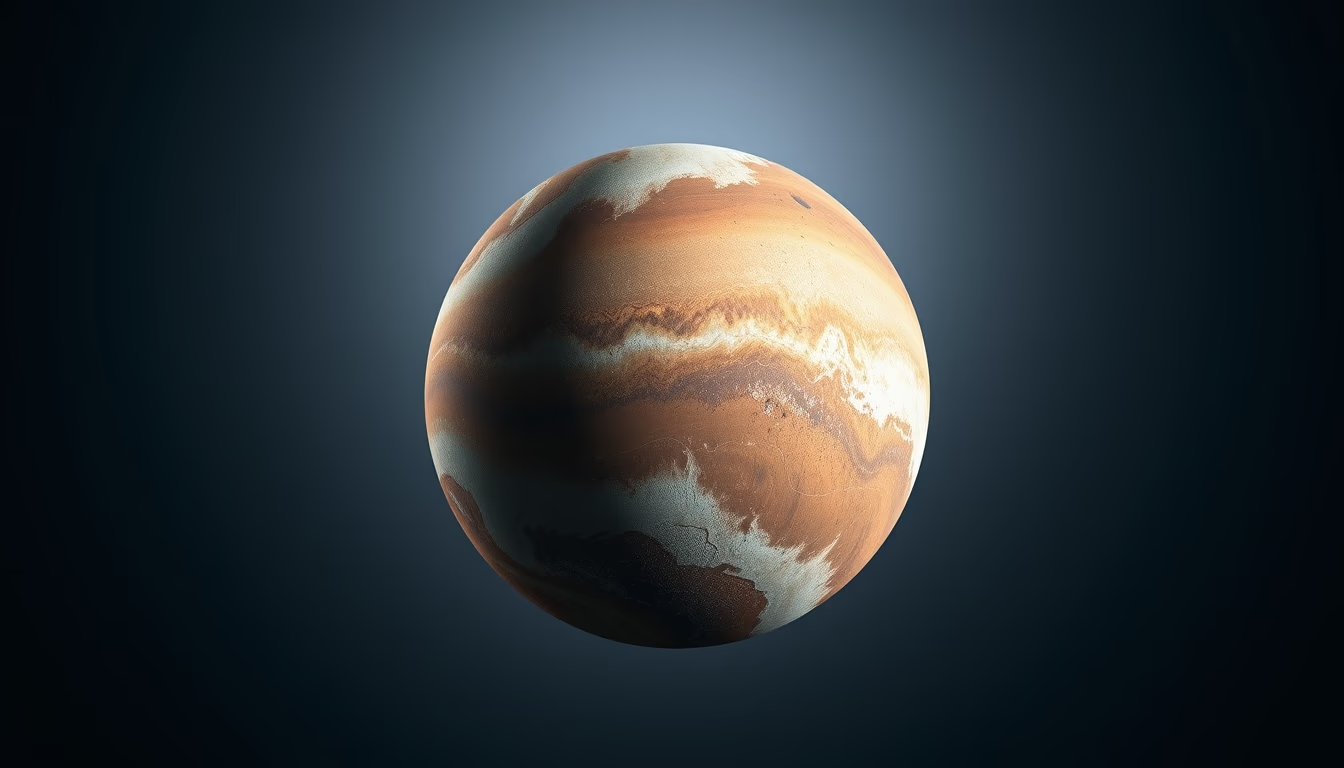
Rogue planet darkness
1344×768 · AVIF · CC BY 4.0
Rogue planets, or free-floating planets, are planetary-mass objects that drift through space without orbiting a star, challenging classical definitions.
About this subject
Rogue planets, also known as interstellar or free-floating planets, are planetary-mass objects not gravitationally bound to any star. They drift freely through the galaxy, often ejected from their original solar systems by violent gravitational interactions. Estimates suggest billions of such bodies exist in the Milky Way alone, outnumbering stars. Detecting them is challenging because they emit no visible light; they are primarily found through gravitational microlensing or residual infrared emission from their formation.
Their origins are diverse. Many form around young stars but are kicked out due to close encounters with massive planets or passing stars. Others may form directly from the collapse of gas and dust clouds, similar to stars, but with insufficient mass to ignite nuclear fusion. These objects are often classified as sub-brown dwarfs if their mass is very low. The distinction between a rogue planet and a brown dwarf is subtle, based on mass and formation process.
Rogue planets are of great astronomical importance. They can provide clues about planet formation and stellar system dynamics. Moreover, if some retain thick atmospheres or subsurface oceans heated by internal sources, they could theoretically harbor microbial life. NASA's New Horizons probe has hinted at small rogue planets in the outer Solar System. Future missions, like the Nancy Grace Roman Space Telescope, promise to significantly expand the catalog of these objects.
Interestingly, the concept of rogue planets was popularized in science fiction but is now an active research field. In 2020, astronomers identified an Earth-sized rogue planet candidate in the Milky Way using Kepler data. The existence of these solitary worlds raises fascinating questions about the potential for life in extreme environments and the true planetary population of the galaxy.
Frequently Asked Questions
How are rogue planets detected if they emit no light?
They are primarily detected through gravitational microlensing, where the planet's gravity bends the light of a background star. They can also be seen in infrared due to residual heat from their formation.
What is the difference between a rogue planet and a brown dwarf?
The main difference is mass and formation. Rogue planets have planetary mass (up to about 13 Jupiter masses) and typically form in protoplanetary disks. Brown dwarfs are more massive and form like stars but without sustained nuclear fusion.
Could life exist on a rogue planet?
Theoretically yes, if the planet has a thick atmosphere or a subsurface ocean heated by radioactivity or tidal forces. Life would be very different from Earth's, but not impossible.
Direct URL
https://pub-c7d6a6ea828543ac903a74a341ccb2e1.r2.dev/imagens/rogue-planet-darkness-commercial-product-photography-fresh2.avifHow to credit
Include a visible link back to UtilizAí. Copy one of the snippets below:
<a href="https://xn--utiliza-eza.com/en/midia/imagens/rogue-planet-darkness-commercial-product-photography-fresh2">Rogue planet darkness</a> by <a href="https://xn--utiliza-eza.com">UtilizAí</a>, licensed under <a href="https://creativecommons.org/licenses/by/4.0/">CC BY 4.0</a>.
[Rogue planet darkness](https://xn--utiliza-eza.com/en/midia/imagens/rogue-planet-darkness-commercial-product-photography-fresh2) by [UtilizAí](https://xn--utiliza-eza.com), CC BY 4.0
License: CC-BY-4.0