Rogue planet darkness
1344×768 · AVIF · CC BY 4.0

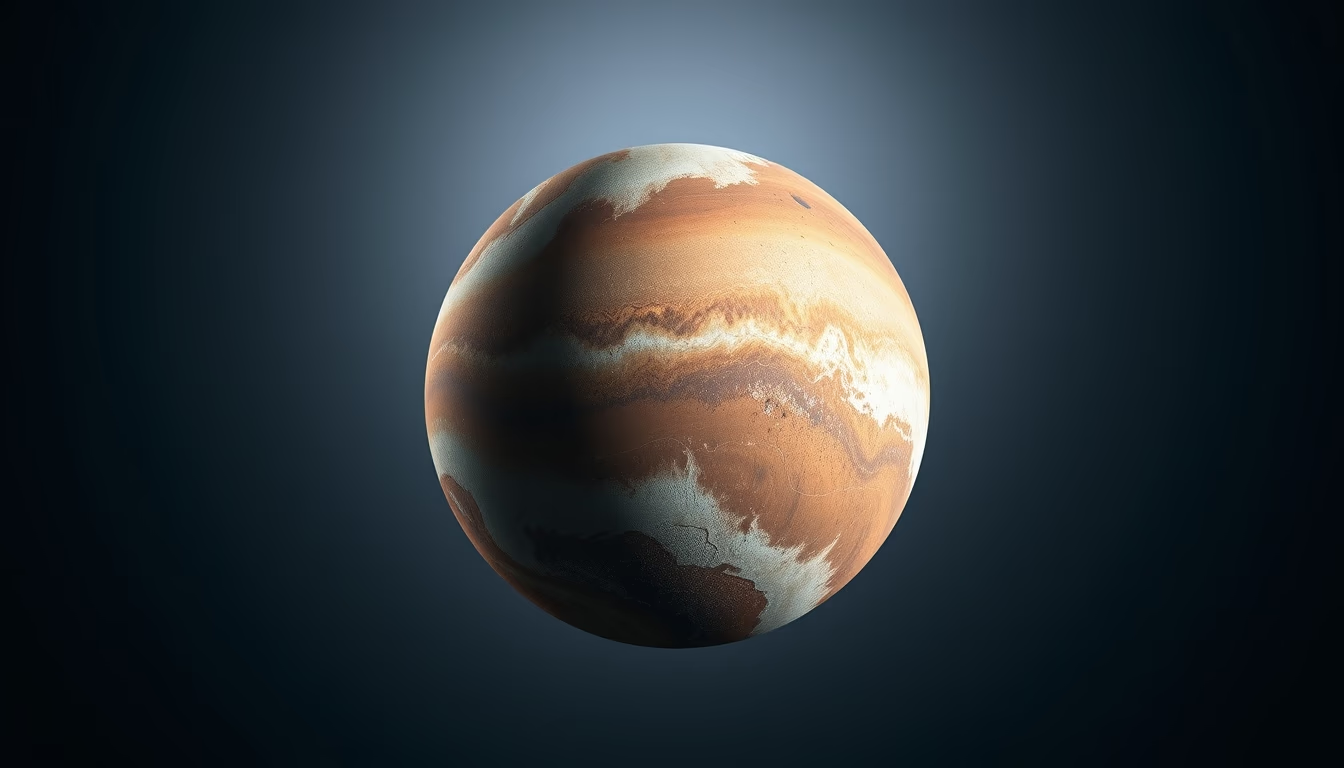
Rogue planets, also called interstellar planets, are starless bodies that wander through interstellar space, shrouded in perpetual darkness.
About this subject
Rogue planets, also known as interstellar planets, are exoplanets that do not orbit any star. They drift freely through the galaxy, receiving no light or heat from a sun. Most are believed to have been ejected from their original planetary systems during formation due to gravitational interactions with larger planets or the star itself. Others may have formed directly from collapsing gas and dust clouds, like failed stars that never ignited nuclear fusion.
Detecting these objects is extremely challenging because they emit no visible light and are too small to be seen directly. Astronomers rely on gravitational microlensing, where the planet's gravity bends the light from a distant star, causing a brief brightening. They are also detected through their thermal infrared emission, coming from residual heat of formation. Known examples include PSO J318.5-22, a planet only 2% the age of the Solar System, and OGLE-2016-BLG-1928, one of the smallest ever found.
It is estimated that there are billions of rogue planets in the Milky Way alone, outnumbering stars. These worlds may host moons that retain internal heat and possibly subsurface liquid oceans under icy crusts, raising the possibility of microbial life. However, the lack of sunlight precludes photosynthesis, so any life would rely on chemosynthesis or geothermal energy.
Studying rogue planets helps understand planetary formation dynamics and the history of stellar systems. Future missions like the Nancy Grace Roman Space Telescope are expected to dramatically increase detections, revealing more about these lonely, dark worlds.
Frequently Asked Questions
How does a planet become rogue?
Rogue planets typically form in stellar systems but are ejected by gravitational interactions with other planets or the star. They can also form independently from collapsing gas and dust clouds, like low-mass brown dwarfs.
Could a rogue planet harbor life?
Yes, it is possible, though unlikely. If the planet has a moon with tidal heating or strong geothermal activity, subsurface oceans could host chemosynthetic microbes. However, the lack of sunlight limits the types of life possible.
How many rogue planets are in the Milky Way?
Estimates range from 100 billion to 1 trillion rogue planets in the Milky Way, outnumbering stars. Most are small and cold, making detection challenging.
Direct URL
https://pub-c7d6a6ea828543ac903a74a341ccb2e1.r2.dev/imagens/rogue-planet-darkness-cinematic-wide-shot-fresh15.avifHow to credit
Include a visible link back to UtilizAí. Copy one of the snippets below:
<a href="https://xn--utiliza-eza.com/en/midia/imagens/rogue-planet-darkness-cinematic-wide-shot-fresh15">Rogue planet darkness</a> by <a href="https://xn--utiliza-eza.com">UtilizAí</a>, licensed under <a href="https://creativecommons.org/licenses/by/4.0/">CC BY 4.0</a>.
[Rogue planet darkness](https://xn--utiliza-eza.com/en/midia/imagens/rogue-planet-darkness-cinematic-wide-shot-fresh15) by [UtilizAí](https://xn--utiliza-eza.com), CC BY 4.0
License: CC-BY-4.0