Globe on student desk vintage
1344×768 · AVIF · CC BY 4.0
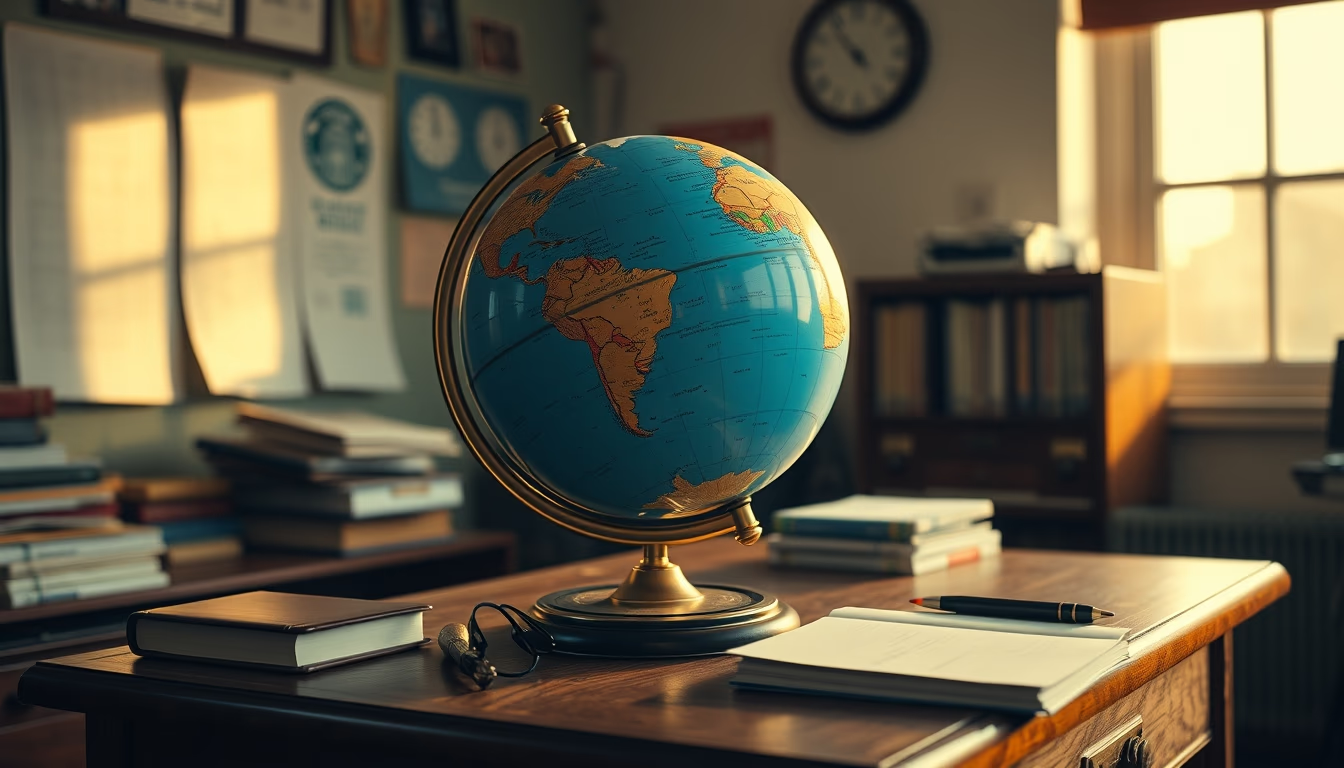
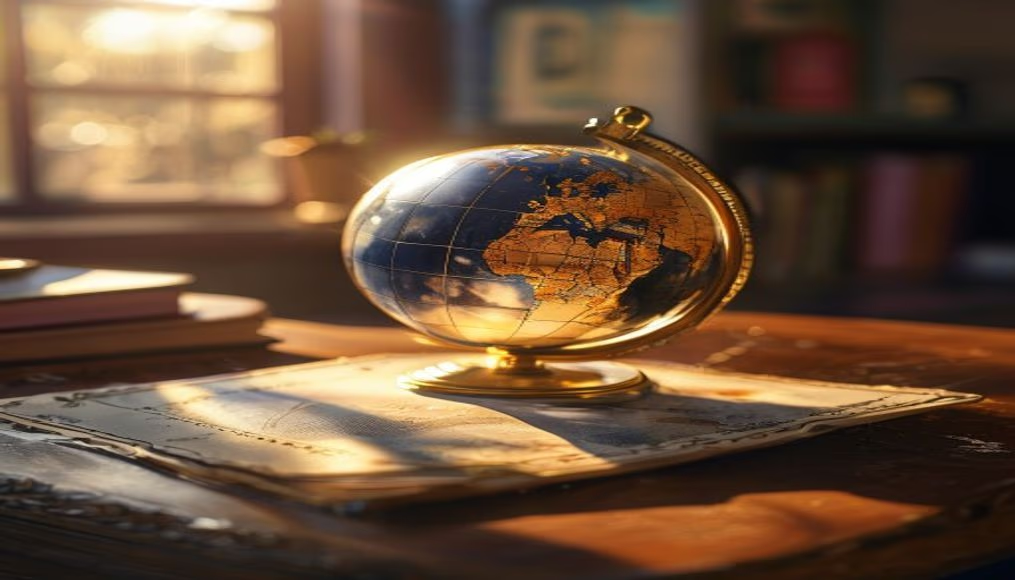
Vintage globe on a student desk, evoking the era of atlases and world discovery before the internet.
About this subject
The vintage terrestrial globe is an icon of classic education, present in classrooms and libraries since the 16th century. Its version on a student desk recalls a time when physical maps were the main tool for understanding geography, politics, and cultures. Unlike digital maps, the globe allows viewing the Earth in its three-dimensional form, without projection distortions, such as the famous Mercator projection that enlarges areas near the poles.
In Brazil, globes were common in traditional schools and teacher training courses, especially from the 1950s to the 1970s. They were often made of cardboard covered with papier-mâché or plastic, with metal supports. The vintage design, with pastel colors and serif fonts, reflects the aesthetics of the era. Many such globes were produced by companies like the German Columbus Verlag or the Brazilian Editora Globo, which also published school atlases.
A curious fact is that before the invention of the globe, students used flat maps and armillary spheres, which represented the sky, not the Earth. The first modern terrestrial globe was created by Martin Behaim in 1492, the same year as Columbus's voyage. In Brazil, the use of globes became popular with the 1961 educational reform, which made geography a mandatory subject. Today, vintage globes are collectible and can be worth hundreds of reais at antique fairs.
The image of a globe on a student desk also carries nostalgic symbolism: it represents the search for knowledge in an analog world, where exploring meant flipping through atlases and spinning the globe with your hands. For many, this object evokes memories of geography classes and dreams of travel, showing how education shapes our view of the planet.
Frequently Asked Questions
What is the difference between a vintage globe and a modern one?
Vintage globes often have outdated maps (e.g., still showing the Soviet Union), pastel colors, and metal stands. Modern ones use plastic, bright colors, and updated data, plus interactive digital versions.
Why are terrestrial globes important in education?
They represent the Earth without projection distortions, helping to understand continents, oceans, and time zones intuitively. They stimulate geographic curiosity and comprehension of scales.
How to identify an original vintage globe?
Look for manufacturer names like Columbus Verlag, Editora Globo, or Rand McNally. Check for old copyright dates (e.g., 1960) and materials like papier-mâché or oxidized metal. Serif typography design is also an indicator.
Direct URL
https://pub-c7d6a6ea828543ac903a74a341ccb2e1.r2.dev/imagens/globe-on-student-desk-vintage-cinematic-wide-shot-v2.avifHow to credit
Include a visible link back to UtilizAí. Copy one of the snippets below:
<a href="https://xn--utiliza-eza.com/en/midia/imagens/globe-on-student-desk-vintage-cinematic-wide-shot-v2">Globe on student desk vintage</a> by <a href="https://xn--utiliza-eza.com">UtilizAí</a>, licensed under <a href="https://creativecommons.org/licenses/by/4.0/">CC BY 4.0</a>.
[Globe on student desk vintage](https://xn--utiliza-eza.com/en/midia/imagens/globe-on-student-desk-vintage-cinematic-wide-shot-v2) by [UtilizAí](https://xn--utiliza-eza.com), CC BY 4.0
License: CC-BY-4.0