Gas giant ringed exoplanet
1344×768 · AVIF · CC BY 4.0
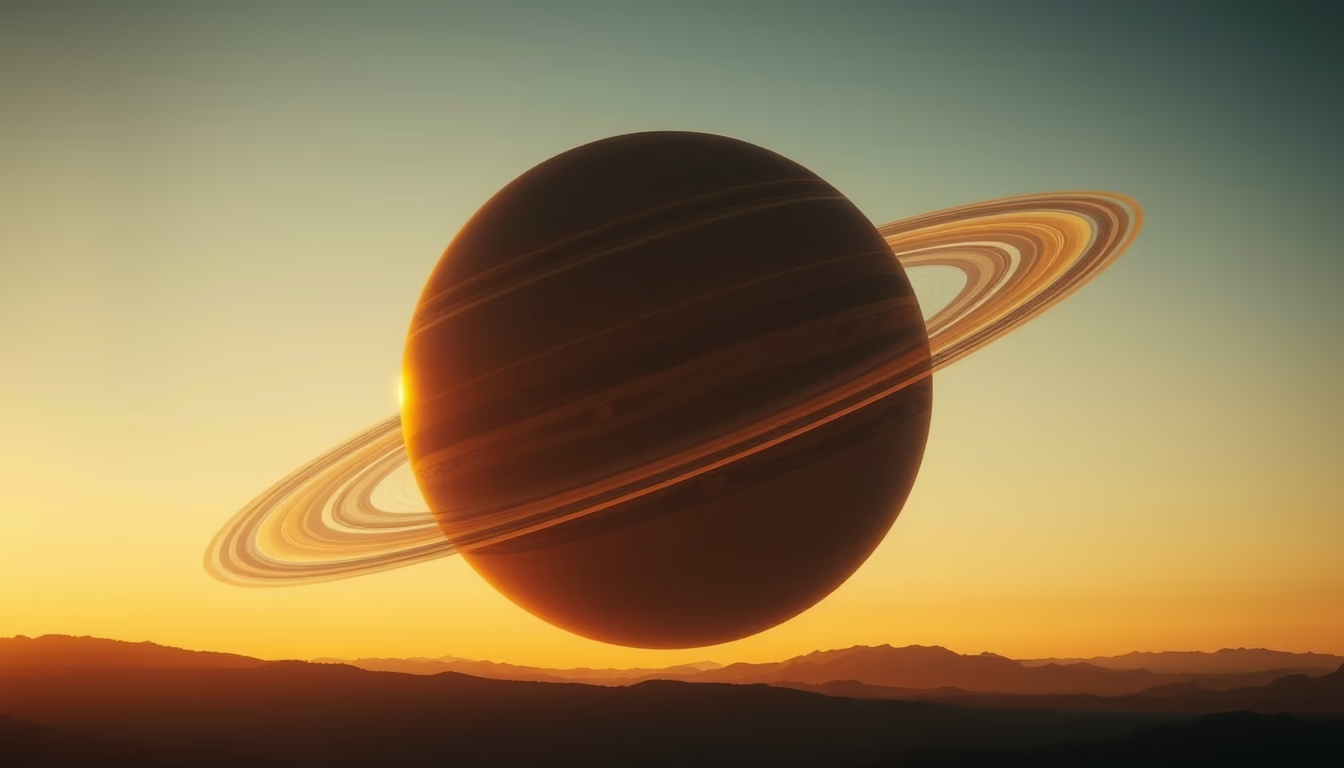
Gas giant ringed exoplanets like the alien Saturn J1407b are rare and fascinating, revealing the diversity of planetary systems.
About this subject
Gas giant ringed exoplanets are celestial objects that intrigue astronomers and enthusiasts. The most notable example is J1407b, discovered in 2012, located about 434 light-years away in the constellation Centaurus. This planet has a ring system more than 200 times larger than Saturn's, with enough space to host an Earth-sized planet. Detecting exoplanetary rings is challenging as they do not emit their own light and are often outshone by the host star.
Rings around gas giants can form through different mechanisms, such as capturing material from a past moon or collisions among satellites. In our solar system, Saturn's rings are mainly composed of ice and dust. Around exoplanets, composition may vary, including silicates and organic material. Observing planetary transits where star light is blocked by the planet and its rings allows astronomers to infer the presence and structure of these ring systems.
The study of exoplanetary rings goes beyond scientific curiosity. They provide clues about the formation and evolution of planetary systems and the orbital dynamics between planets and moons. Massive rings can also influence exoplanet detection by creating complex light signatures that may be mistaken for other phenomena. Projects like the James Webb Space Telescope promise to refine these observations, unveiling more details about these distant worlds.
Curiously, J1407b's ring system is so extensive that if it replaced Saturn's rings, it would be visible to the naked eye from Earth at night, outshining the Moon. This young planet, about 16 million years old, is still forming, and its rings might eventually coalesce into moons. This conceptual image of a ringed gas giant reminds us of the immense variety of planetary architectures in the universe.
Frequently Asked Questions
How are exoplanet rings detected?
Rings are detected via transit light curves, where starlight is asymmetrically blocked by the planet and its rings, creating characteristic patterns.
What is the largest known ringed exoplanet?
The largest known ring system belongs to J1407b, with a radius of about 0.6 AU (90 million km), much larger than Saturn's.
Can exoplanet rings form moons?
Yes, massive rings around young planets like J1407b may eventually coalesce into moons, similar to what happened on Saturn.
Direct URL
https://pub-c7d6a6ea828543ac903a74a341ccb2e1.r2.dev/imagens/gas-giant-ringed-exoplanet-cinematic-wide-shot-fresh17.avifHow to credit
Include a visible link back to UtilizAí. Copy one of the snippets below:
<a href="https://xn--utiliza-eza.com/en/midia/imagens/gas-giant-ringed-exoplanet-cinematic-wide-shot-fresh17">Gas giant ringed exoplanet</a> by <a href="https://xn--utiliza-eza.com">UtilizAí</a>, licensed under <a href="https://creativecommons.org/licenses/by/4.0/">CC BY 4.0</a>.
[Gas giant ringed exoplanet](https://xn--utiliza-eza.com/en/midia/imagens/gas-giant-ringed-exoplanet-cinematic-wide-shot-fresh17) by [UtilizAí](https://xn--utiliza-eza.com), CC BY 4.0
License: CC-BY-4.0