Chalkboard with mathematical equations
1344×768 · AVIF · CC BY 4.0
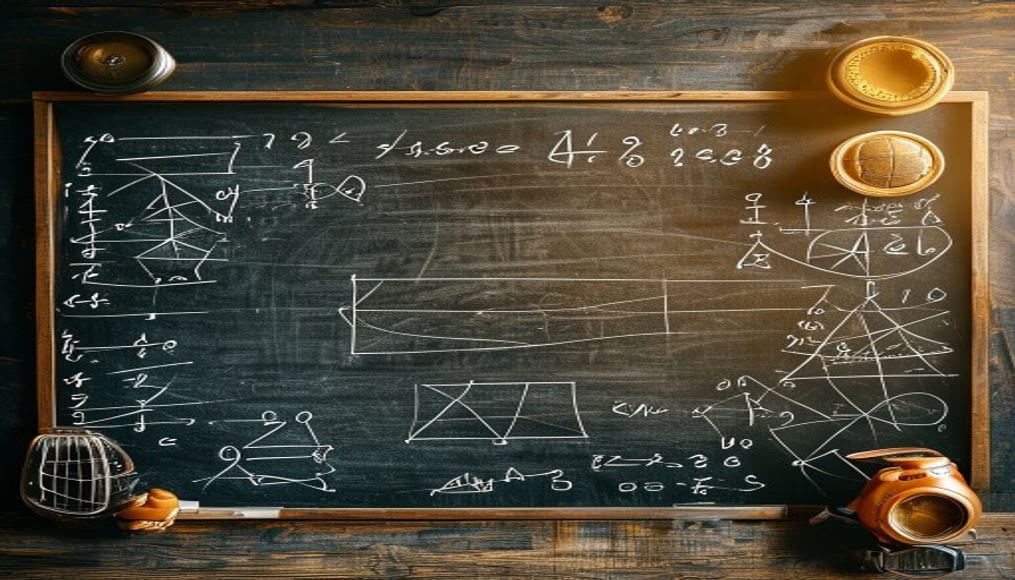
Blackboard covered with mathematical equations, a universal symbol of learning and science in classrooms worldwide.
About this subject
The blackboard, also known as a chalkboard, stands as one of the most iconic tools in traditional education. Its origins trace back to the late 18th century, when Scottish teachers began using large black slate boards to write with chalk. This method quickly spread across schools and universities, becoming essential for teaching subjects like mathematics, physics, and chemistry. Handwritten equations on a blackboard evoke the classic image of an instructor explaining complex concepts, from basic algebra to advanced calculus.
Mathematics, often called the universal language, comes to life on the blackboard. Equations such as Einstein's E = mc², the quadratic formula, or Newton's integrals are examples of how symbols and numbers become tools to understand the universe. Usage of blackboards varies worldwide: in Japan, it remains common in traditional classrooms, while in Nordic countries, digital technology is gradually replacing chalk. In Brazil, despite modernization, blackboards persist in many public and private schools as a teaching resource.
Interestingly, the sound and texture of chalk on the board create a unique sensory experience, often associated with concentration and active learning. Studies show that handwriting, rather than typing, can improve information retention. Additionally, a blackboard allows real-time erasure and correction, fostering a dynamic dialogue between teacher and student. In the digital age, it is still celebrated as an icon of knowledge transmitted in a personal and direct way.
Mathematical equations on a blackboard also appear in cultural contexts, such as in films (A Beautiful Mind) and even in themed coffee shops. The image of a board filled with formulas is globally recognized as synonymous with intelligence and research, transcending language barriers.
Frequently Asked Questions
What is the origin of the blackboard?
The blackboard was invented in the late 18th century in Scotland, when teachers used large dark slate boards to write with chalk. It became popular because it allowed multiple students to see explanations simultaneously.
Why are mathematical equations so common on blackboards?
Mathematics is a visual and sequential subject; writing equations step by step on the board helps students follow the reasoning. Additionally, the board allows erasing and redoing, facilitating error correction.
Is the blackboard still used in modern classrooms?
Yes, especially in developing countries and schools that value traditional methods. Over time, many boards have been replaced by whiteboards or digital screens, but blackboards remain common in math and science classes.
Direct URL
https://pub-c7d6a6ea828543ac903a74a341ccb2e1.r2.dev/imagens/chalkboard-with-mathematical-equations-travel-photography-v10.avifHow to credit
Include a visible link back to UtilizAí. Copy one of the snippets below:
<a href="https://xn--utiliza-eza.com/en/midia/imagens/chalkboard-with-mathematical-equations-travel-photography-v10">Chalkboard with mathematical equations</a> by <a href="https://xn--utiliza-eza.com">UtilizAí</a>, licensed under <a href="https://creativecommons.org/licenses/by/4.0/">CC BY 4.0</a>.
[Chalkboard with mathematical equations](https://xn--utiliza-eza.com/en/midia/imagens/chalkboard-with-mathematical-equations-travel-photography-v10) by [UtilizAí](https://xn--utiliza-eza.com), CC BY 4.0
License: CC-BY-4.0