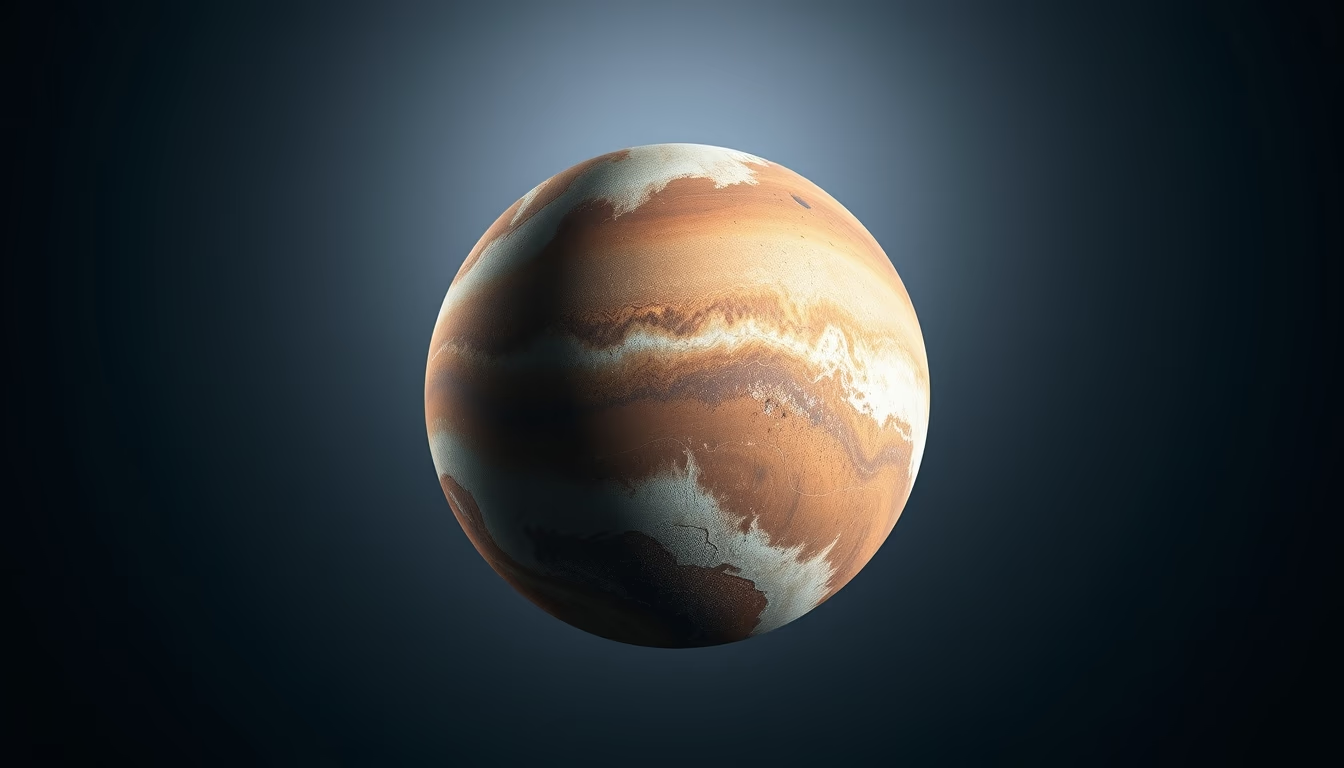
Binary star sunset
1344×768 · AVIF · CC BY 4.0
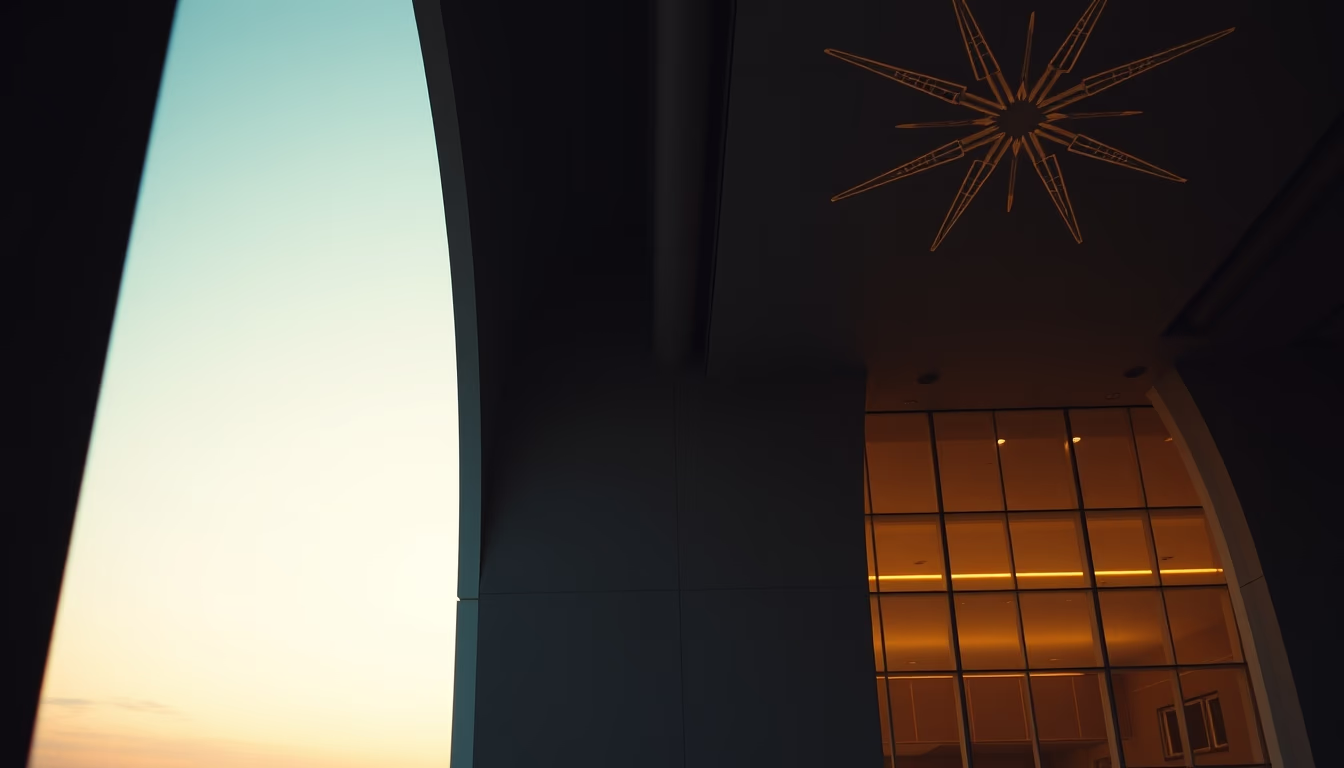
Imagine a sunset on an exoplanet orbiting a binary star system: two suns setting on the horizon, a fascinating phenomenon studied by astrophysics.
About this subject
About half of all stars in the Milky Way are part of binary systems, stellar pairs orbiting a common center of mass. When an exoplanet resides in such a system, its sky may feature double sunsets, a spectacle that varies with the stars' characteristics. The first confirmed exoplanet orbiting a binary star was Kepler-16b, discovered in 2011, located 200 light-years from Earth in the constellation Cygnus. This cold, gaseous world completes an orbit every 229 days around two dwarf stars: an orange (K-type) and a red (M-type) with masses 0.69 and 0.20 times that of the Sun, respectively.
Depending on orbital configuration, an exoplanet may experience simultaneous or sequential dual sunsets. In close binary systems like Kepler-16, the two stellar disks can appear nearly overlapping on the horizon, producing a color gradient from orange to red. The duration and color of twilight are influenced by each star's temperature and luminosity: hotter stars yield bluish hues, while cooler ones tend toward deep red. In systems with eccentric orbits, varying distances between the planet and its stars can alter the apparent size and brightness during sunset.
The habitability of planets in binary systems is an active research field. The habitable zone, where liquid water can exist, is more complex to define due to the combined radiation from two stars. In some cases, the planet may be in a circumbinary orbit (around both stars) or in orbit around only one (S-type). Examples like Proxima Centauri b, which orbits a red dwarf in a triple system, show that such worlds may be relatively common. Climate models suggest that for a terrestrial planet in the habitable zone of a binary, the double sunset could influence wind and precipitation patterns, creating unique daily and seasonal cycles.
Frequently Asked Questions
What is a binary star system?
A system of two stars orbiting a common center of mass, bound by gravity. About half of all stars in the universe are part of binary or multiple systems.
How are exoplanets in binary systems detected?
Mainly via the transit method (dimming when the planet passes in front of one star) or the radial velocity method (spectral oscillations from gravitational pull of the planet).
Can double sunsets occur on every planet in a binary system?
It depends on orbital configuration. Circumbinary planets (orbiting both stars) can see two suns on the same horizon. S-type planets (orbiting one star) see the other star as a bright point in the sky, not a second sun.
Direct URL
https://pub-c7d6a6ea828543ac903a74a341ccb2e1.r2.dev/imagens/binary-star-sunset-architectural-photography-fresh8.avifHow to credit
Include a visible link back to UtilizAí. Copy one of the snippets below:
<a href="https://xn--utiliza-eza.com/en/midia/imagens/binary-star-sunset-architectural-photography-fresh8">Binary star sunset</a> by <a href="https://xn--utiliza-eza.com">UtilizAí</a>, licensed under <a href="https://creativecommons.org/licenses/by/4.0/">CC BY 4.0</a>.
[Binary star sunset](https://xn--utiliza-eza.com/en/midia/imagens/binary-star-sunset-architectural-photography-fresh8) by [UtilizAí](https://xn--utiliza-eza.com), CC BY 4.0
License: CC-BY-4.0