Underwater robot submersible
1344×768 · AVIF · CC BY 4.0
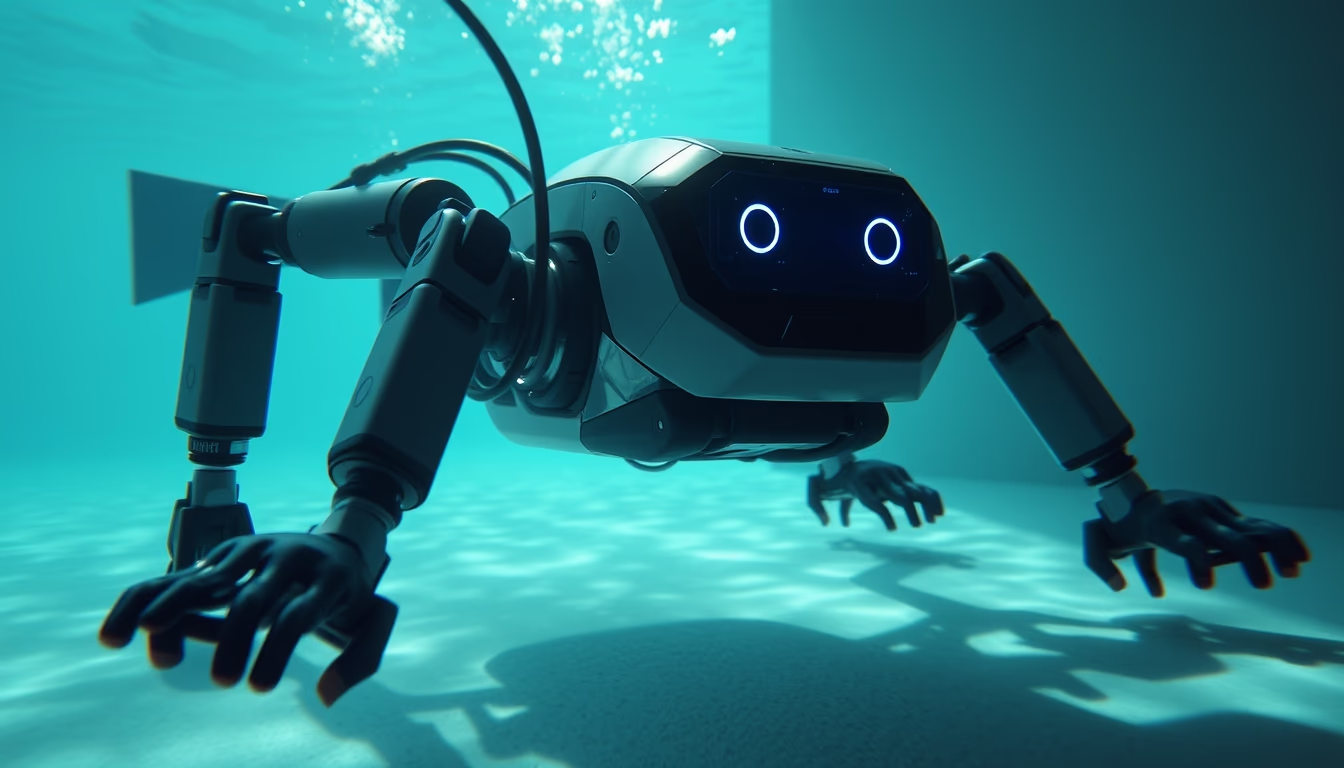
Submersible robots revolutionize ocean exploration, infrastructure inspection, and marine research with autonomous technology.
About this subject
Submersible robots, also known as remotely operated vehicles (ROVs) or autonomous underwater vehicles (AUVs), are machines designed to operate in submerged environments, from shallow coastal waters to the deepest ocean trenches. Unlike manned submarines, these robots do not require life support systems, enabling long-duration missions and access to high-risk locations such as oil spills or abyssal zones. Development began in the 1950s for military search and rescue, but today they are widely used in the oil and gas industry for pipeline inspection, in science for sampling biology and geology, and even in archaeology to explore shipwrecks.
AUV autonomy allows them to follow pre-programmed routes without constant human control, using sensors like sonars, high-definition cameras, and thermometers and salinometers. Modern models can operate at depths exceeding 6,000 meters, such as the famous Nereus, which explored the Mariana Trench. ROVs, meanwhile, are tethered to a surface vessel by cables, receiving power and transmitting data in real time, making them ideal for tasks requiring remote human intervention, like repairs on offshore platforms.
In Brazil, pre-salt exploration heavily relies on ROVs and AUVs for seabed mapping and equipment monitoring. Petrobras, for example, uses these robots for riser inspection and maintenance of subsea fields. Beyond the energy sector, Brazilian universities like USP and UFRJ develop prototypes for oceanographic research, including vehicles for monitoring the Blue Amazon. Current challenges include improving energy efficiency and onboard processing capability for greater tether-free autonomy.
The minimalist aesthetic depicted in graphical representations of these robots reflects their functionality: hydrodynamic shapes, no frills, and a focus on performance. This simplicity is not only visual but also conceptual, as every component is designed to withstand extreme pressure, corrosion, and temperature variations. Advances in materials, such as titanium alloys and carbon fiber composites, have enabled lighter and stronger designs, pushing the boundaries of underwater exploration.
Frequently Asked Questions
What is the difference between ROV and AUV?
ROVs (Remotely Operated Vehicles) are controlled via a tether from a surface vessel, receiving power and transmitting data in real time. AUVs (Autonomous Underwater Vehicles) operate independently on pre-programmed routes without a tether, surfacing to transfer data.
How deep can a submersible robot go?
Common commercial models reach depths up to 3,000 meters, but research vehicles like Nereus (now retired) reached 10,994 meters in the Mariana Trench. Currently, the practical limit is around 11,000 meters, enough to explore any ocean point.
How are submersible robots used in Brazil?
Brazil uses ROVs and AUVs mainly in the oil and gas industry for inspecting pipelines and subsea equipment in pre-salt fields. Additionally, research institutions employ them for oceanographic studies and environmental monitoring in the Blue Amazon.
Direct URL
https://pub-c7d6a6ea828543ac903a74a341ccb2e1.r2.dev/imagens/underwater-robot-submersible-minimalist-composition-p9.avifHow to credit
Include a visible link back to UtilizAí. Copy one of the snippets below:
<a href="https://xn--utiliza-eza.com/en/midia/imagens/underwater-robot-submersible-minimalist-composition-p9">Underwater robot submersible</a> by <a href="https://xn--utiliza-eza.com">UtilizAí</a>, licensed under <a href="https://creativecommons.org/licenses/by/4.0/">CC BY 4.0</a>.
[Underwater robot submersible](https://xn--utiliza-eza.com/en/midia/imagens/underwater-robot-submersible-minimalist-composition-p9) by [UtilizAí](https://xn--utiliza-eza.com), CC BY 4.0
License: CC-BY-4.0