Hexapod robot moving
1344×768 · AVIF · CC BY 4.0
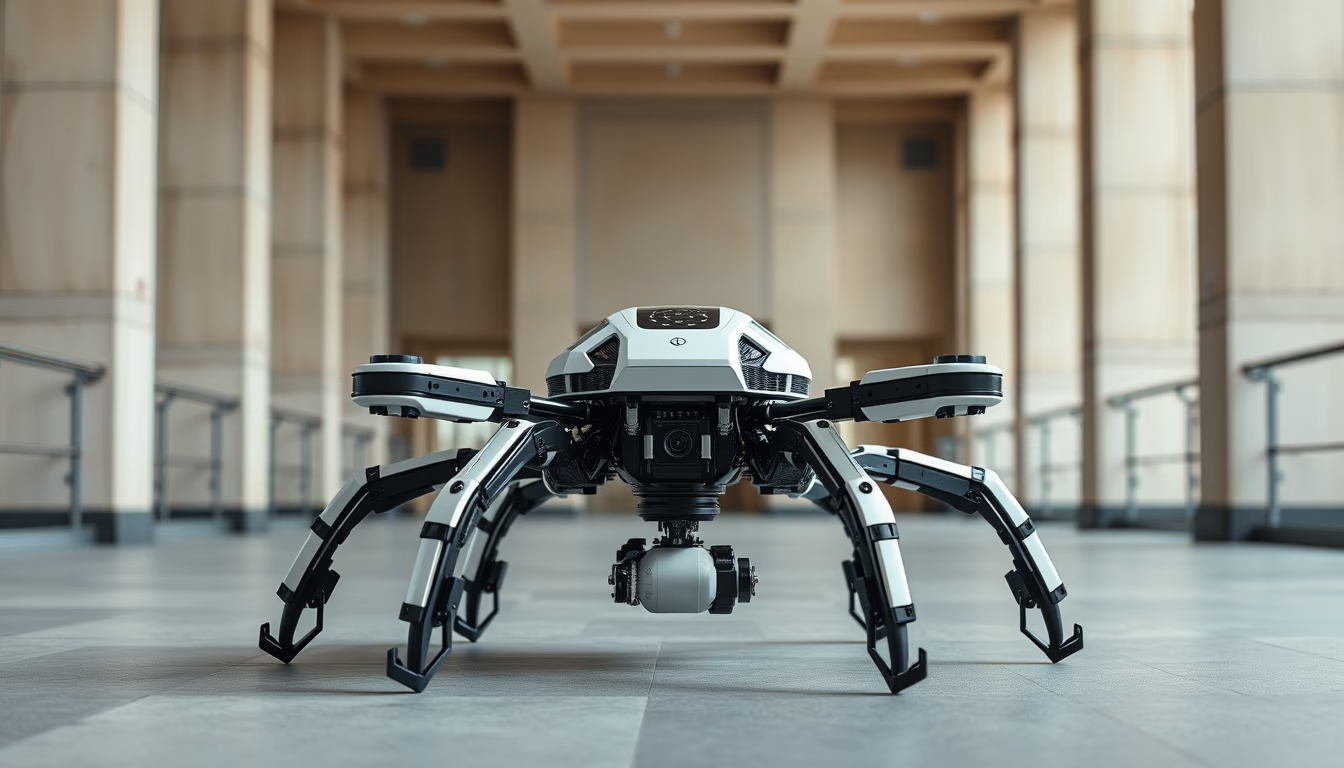
Hexapod robots are machines inspired by insects and arachnids, capable of stable locomotion on uneven terrain thanks to six articulated legs.
About this subject
Hexapod robots are a type of mobile robot that uses six legs for locomotion, unlike wheeled or tracked robots. This configuration offers significant advantages on uneven terrain, such as rocks, stairs, or irregular surfaces, because the legs can actively adapt to the terrain. The design is inspired by insects like ants and beetles and spiders, which naturally use six legs for balance and speed.
Controlling a hexapod is complex: each leg typically has multiple degrees of freedom (usually three joints: hip, knee, and ankle), requiring coordination algorithms to maintain balance and generate gait patterns, such as the static tripod (where three legs touch the ground while the others move). Advanced models use inertial sensors, cameras, and LIDAR for autonomous navigation.
Applications include exploration in hazardous environments (nuclear plants, disaster areas), industrial inspection, precision agriculture, and even entertainment. Companies like Boston Dynamics and Ghost Robotics have developed commercial hexapods, but the concept is also popular in open-source projects and robotics competitions. A notable example is Theo Jansen's 'Strandbeest', though wind-powered, not motorized.
The connection to architectural photography arises when hexapods are used for inspecting facades, bridges, and tall structures, where stability and climbing ability are key. The image likely shows a hexapod in an architectural setting, highlighting its versatility in built environments.
Frequently Asked Questions
How many legs does a hexapod robot have and why six?
Six legs, allowing a static tripod gait: three legs on the ground form a triangular support base while the other three advance, ensuring balance and stability on uneven terrain.
What is the main difference between a hexapod and a wheeled robot?
Hexapods can traverse obstacles like stairs, rocks, and irregular surfaces more easily, while wheeled robots are faster on flat ground. The choice depends on the application.
Are hexapods used in the construction industry?
Yes, mainly for structural inspection, e.g., bridges and facades, where they can access hazardous locations. They are also used for 3D mapping of environments.
Direct URL
https://pub-c7d6a6ea828543ac903a74a341ccb2e1.r2.dev/imagens/hexapod-robot-moving-architectural-photography-p12.avifHow to credit
Include a visible link back to UtilizAí. Copy one of the snippets below:
<a href="https://xn--utiliza-eza.com/en/midia/imagens/hexapod-robot-moving-architectural-photography-p12">Hexapod robot moving</a> by <a href="https://xn--utiliza-eza.com">UtilizAí</a>, licensed under <a href="https://creativecommons.org/licenses/by/4.0/">CC BY 4.0</a>.
[Hexapod robot moving](https://xn--utiliza-eza.com/en/midia/imagens/hexapod-robot-moving-architectural-photography-p12) by [UtilizAí](https://xn--utiliza-eza.com), CC BY 4.0
License: CC-BY-4.0