Solar panel array desert
1344×768 · AVIF · CC BY 4.0
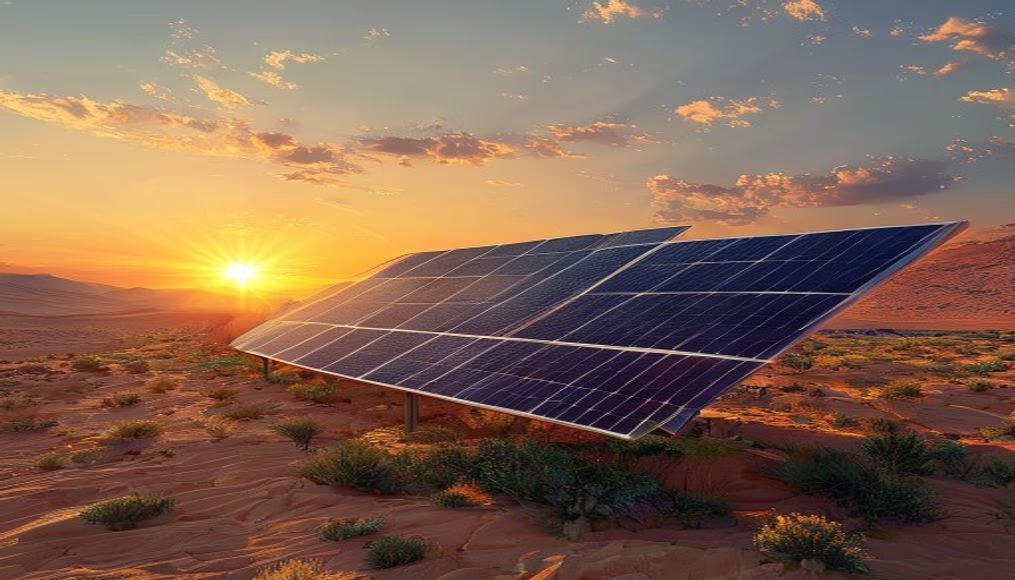
Solar farms in deserts harness high irradiation to generate clean energy on a large scale.
About this subject
Solar farms in deserts are large-scale installations that convert sunlight into electricity, taking advantage of the high irradiation and low cloud cover typical of these regions. Notable examples include the Atacama solar complex in Chile, the Noor Solar Park in the Moroccan Sahara, and the Ivanpah plant in California's Mojave Desert. These projects are key to the global energy transition, helping reduce carbon emissions and diversify power matrices.
Efficiency of solar panels in deserts faces the paradox of intense heat: though they receive more light, high temperatures reduce photovoltaic cell performance. To mitigate this, active or passive cooling systems are employed, and technologies like bifacial panels and solar trackers maximize capture. Additionally, desert solar generation often competes in energy auctions, reaching competitive prices due to economies of scale and abundant solar resource.
Environmental impact of these plants is debated. Large land occupation alters ecosystems adapted to extreme conditions, potentially affecting local species and surface albedo. However, studies show shading from panels may benefit understory vegetation in some cases. Compared to thermal power plants, desert solar has a lower water footprint and emits no air pollutants, but requires careful planning to minimize ecological disruption.
Interestingly, the world's largest solar farm, Bhadla Solar Park in India's Thar Desert, has a capacity of 2,245 MW. Another technology used in deserts is concentrating solar power, which uses heliostat mirrors to focus heat and drive turbines. Future challenges include energy storage for nighttime demand, with batteries and molten salt systems already operating in projects like Ouarzazate in Morocco.
Frequently Asked Questions
What is the world's largest solar farm in a desert?
The world's largest desert solar farm is Bhadla Solar Park in India's Thar Desert, with an installed capacity of 2,245 MW.
Why are deserts considered ideal locations for solar energy?
Deserts offer high solar irradiation, low cloud cover, scarce rainfall, and large flat areas, all of which maximize per-panel generation and reduce installation costs.
How does extreme heat affect solar panel performance?
High temperatures reduce photovoltaic cell efficiency by increasing electrical resistance and lowering voltage. Consequently, desert solar plants use cooling systems and panels with better temperature coefficients.
Direct URL
https://pub-c7d6a6ea828543ac903a74a341ccb2e1.r2.dev/imagens/solar-panel-array-desert-travel-photography-v10.avifHow to credit
Include a visible link back to UtilizAí. Copy one of the snippets below:
<a href="https://xn--utiliza-eza.com/en/midia/imagens/solar-panel-array-desert-travel-photography-v10">Solar panel array desert</a> by <a href="https://xn--utiliza-eza.com">UtilizAí</a>, licensed under <a href="https://creativecommons.org/licenses/by/4.0/">CC BY 4.0</a>.
[Solar panel array desert](https://xn--utiliza-eza.com/en/midia/imagens/solar-panel-array-desert-travel-photography-v10) by [UtilizAí](https://xn--utiliza-eza.com), CC BY 4.0
License: CC-BY-4.0