Oil refinery night lights
1344×768 · AVIF · CC BY 4.0
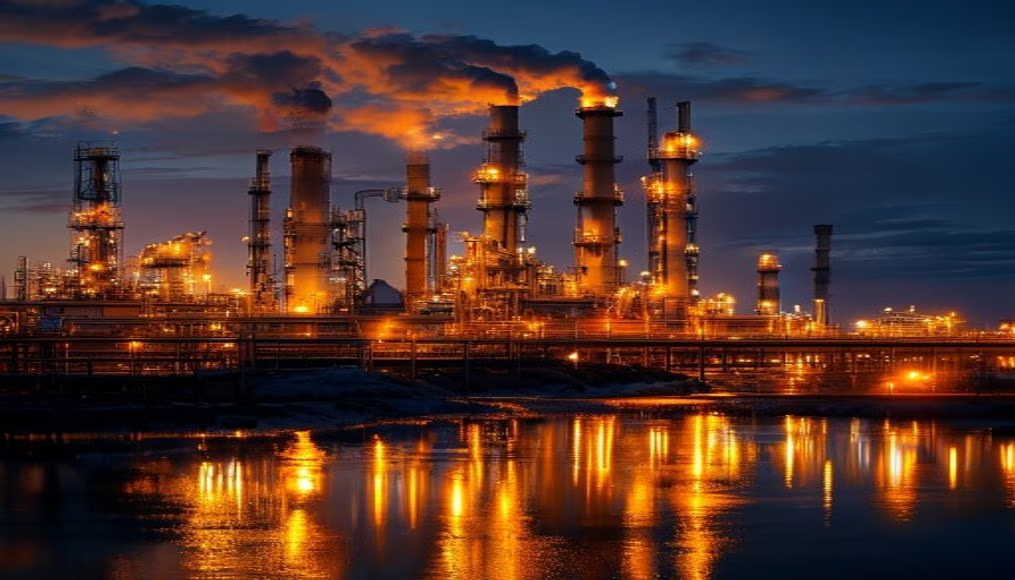
Oil refineries operate around the clock. At night, thousands of lights illuminate towers and pipelines in an impressive industrial complex.
About this subject
Oil refineries are industrial facilities responsible for processing crude oil into derivatives such as gasoline, diesel, kerosene, and naphtha. They operate continuously, and nighttime lighting is essential for safety and ongoing operations. A typical refinery can cover hundreds of hectares, with distillation towers, storage tanks, pipelines, and chimneys that at night create a landscape of lights and shadows.
Nighttime illumination serves practical purposes: it allows workers and monitoring equipment to detect leaks, perform maintenance, and prevent accidents. Furthermore, lights indicate different areas of the refinery: process zones, storage, utilities, and loading areas. In many regions, refineries become night landmarks visible for kilometers, contrasting with the dark sky.
Globally, there are over 700 refineries in operation, with a total processing capacity exceeding 100 million barrels per day. The largest concentrations are in the United States, China, India, and Russia. Each refinery is designed to process specific types of crude oil (light, medium, heavy) and produce a mix of derivatives according to local demand. The nighttime glow is a testament to economic activity and global energy consumption.
Interestingly, refinery lighting also raises environmental concerns, such as light pollution and impacts on nocturnal wildlife. Some regions adopt directed LED technologies to reduce light waste. Despite this, for many, the night view of a refinery symbolizes industrial progress and wealth generation.
Frequently Asked Questions
Why do oil refineries operate at night?
They run 24 hours because distillation and cracking processes are continuous. Stopping and restarting a refinery is costly and time-consuming, taking days or weeks. Nighttime lighting ensures safety and constant monitoring.
How many refineries are there in the world?
There are over 700 refineries in operation globally, with a total capacity exceeding 100 million barrels per day. The largest hubs are in the United States, China, India, and Russia.
Does refinery lighting cause light pollution?
Yes, intense lighting can contribute to light pollution, affecting astronomical observation and local wildlife. New technologies, such as directed LED fixtures, are being adopted to minimize this impact.
Direct URL
https://pub-c7d6a6ea828543ac903a74a341ccb2e1.r2.dev/imagens/oil-refinery-night-lights-travel-photography-v10.avifHow to credit
Include a visible link back to UtilizAí. Copy one of the snippets below:
<a href="https://xn--utiliza-eza.com/en/midia/imagens/oil-refinery-night-lights-travel-photography-v10">Oil refinery night lights</a> by <a href="https://xn--utiliza-eza.com">UtilizAí</a>, licensed under <a href="https://creativecommons.org/licenses/by/4.0/">CC BY 4.0</a>.
[Oil refinery night lights](https://xn--utiliza-eza.com/en/midia/imagens/oil-refinery-night-lights-travel-photography-v10) by [UtilizAí](https://xn--utiliza-eza.com), CC BY 4.0
License: CC-BY-4.0