Gear mechanism mechanical
1344×768 · AVIF · CC BY 4.0
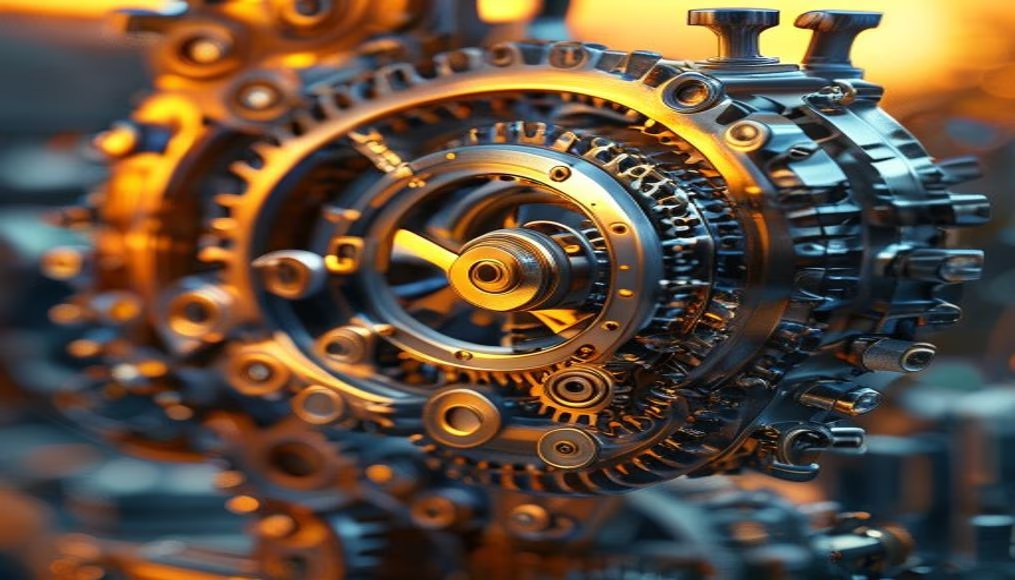
Mechanical gears are fundamental components in machines and vehicles, transmitting force and motion with precision in industrial and transportation systems.
About this subject
Mechanical gears are essential components in virtually all systems involving power and motion transmission. They consist of toothed wheels that mesh to transfer torque and rotation between shafts, changing speed, direction, or force. Their principle dates back to ancient Greece, but it was during the Industrial Revolution that gear design and manufacturing advanced, driving the mechanization of factories, locomotives, and textile machinery.
In modern infrastructure, gears are vital in wind turbines, ports, subway systems, and construction equipment. For instance, in a hydroelectric plant, reduction gears adjust turbine rotation to generate electricity efficiently. In transportation, vehicle gearboxes use gear sets to adapt engine power to road conditions. Each gear tooth is designed with specific curves (like the involute) to minimize friction and wear, ensuring long service life.
Notably, the invention of cycloidal gearing, attributed to 18th-century clockmakers, enabled precision in clocks and instruments. Today, gears are made from steel alloys, bronze, or polymers depending on the application. In travel photography, gear mechanisms often appear in industrial heritage contexts, such as old factories or mills, symbolizing human ingenuity.
Frequently Asked Questions
How do mechanical gears work?
Gears work by meshing teeth to transmit rotational motion between shafts. The gear ratio is determined by the number of teeth on each gear, allowing torque or speed to be increased.
What are the main types of gears?
Main types include spur, helical, bevel, worm, and planetary gears. Each is chosen based on angle, noise, and load capacity requirements.
Where are gears most common in infrastructure?
They are common in elevators, escalators, wind turbines, irrigation systems, locomotives, and construction machinery. They are also essential in vehicle transmissions.
Direct URL
https://pub-c7d6a6ea828543ac903a74a341ccb2e1.r2.dev/imagens/gear-mechanism-mechanical-travel-photography-v10.avifHow to credit
Include a visible link back to UtilizAí. Copy one of the snippets below:
<a href="https://xn--utiliza-eza.com/en/midia/imagens/gear-mechanism-mechanical-travel-photography-v10">Gear mechanism mechanical</a> by <a href="https://xn--utiliza-eza.com">UtilizAí</a>, licensed under <a href="https://creativecommons.org/licenses/by/4.0/">CC BY 4.0</a>.
[Gear mechanism mechanical](https://xn--utiliza-eza.com/en/midia/imagens/gear-mechanism-mechanical-travel-photography-v10) by [UtilizAí](https://xn--utiliza-eza.com), CC BY 4.0
License: CC-BY-4.0