Concrete texture macro
1344×768 · AVIF · CC BY 4.0
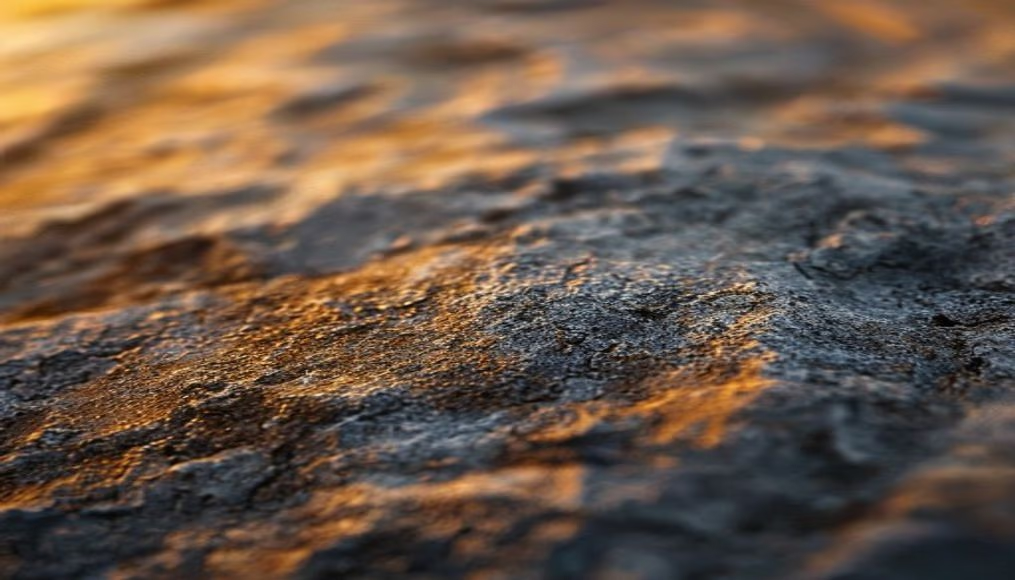
Macro concrete texture reveals granular details and characteristic cracks of this ubiquitous construction material.
About this subject
Concrete is one of the most widely used construction materials globally, present from building foundations to major infrastructure works such as dams and bridges. Its basic composition combines cement, water, aggregates (like sand and gravel), and often admixtures that modify properties like curing time and strength. The surface texture of concrete can vary greatly depending on the mix design, finishing method (troweled, brushed, washed), and exposure to weather. In a macro view, one observes porosity, capillary cracks, aggregate inclusions, and color variations that tell the story of the piece: from placement to wear by use and climate.
Historically, concrete was perfected by the Romans with opus caementicium, but its modern version with Portland cement patented in 1824 revolutionized architecture. Reinforced concrete, which incorporates steel bars to resist tension, allowed for lighter and more slender constructions such as skyscrapers and thin shells. In Brazil, concrete is key in works like the Copan Building (São Paulo) and Maracanã Stadium (Rio de Janeiro). The texture, often considered plain, gains complexity when magnified: each air bubble, microcrack, and exposed grain reveals the interaction between chemistry and physics during setting and hardening.
From a technical standpoint, macro analysis of concrete texture is valuable for engineers and restorers. Porosity, for example, influences permeability and durability; cracks may indicate drying shrinkage or overload. Testing methods like sclerometry and ultrasonography indirectly evaluate surface texture. Moreover, texture affects the adhesion of coatings and paints. Macro photographs are used in expert reports to document the conservation state of structures like bridges and viaducts.
Interestingly, concrete is also an artistic subject: the brutalism and minimalism movements value its texture as an aesthetic element. Artists like Brazilian Amílcar de Castro explored concrete in monumental sculptures, emphasizing its roughness and strength. In macro photography, concrete texture takes on an abstract character, with shapes resembling landscapes or reliefs. This versatility makes concrete not only a functional material but also a source of visual inspiration.
Frequently Asked Questions
What causes cracks on concrete surfaces?
Cracks can result from drying shrinkage, thermal variation, structural overload, or chemical reactions like alkali-aggregate reaction. Not all indicate risk; microcracks are common and often superficial.
How does concrete texture affect its durability?
More porous textures tend to absorb more water and aggressive agents, reducing durability. Dense finishes or sealers provide better protection against weathering and chemical attacks.
What is the difference between exposed concrete and conventional concrete in terms of texture?
Exposed concrete is planned to be seen, with well-defined forms and controlled texture (smooth or brushed). Conventional concrete often receives coatings, so texture is less aesthetically important.
Direct URL
https://pub-c7d6a6ea828543ac903a74a341ccb2e1.r2.dev/imagens/concrete-texture-macro-travel-photography-v10.avifHow to credit
Include a visible link back to UtilizAí. Copy one of the snippets below:
<a href="https://xn--utiliza-eza.com/en/midia/imagens/concrete-texture-macro-travel-photography-v10">Concrete texture macro</a> by <a href="https://xn--utiliza-eza.com">UtilizAí</a>, licensed under <a href="https://creativecommons.org/licenses/by/4.0/">CC BY 4.0</a>.
[Concrete texture macro](https://xn--utiliza-eza.com/en/midia/imagens/concrete-texture-macro-travel-photography-v10) by [UtilizAí](https://xn--utiliza-eza.com), CC BY 4.0
License: CC-BY-4.0