Sextant navigation tool
1344×768 · AVIF · CC BY 4.0
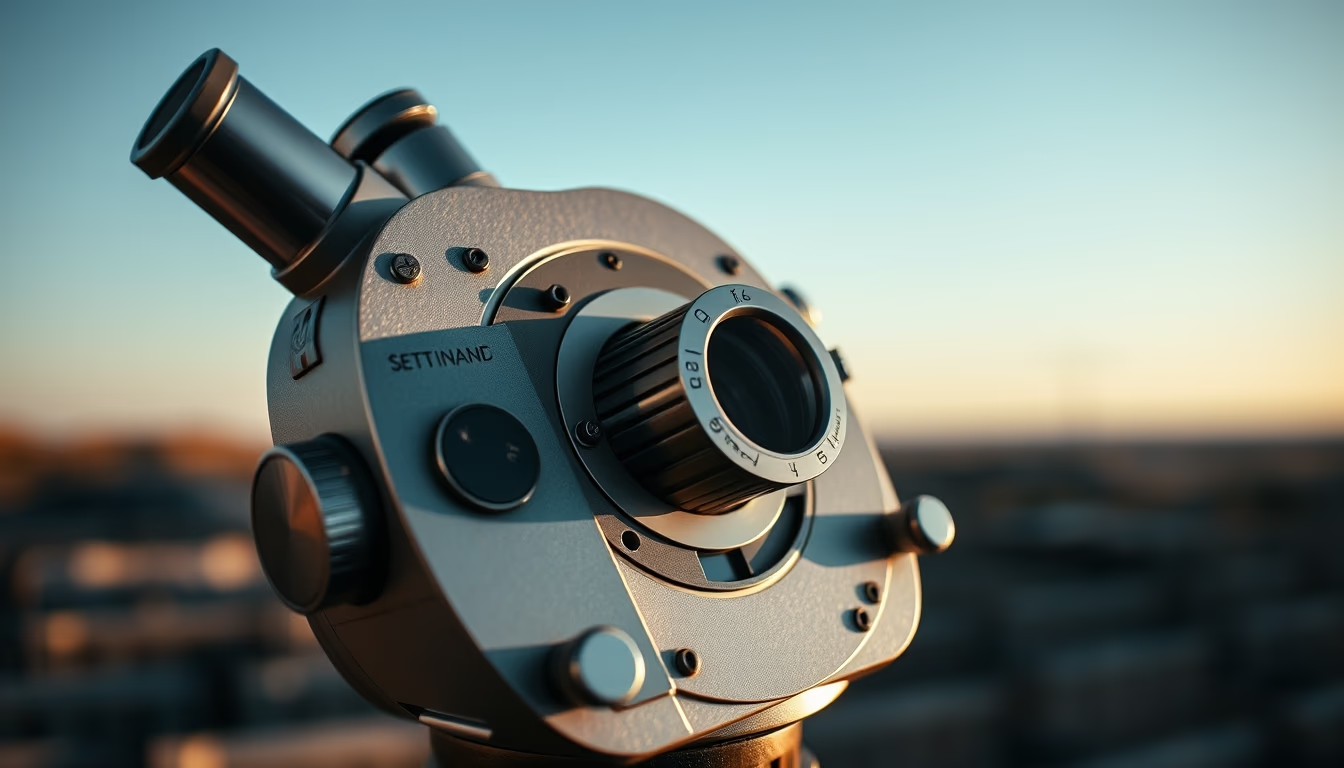
The sextant, an astronomical navigation instrument, was essential for the Age of Discovery and global maritime exploration.
About this subject
The sextant is a navigation instrument designed to measure angles between two objects, such as the Sun, Moon, stars or planets, and the horizon. This measurement allows the determination of latitude and, with the help of a chronometer, longitude, making it essential for ocean navigation before the satellite era. Invented in the 18th century, the sextant replaced older instruments like the astrolabe and quadrant, offering greater precision and practicality on board.
Its creation is credited to John Hadley in England and Thomas Godfrey in the United States, both in 1731. The name derives from the 60-degree arc (one sixth of a circle) that forms its scale. Quickly adopted by sailors, the sextant played a crucial role in the great scientific and colonial expeditions of the 18th and 19th centuries. Captain James Cook, for example, used the sextant on his voyages across the Pacific, contributing to the accurate mapping of islands and coastlines.
Culturally, the sextant symbolizes the Age of Discovery and the audacity of navigators who faced the unknown with simple yet ingenious tools. Today, its use has drastically declined due to GPS, but it is still taught in navigation courses as a backup and for its historical value. Museums and collectors preserve antique sextants, appreciated both for their mechanical precision and for their brass-and-wood aesthetics. Interestingly, the sextant can also be used on land to measure angles in surveying and amateur astronomy.
Frequently Asked Questions
How does a sextant work?
The sextant measures the angle between a celestial body and the horizon using mirrors and a graduated scale. The navigator aligns the reflected image of the celestial object with the horizon and reads the angle, allowing the calculation of latitude.
What is the difference between a sextant and an astrolabe?
The astrolabe is older and less accurate, used mainly on land. The sextant is more precise, portable, and suitable for maritime navigation, replacing the astrolabe and quadrant.
Is the sextant still used today?
Yes, but mainly as a backup for electronic systems and in navigation courses. It is also used in recreational sailing and by enthusiasts of astronomy and history.
Direct URL
https://pub-c7d6a6ea828543ac903a74a341ccb2e1.r2.dev/imagens/sextant-navigation-tool-magazine-editorial-p1.avifHow to credit
Include a visible link back to UtilizAí. Copy one of the snippets below:
<a href="https://xn--utiliza-eza.com/en/midia/imagens/sextant-navigation-tool-magazine-editorial-p1">Sextant navigation tool</a> by <a href="https://xn--utiliza-eza.com">UtilizAí</a>, licensed under <a href="https://creativecommons.org/licenses/by/4.0/">CC BY 4.0</a>.
[Sextant navigation tool](https://xn--utiliza-eza.com/en/midia/imagens/sextant-navigation-tool-magazine-editorial-p1) by [UtilizAí](https://xn--utiliza-eza.com), CC BY 4.0
License: CC-BY-4.0