Pick and place robot
1344×768 · AVIF · CC BY 4.0
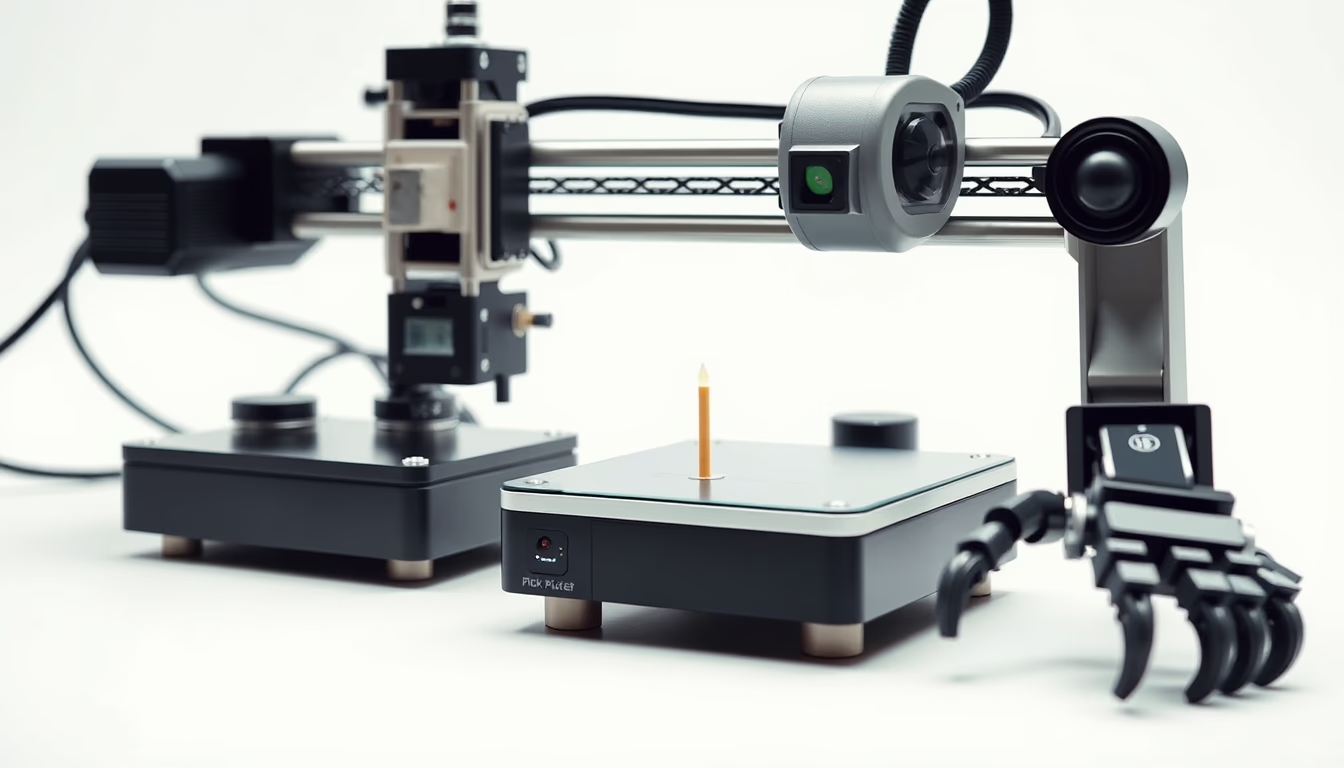
A pick and place robot is an industrial automation equipment used to move objects from one point to another with high speed and precision.
About this subject
The pick and place robot is a type of industrial manipulator designed for repetitive tasks of picking and placing objects. It is widely used in assembly lines, packaging, electronics, and general manufacturing. Its key feature is the ability to operate at high speed with submillimeter precision, making it essential for processes requiring speed and consistency.
These robots can be classified into different kinematic configurations, such as SCARA (Selective Compliance Assembly Robot Arm) and Cartesian robots. The SCARA model is particularly popular for pick and place due to its vertical rigidity and horizontal flexibility, enabling fast and precise movements in parallel planes. Cartesian robots, with a gantry structure, are suitable for heavier loads or larger work areas.
The history of pick and place robots dates back to the 1960s, when the first industrial robots were developed. A milestone was the Unimate, installed at General Motors in 1961, which performed part-transfer tasks. Since then, technology has evolved with the incorporation of sensors, computer vision, and software control, allowing robots to adapt to variations in part position and orientation.
Today, pick and place robots are key components in Industry 4.0, integrated into intelligent automation systems. They can be programmed to handle a wide variety of materials, from tiny electronic components to medium-sized automotive parts. Demand for these robots grows with the need for efficiency, error reduction, and increased productivity, especially in sectors like food and pharmaceuticals, where hygiene and precision are critical.
Frequently Asked Questions
What is the difference between a SCARA robot and a Cartesian robot for pick and place?
A SCARA robot has rotational arm movements, offering high speed and flexibility in horizontal planes, ideal for light parts. A Cartesian robot uses linear motion in X, Y, and Z axes, with greater rigidity and load capacity for heavier parts or large areas.
Which industries most commonly use pick and place robots?
Electronics (circuit board assembly), packaging (placing products into boxes), automotive (part handling), and pharmaceutical (medicine manipulation) are among the top, due to requirements for precision and speed.
How does a pick and place robot handle variations in part position?
Modern systems use computer vision and sensors to detect part position and orientation, automatically adjusting robot movements for accurate picking. This allows working with disordered parts or on conveyors.
Direct URL
https://pub-c7d6a6ea828543ac903a74a341ccb2e1.r2.dev/imagens/pick-and-place-robot-commercial-product-photography-p0.avifHow to credit
Include a visible link back to UtilizAí. Copy one of the snippets below:
<a href="https://xn--utiliza-eza.com/en/midia/imagens/pick-and-place-robot-commercial-product-photography-p0">Pick and place robot</a> by <a href="https://xn--utiliza-eza.com">UtilizAí</a>, licensed under <a href="https://creativecommons.org/licenses/by/4.0/">CC BY 4.0</a>.
[Pick and place robot](https://xn--utiliza-eza.com/en/midia/imagens/pick-and-place-robot-commercial-product-photography-p0) by [UtilizAí](https://xn--utiliza-eza.com), CC BY 4.0
License: CC-BY-4.0