Mass spectrometer device
1344×768 · AVIF · CC BY 4.0

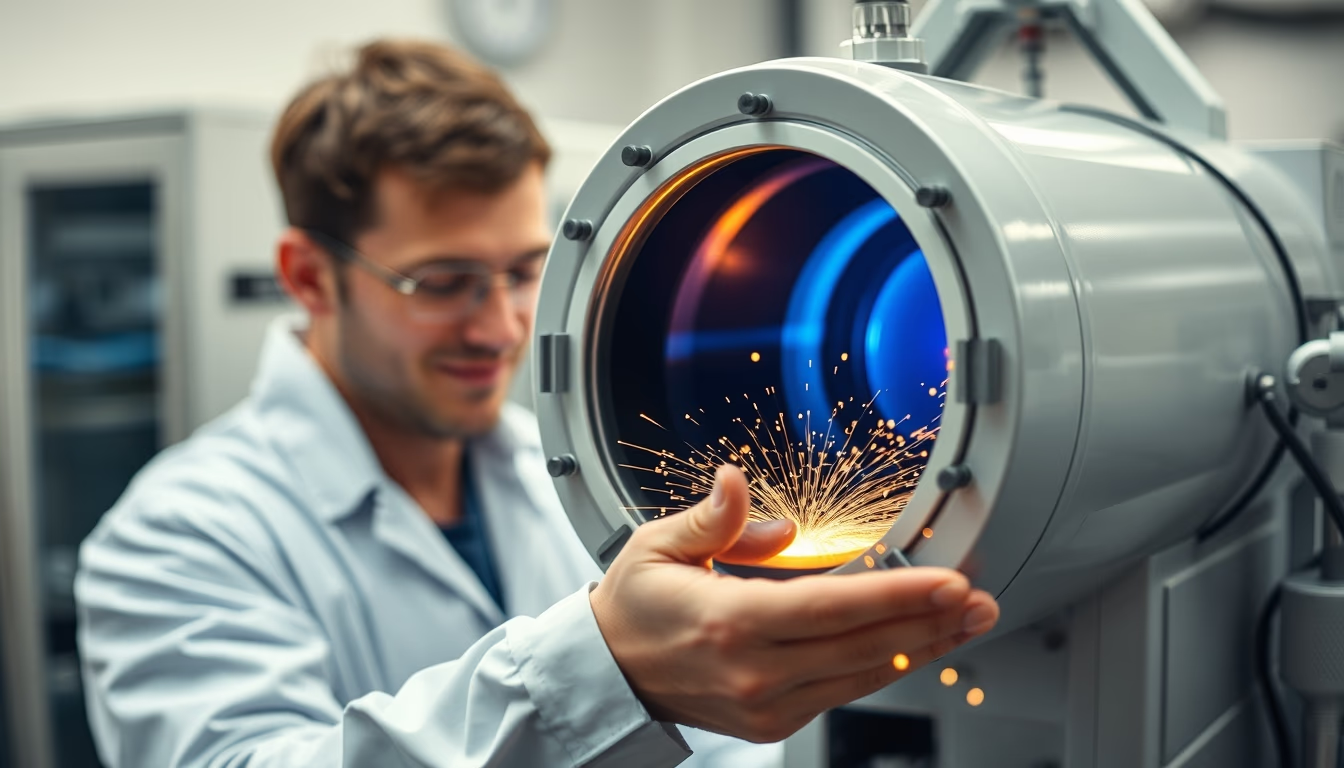
Mass spectrometer, an analytical instrument that identifies molecules by mass-to-charge ratio, essential in chemistry and biology labs.
About this subject
A mass spectrometer is a high-precision analytical instrument used to determine the chemical composition of samples. It works by ionizing molecules, separating the resulting ions based on their mass-to-charge ratio (m/z), and detecting them. This technique is fundamental in diverse fields such as organic chemistry, biochemistry, pharmacology, forensic science, and environmental monitoring.
The basic principle was developed in the early 20th century by Francis Aston and J.J. Thomson, but modern instruments are highly sophisticated, with resolution capable of distinguishing masses differing by less than 0.001 daltons. There are several types of mass analyzers: quadrupole, time-of-flight (TOF), electrospray ionization (ESI), matrix-assisted laser desorption/ionization (MALDI), among others. The choice depends on the application: MALDI-TOF is common in proteomics for identifying proteins, while GC-MS (gas chromatography coupled with mass spectrometry) is standard for volatile compounds analysis.
In practice, a mass spectrometer can detect trace substances at concentrations down to parts per trillion (ppt). It is used to identify drugs in biological fluids, pesticide residues in food, environmental pollutants, and even organic compounds in meteorites. The equipment requires frequent calibration with known standards and high vacuum operation to avoid unwanted collisions. The studio portrait depicts a modern benchtop instrument, typically installed on clean laboratory benches, reflecting the precision and sterility required.
A curiosity: the mass spectrometer was crucial in the discovery of stable isotopes and in confirming special relativity through precise atomic mass measurements. Today, portable versions are used in the field for rapid detection of chemical warfare agents.
Frequently Asked Questions
What is a mass spectrometer used for?
It identifies and quantifies molecules in a sample by determining their mass and structure. It is used in chemistry, biology, medicine, forensics, and quality control.
What is the difference between mass spectrometry and spectroscopy?
Mass spectrometry measures the mass-to-charge ratio of ions, while spectroscopy studies interactions of radiation with matter. Both provide compositional information but through different principles.
How much does a professional mass spectrometer cost?
Prices range from $50,000 to over $1 million, depending on type and resolution. Benchtop models for research labs typically cost $100,000, 300,000.
Direct URL
https://pub-c7d6a6ea828543ac903a74a341ccb2e1.r2.dev/imagens/mass-spectrometer-device-studio-editorial-portrait-fresh1.avifHow to credit
Include a visible link back to UtilizAí. Copy one of the snippets below:
<a href="https://xn--utiliza-eza.com/en/midia/imagens/mass-spectrometer-device-studio-editorial-portrait-fresh1">Mass spectrometer device</a> by <a href="https://xn--utiliza-eza.com">UtilizAí</a>, licensed under <a href="https://creativecommons.org/licenses/by/4.0/">CC BY 4.0</a>.
[Mass spectrometer device](https://xn--utiliza-eza.com/en/midia/imagens/mass-spectrometer-device-studio-editorial-portrait-fresh1) by [UtilizAí](https://xn--utiliza-eza.com), CC BY 4.0
License: CC-BY-4.0