Magnifying glass papers
1344×768 · AVIF · CC BY 4.0
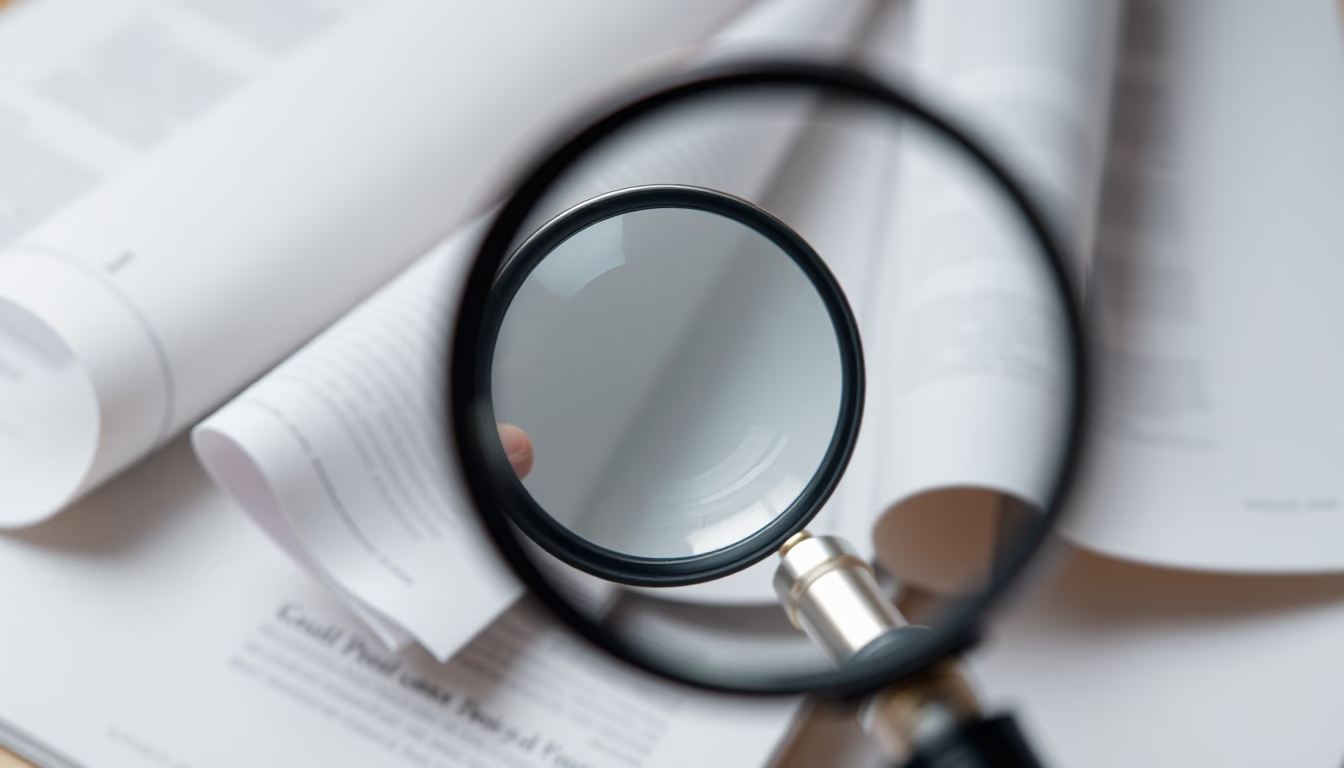
Magnifying glass over old papers: an essential tool for paleographers and historians reading historical documents.
About this subject
A magnifying glass is a fundamental optical instrument for studying old documents, such as manuscripts, maps, and letters. Composed of a convex lens that enlarges the image, it allows historians and paleographers to examine minute details, such as traces of faded ink, watermarks, or paper textures. The use of magnifying glasses dates back to antiquity, with the first glass lenses developed by civilizations like the Romans and Arabs. In the 13th century, the monk Roger Bacon described the principle of magnification, and by the 17th century, handheld magnifiers became common among scholars.
Historical documents often show natural wear, stains, or tiny handwriting. The magnifying glass aids in transcribing and interpreting these texts without damaging them. For instance, when reading documents from Brazil's National Archive or colonial-era letters, magnification reveals erasures and marginal notes that would otherwise go unnoticed. Standard magnifications of 5x to 10x are typical in archives and museums.
The tilt-shift technique, often used in photography, can simulate the effect of a magnifying glass by creating a shallow depth of field, highlighting specific areas of a document. While not a real magnifier, this visual approach evokes the idea of selective enlargement. In antiquities, pairing a physical magnifying glass with proper lighting is essential to avoid glare and preserve paper integrity.
Interestingly, antique magnifying glasses with ivory handles or carved wood are collectible items in their own right. They represent the evolution of optics and the human effort to understand the past. Museums like the Science Museum in London or the Louvre display historical specimens, connecting the tool to the study of illuminated manuscripts and incunabula.
Frequently Asked Questions
Why use a magnifying glass instead of a digital camera to examine old papers?
A magnifying glass allows direct, tactile observation without needing power or complex equipment. It reveals subtle details like paper texture and ink depth that may be lost in digital images. It is also portable and requires no calibration.
What is the historical origin of the magnifying glass?
Early magnifiers appeared in ancient Rome with water-filled glass lenses. In the 11th century, Arab scientist Alhazen wrote about magnifying lenses. The handheld magnifying glass became widespread in Europe during the Renaissance, driven by manuscript study and jewelry making.
How to preserve old documents while observing them with a magnifying glass?
Wear cotton gloves to avoid skin oils. Keep the lens clean with a soft cloth and avoid touching the paper directly. Use cool, diffused light to prevent heating or damage. Never rest the magnifier on the document; hold it at a safe distance.
Direct URL
https://pub-c7d6a6ea828543ac903a74a341ccb2e1.r2.dev/imagens/magnifying-glass-papers-tilt-shift-miniature-p3.avifHow to credit
Include a visible link back to UtilizAí. Copy one of the snippets below:
<a href="https://xn--utiliza-eza.com/en/midia/imagens/magnifying-glass-papers-tilt-shift-miniature-p3">Magnifying glass papers</a> by <a href="https://xn--utiliza-eza.com">UtilizAí</a>, licensed under <a href="https://creativecommons.org/licenses/by/4.0/">CC BY 4.0</a>.
[Magnifying glass papers](https://xn--utiliza-eza.com/en/midia/imagens/magnifying-glass-papers-tilt-shift-miniature-p3) by [UtilizAí](https://xn--utiliza-eza.com), CC BY 4.0
License: CC-BY-4.0