Film camera leica
1344×768 · AVIF · CC BY 4.0
The Leica is a compact 35mm film camera, a symbol of innovation and quality in photography since 1925.
About this subject
The Leica was introduced in 1925 by the German company Leitz, revolutionizing photography by popularizing the 35mm format. Before it, cameras were large and used medium-format film or glass plates. With its compact size and mechanical precision, the Leica became the ideal companion for street photographers, documentarians, and especially architects. The lightweight body allowed shooting buildings from unusual angles, while the high-sharpness lenses, such as the Summicron, captured architectural details with fidelity.
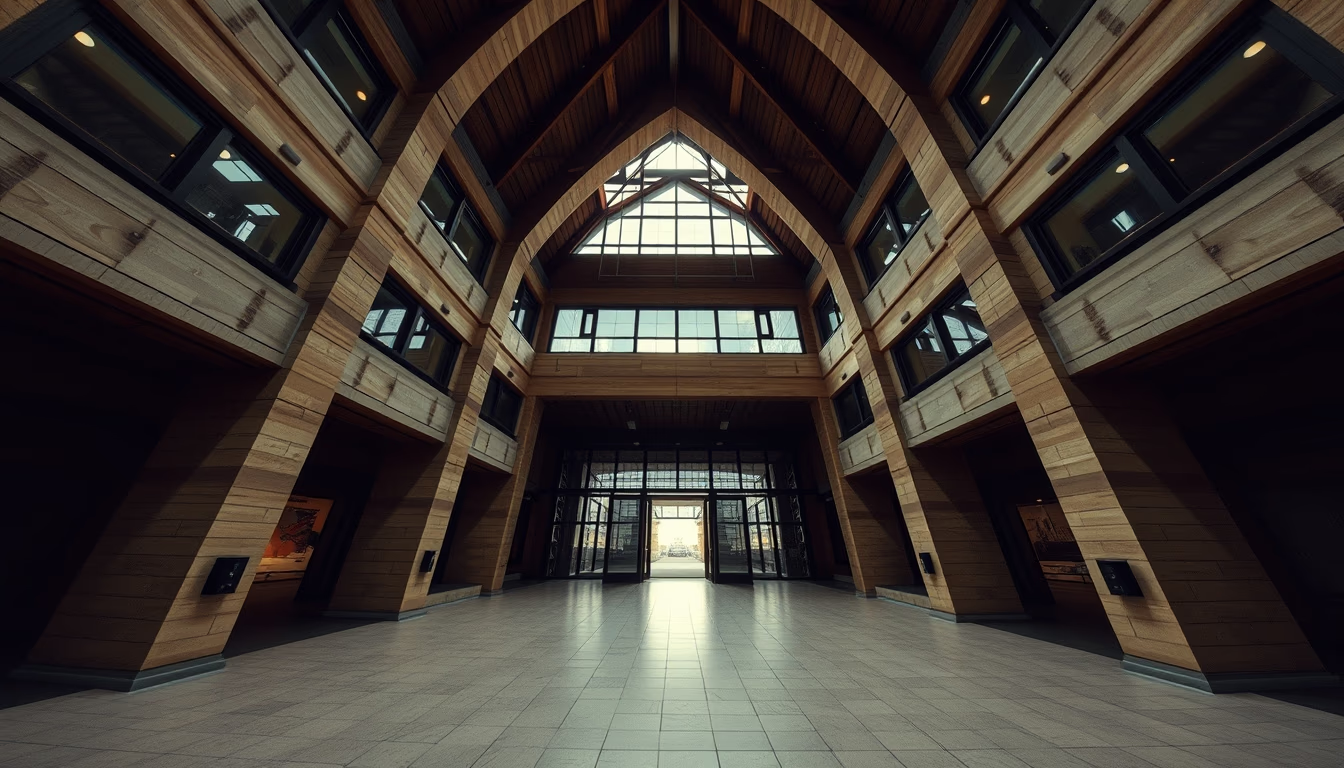
In architectural photography, the Leica stood out for its ability to use wide-angle lenses with controlled distortion. Models like the Leica M3 and M6 are classics in this field, thanks to the rangefinder viewfinder that enables precise framing. Many architects and photographers, such as Julius Shulman, used Leicas to record modernist works, emphasizing straight lines and textures. The camera was also used by reporters like Henri Cartier-Bresson, who championed the 'decisive moment.'
The robust construction of the Leica, with a metal body and focal-plane shutter mechanism, ensures durability and reliability even in adverse conditions. Each camera is hand-assembled, with precise adjustments that explain its high cost and status as a luxury item. The M-mount lens system is one of the most respected in history, with examples like the Noctilux, famous for its maximum aperture of f/0.95, ideal for low-light interiors such as churches or museums.
Today, analog Leicas are collectible and still used by purists and professionals who appreciate the texture of film. The German company continues to produce digital cameras, but the film models remain icons of design and engineering. For architectural photography, the Leica offers a balance between portability and optical quality, making it a tool of choice for those seeking sharp, timeless images.
Frequently Asked Questions
Why is Leica considered a luxury camera?
Leica is considered luxury due to its handcrafted construction, use of premium materials like metal and high-quality glass, and its optical and mechanical precision, resulting in high production costs and retail price.
What is the difference between a Leica M and other film cameras?
The Leica M is a rangefinder camera, using a coincidence focusing system, unlike SLRs which use a mirror and pentaprism. This allows a brighter viewfinder, reduced size, and less vibration and noise.
Which Leica lenses are recommended for architectural photography?
For architecture, wide-angle lenses like the Elmarit-M 21mm f/2.8 and Super-Elmar-M 18mm f/3.8 are popular. They offer high sharpness and minimal distortion, essential for capturing straight lines of buildings.
Direct URL
https://pub-c7d6a6ea828543ac903a74a341ccb2e1.r2.dev/imagens/film-camera-leica-architectural-photography-p8.avifHow to credit
Include a visible link back to UtilizAí. Copy one of the snippets below:
<a href="https://xn--utiliza-eza.com/en/midia/imagens/film-camera-leica-architectural-photography-p8">Film camera leica</a> by <a href="https://xn--utiliza-eza.com">UtilizAí</a>, licensed under <a href="https://creativecommons.org/licenses/by/4.0/">CC BY 4.0</a>.
[Film camera leica](https://xn--utiliza-eza.com/en/midia/imagens/film-camera-leica-architectural-photography-p8) by [UtilizAí](https://xn--utiliza-eza.com), CC BY 4.0
License: CC-BY-4.0