Crystal salt macro
1344×768 · AVIF · CC BY 4.0
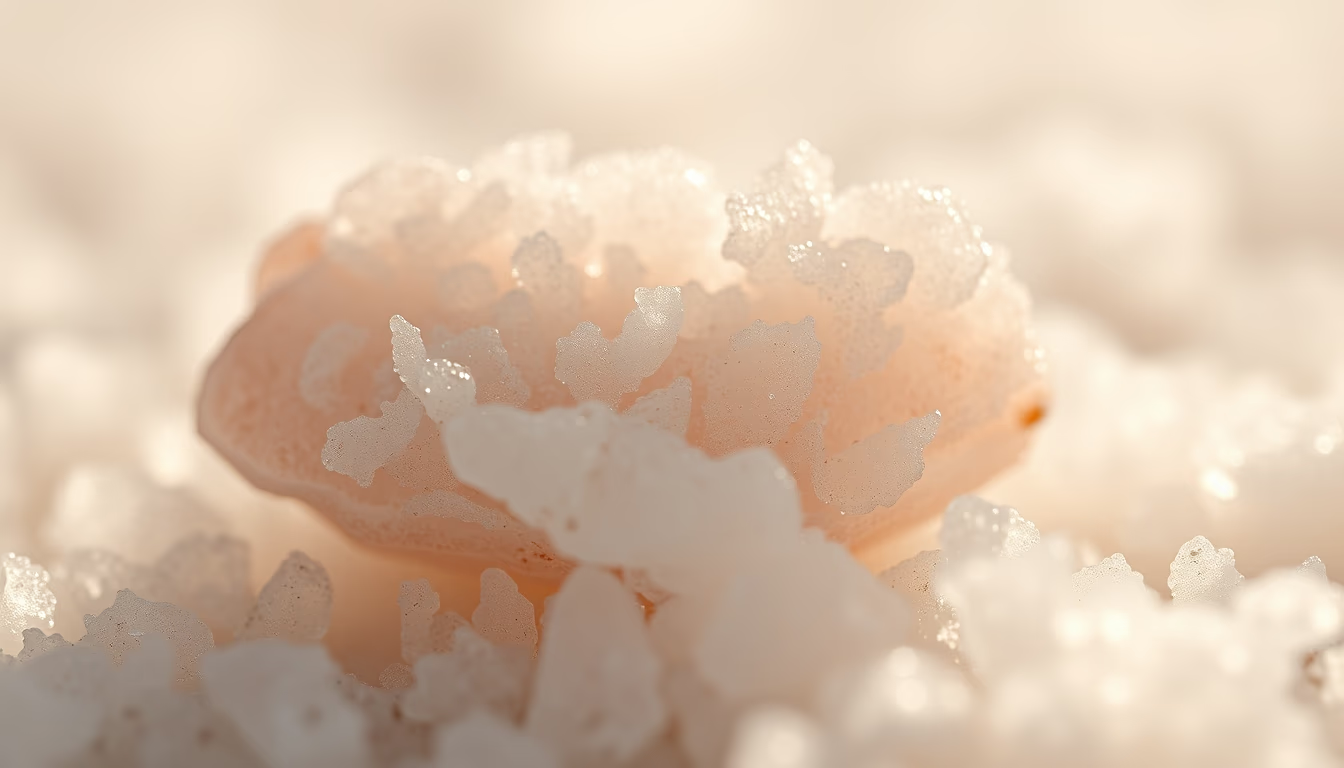
Salt crystals display perfect cubic geometric shapes, resulting from the crystalline structure of sodium chloride, revealing the hidden beauty of a mineral essential to life.
About this subject
Salt crystals are classic examples of ionic crystallization, forming regular cubes due to the face-centered cubic lattice of sodium chloride. This atomic arrangement occurs naturally when saltwater evaporates slowly, as in coastal salt pans or hypersaline lakes. In Brazil, the salt pans of Rio Grande do Norte produce marine salt whose crystals can reach varying sizes depending on evaporation rate and brine purity.
The cubic morphology is so characteristic that salt can be identified even in microscopic samples. Impurities such as magnesium or calcium can slightly distort the faces, generating crystals with rounded edges or prismatic shapes. Besides common table salt, varieties include Himalayan pink salt, which gets its color from trace amounts of iron oxide, and Hawaiian black salt, enriched with activated charcoal.
Historically, salt was used as currency and preservative, driving trade routes for millennia. In ancient Rome, soldiers received part of their pay in salt (salarium, origin of the word salary). Today, salt is extracted from underground mines or by solar evaporation, with Brazil being one of the world's largest producers of marine salt. Purity and crystal size influence commercial value, with larger crystals preferred for decorative or gourmet culinary uses.
Frequently Asked Questions
How do salt crystals form?
Salt crystals form by evaporation of saltwater. When the concentration of sodium chloride reaches saturation, ions begin to organize into a cubic crystal structure, growing as more water evaporates.
Why are salt crystals cubic?
The cubic shape results from the crystal structure of sodium chloride, which adopts a face-centered cubic lattice. This arrangement of atoms produces 90-degree angles between faces, yielding perfect cubes.
What is the difference between sea salt and refined table salt?
Sea salt is obtained by evaporating seawater and retains trace minerals, giving it varied flavor and color. Refined table salt undergoes processing to remove impurities and adds iodine, resulting in more uniform, fine crystals.
Direct URL
https://pub-c7d6a6ea828543ac903a74a341ccb2e1.r2.dev/imagens/crystal-salt-macro-documentary-photography-p2.avifHow to credit
Include a visible link back to UtilizAí. Copy one of the snippets below:
<a href="https://xn--utiliza-eza.com/en/midia/imagens/crystal-salt-macro-documentary-photography-p2">Crystal salt macro</a> by <a href="https://xn--utiliza-eza.com">UtilizAí</a>, licensed under <a href="https://creativecommons.org/licenses/by/4.0/">CC BY 4.0</a>.
[Crystal salt macro](https://xn--utiliza-eza.com/en/midia/imagens/crystal-salt-macro-documentary-photography-p2) by [UtilizAí](https://xn--utiliza-eza.com), CC BY 4.0
License: CC-BY-4.0